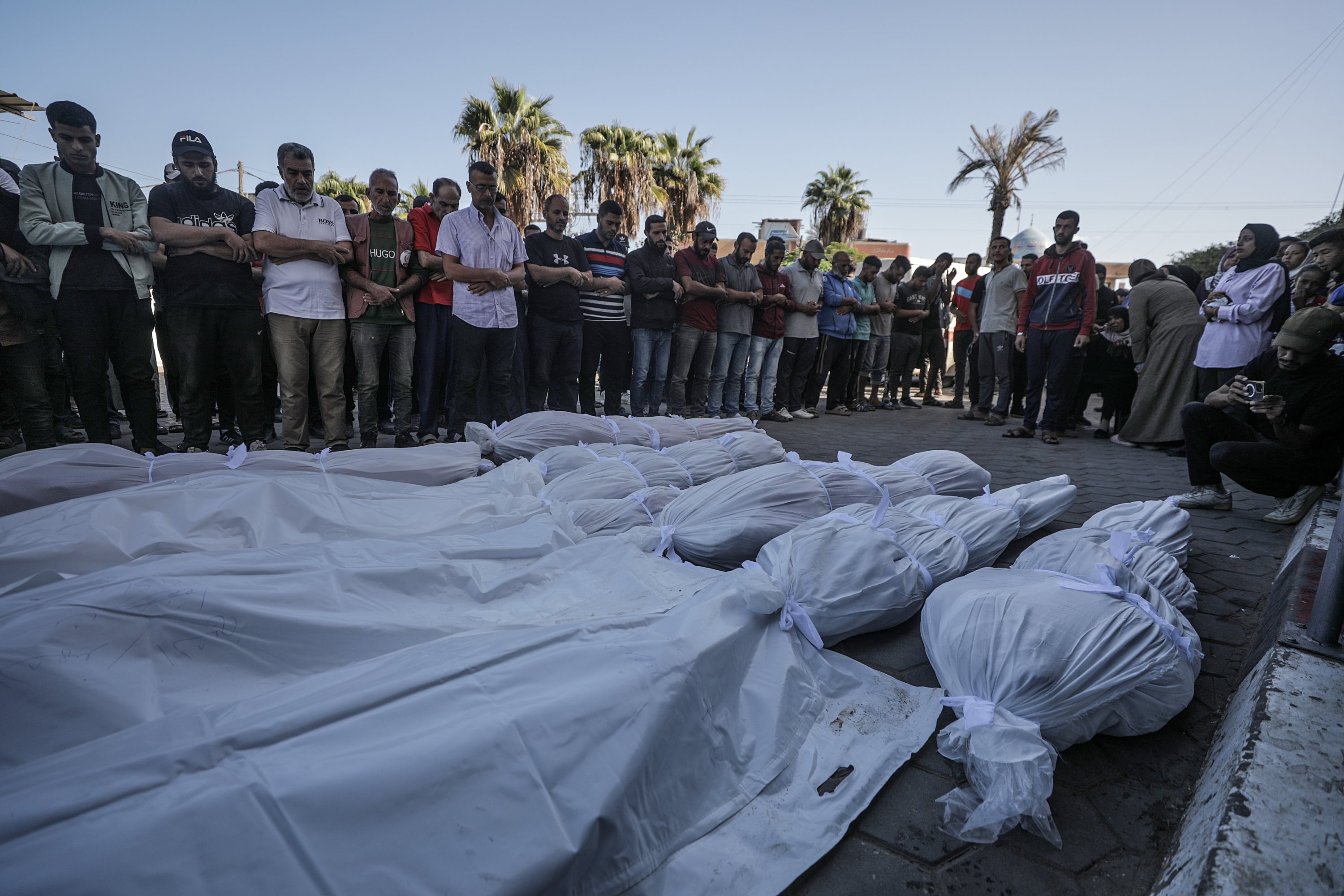
Last week, Israeli airstrikes hit Al-Aqsa Martyrs' Hospital in Gaza, incinerating not only tents but once again the very idea of sanctity in a place meant to heal. Sha'ban al-Dalou, a 19-year-old university student, was killed as flames engulfed him on a hospital bed, while still attached to an IV drip. His brutal death, caught on video, shocked those who had grown accustomed to the illusion that barbarism had been relegated to the past.
Yet what is even more shocking is the persistent belief that cruelty diminishes with time, as if the mere fact of living in the 21st century could inoculate us against such acts. This naive assumption is rooted in a grave misunderstanding of history, and more broadly, of time. From a young age, we are introduced to the atrocities of history: the burning of heretics in medieval Europe, the annihilation of indigenous populations by European colonizers, and the atrocities committed during the trans-Atlantic slave trade. These are accepted facts, but they remain remote to us nonetheless – cold, detached data points in a textbook. Their horror is acknowledged, but not internalized. We perceive these events as if they happened in another world, far removed from the present, and their reality dulled by the distance of centuries. At most, they are viewed as “lessons of history” that may or may not guide us in the present.
Of course, this is a result of a conception of time according to which individual events can literally be juxtaposed side by side on a straight line, and when convenient, can be cut from each other. This, in turn, leads to a kind of historical amnesia that reveals something very significant about how we are taught to think about history and progress. While recognized as facts, the atrocities of history exist for most of us simply as abstractions, severed from the present by the comforting buffer of time. Thus they are really virtual, almost like scenes from a book or a movie, and predictably so, for they are generally known via those mediums.
Do we not know better? How do we forget, or never realize in the first place, that cruelty is not confined to a particular period, nor is it extinguished by the passage of centuries? Our belief in a linear, progressive view of history, where we have “moved beyond” such barbarities, seems to mask the persistence of violence in new forms. We imagine civilization marching forward, leaving behind the savagery of earlier epochs. Yet how we can leave anything “behind” in the past, which has supposedly ceased to exist, remains a mystery.
The fog of mystery dissipates, however, when we regard time no longer as a fixed sequence, progressing from the "barbaric" to the "civilized." As the French philosopher Henri Bergson explained, time is a continuous flow – indivisible and unquantifiable. The past is not a distant relic but a reality that is always with us, accumulating in the ever-growing present. The burning of Sha'ban al-Dalou in Gaza is not an anomaly; it is a reminder that the capacity for cruelty remains as potent now as it was throughout centuries. After all, was it not people just like us, or the Palestinians today, who were killed by cruel rulers and ruthless emperors that we learn from the records?
The idea of progress, that time automatically brings moral improvement, is surely a comforting myth, one that serves the interests of those who benefit from the status quo. It allows us to overlook the structural conditions that perpetuate violence – conditions that are no less real now than they were a thousand years ago. The technologies may change and the justifications may shift, but the underlying dynamics of power and cruelty remain strikingly consistent. If I close my eyes standing in the middle of Great Tower Street in London, and imagine myself in the early 18th century, I may come to see that it was exactly here on this street, where I am standing right now at this very moment, that the “white-collar workers” were underwriting the slave trade. The possibility manifests itself through actuality.
In this sense, what happened at Al-Aqsa Martyrs' Hospital, and what has been happening over the last year in Gaza, should not really surprise us. It is a reflection of the reality that human beings, when placed in conditions of unchecked power, will resort to extreme cruelty, just as they always have. The problem is not time, but the structures of power that allow, indeed incentivize, such acts to occur. And those structures, though still present in the world that we live in, become myths in people’s minds when history is treated merely as a “museum of horrors.” The historical amnesia lies in this, that we fail to see in the oligarchs of today, for instance, a continuity with the feudal lords of the past.
The conviction that history moves in a linear fashion, progressing from the primitive to the advanced, blinds us to the ongoing presence of barbarism in the world. Until we recognize that time does not heal cruelty, we will continue to be shocked by the kinds of violence that should, by now, be all too familiar. What is needed is not time, but the will of the people who can choose to be “healers.” And every one of us has the responsibility to work toward the triumph of healers, whether through initiating direct action or raising awareness to inspire more healers.