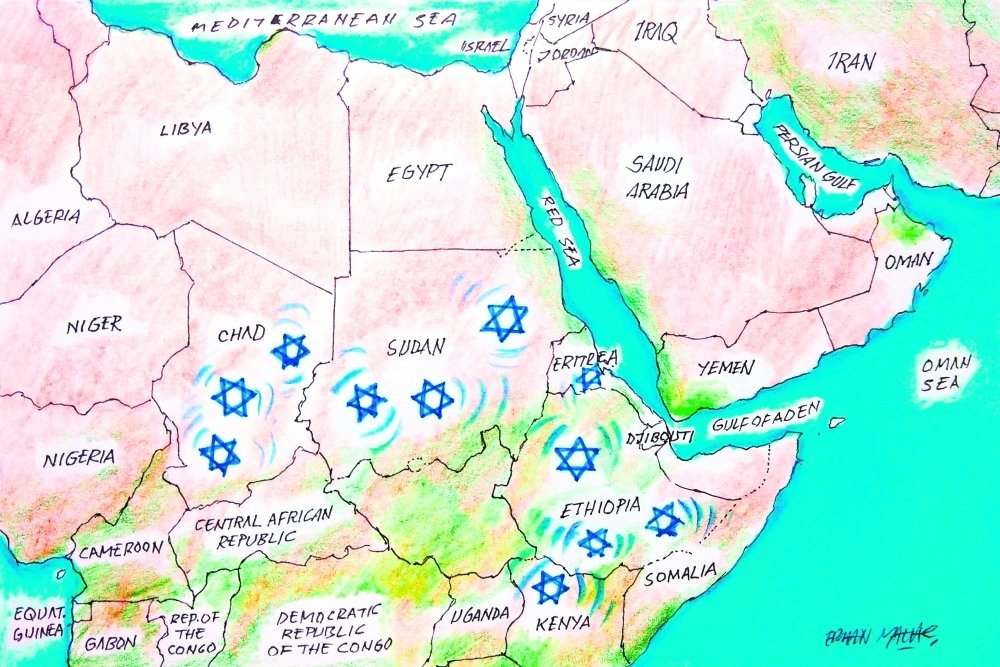
In addition to the crimes against humanity that Israel committed in Gaza, its aggressive stance in the Middle East has become increasingly uncontrollable, leading its ally, the U.S., into a war with Iran. At the same time, its expansionist approach toward Palestine and its strikes on Iran have constrained the Tel Aviv administration, compelling it to reassess and adapt its foreign policy. In this search for new spheres of influence, Africa has emerged as a potential focus.
During the Cold War, Israeli foreign policy focused on forming alliances with non-Arab actors in the Middle East to neutralize potential threats, as it was surrounded by hostile Arab states in the region. Today, Israel perceives Iran and the Houthis in Yemen as its biggest threats in the Middle East. Tel Aviv is trying to create a new containment strategy to both neutralize these threats and ensure the smooth functioning of global maritime trade, which is vital for its economy.
To this end, it has been trying to establish new spheres of influence in Africa, especially in strategically located East Africa, in recent years. For example, with the Abraham Accords signed in 2020 with U.S. support, Israel aimed to normalize diplomatic relations with Morocco and Sudan, in addition to the UAE and Bahrain. Efforts have also been made to strengthen contacts with Chad, Mauritania, Niger, Ethiopia and Kenya.
In recent years, Israel's rather bold strategic moves in the Horn of Africa, located near the Bab el-Mandeb Strait, have attracted attention. Israel has long since developed cooperation with numerous countries in East Africa on defense and military matters, conducting intelligence operations, counter-terrorism activities and transferring military technology. However, since the mid-2010s, Israel has placed greater emphasis on controlling military bases in the region. Israeli investments in the Berbera Port of Somaliland, a region in Somalia, have made it a crucial logistical location for military strategies in the area. Therefore, Israel's decision to recognize Somaliland on Dec. 26, 2025, which was met with significant international condemnation, can be interpreted as part of this strategy.
Furthermore, while tensions between Ethiopia and Somalia were being resolved through Türkiye's mediation via the Ankara Declaration, Israel, acting in its own interests, escalated tensions in the region through Somaliland and Ethiopia. It is also necessary to state that Türkiye's increasingly growing presence in the Horn of Africa is unsettling for Tel Aviv. Therefore, in recent years, Israel has placed importance on limiting Türkiye's influence in the region. Indeed, the increased visits of Israeli officials to Ethiopia in recent months, a country they prefer to see as a strategic partner and with which Türkiye has developing relations, is an indication of this.
Aside from Somaliland, Sudan has also been one of the countries Israel considers important for its military presence on the continent. The Red Sea coast of Sudan, with which Israel aimed for normalization through the Abraham Accords, was of interest to Tel Aviv. However, the civil war that erupted in Sudan on April 15, 2023, prevented Israel from achieving this goal. Finally, Israel is also interested in establishing a base in Djibouti, where many countries have military bases. However, Tel Aviv's decision to recognize Somaliland has been harshly condemned by Djibouti.
Israel's efforts to increase its presence in Africa may intensify following the war with Iran, and competition with Iran on the continent is also a possibility. Indeed, in previous years, Israel, benefiting from the normalization atmosphere created by the Abraham Accords, increased its diplomatic and strategic contacts in Africa. Parallel to this process, Iran also accelerated its outreach to the continent. In this context, the visits of then-President Ebrahim Raisi to Kenya, Uganda and Zimbabwe in July 2023 were a concrete demonstration of Iran's efforts to build its own sphere of influence in the face of the growing Israeli presence in the region. This visit marked the first official contact by an Iranian president with Africa in 11 years.
The increasing competition between regional powers in Africa creates a positive scenario for the continent, potentially increasing the bargaining power of African countries in foreign policy, military and trade cooperation. However, the increased competition and military presence of Israel and Iran, two warring parties, in Africa, a continent with highly fragile structures, also poses certain risks to regional security.
Tel Aviv's Africa policy focuses primarily on cooperation in military and intelligence areas and the transfer of defense technology. Iran, on the other hand, could establish spheres of influence in the continent by using proxy actors such as the "Islamic Movement of Nigeria," a Shiite group led by Ibrahim Zakzaky in Nigeria. These spheres of influence created by Iran could be manipulated with ideological rhetoric and motivations against Israel, bringing about new pressures on regional security. The competition between Iran and Israel over Africa is likely to lead to a more militaristic approach to Israel's Africa policy. This could indirectly create negative repercussions, particularly in East Africa, regarding security dynamics.
The intensifying competition and security risks in Africa will disrupt investment and fund transfers to the region. In particular, the potential spillover of the Iran-Israel conflict into the Gulf states and their potential involvement in a regional war pose a significant risk to aid and investments from Gulf countries to Africa in recent years.
In Africa, where security and development are closely intertwined, this situation could bring about profound risks. Therefore, many African states may view Israel as responsible for this environment where development policies are disrupted, and regional security is jeopardized. The strengthening of this perception could lead to questioning and public backlash against the diplomatic and economic contacts that Israel has recently been trying to establish and strengthen in the future. In African countries with large Muslim populations and where foreign policy is closely followed by the public, relations with Israel could provoke a negative reaction.
At this point, if Iran manipulates these reactions and develops the right strategies, its influence in Africa could increase. However, the question of how Iran can make this influence permanent also arises since the country does not have sufficient potential to provide the investment, development aid and diplomatic support that African states need.
In conclusion, with the Israeli-Iranian rivalry becoming more pronounced and the Gulf states being drawn into a regional conflict atmosphere, African countries will assume a more active role in foreign policy. African states will strive to balance different actors and maximize their interests, particularly during these critical periods when global maritime trade and energy supply are disrupted. However, in areas where global and regional competition intensifies, development projects may become more vulnerable to security threats, and this crisis environment could allow many radical organizations to expand their spheres of influence. This, in turn, could cyclically create the risk of security and development issues in Africa becoming chronic.