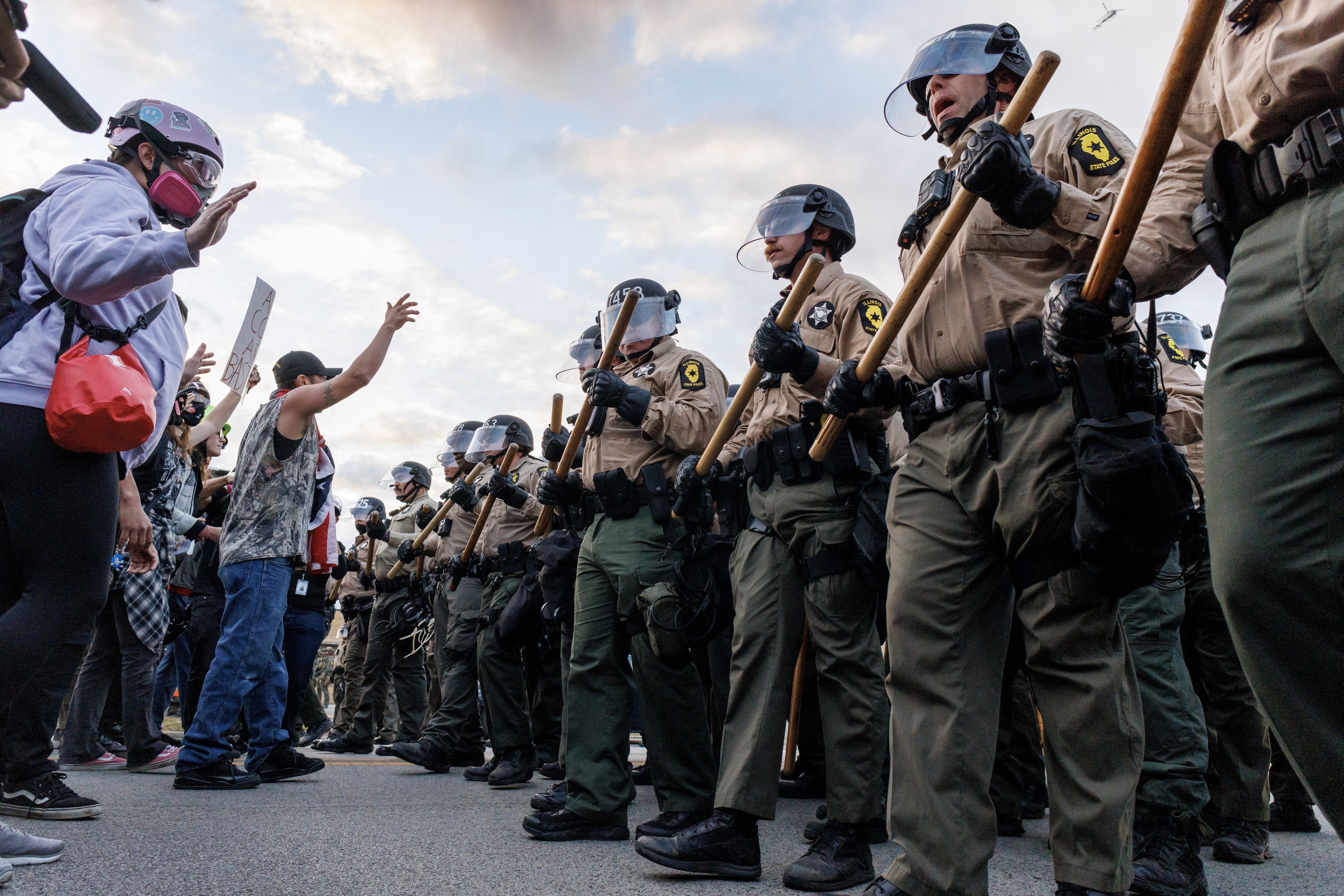
The spark that ignited Chicago’s unrest came in the final week of September 2025, from President Donald Trump’s Truth Social post titled “Chipocalypse Now.” Featuring helicopters circling the city’s skyline, the post portrayed Chicago as a war zone and triggered an immediate public backlash. The message was not merely symbolic; it echoed a broader political narrative that has long depicted America’s cities as sites of chaos, fueling fear rather than understanding.
Soon after, U.S. Immigration and Customs Enforcement (ICE) operations intensified under “Operation Midwest Blitz.” Clashes erupted between federal agents and protesters at the ICE facility in Broadview. On Oct. 3, 2025, the fatal shooting of a civilian by an ICE officer in Franklin Park triggered nationwide condemnation. What began as a law-enforcement action quickly turned into a moral confrontation over who defines safety, and at what cost?
As a federal court now prepares to hear arguments on the legality of the National Guard deployment, protests continue to mount. Rallies near Federal Plaza bring together immigrant families carrying candles and counter-protesters waving American flags. The city’s core has become a maze of new barricades, blurring the line between protest and occupation. Chicago, once the emblem of industrial progress, now stands as a moral crossroads; negotiating, in real time, the meaning of freedom and control. What is unfolding in Chicago today is not an isolated crisis but a mirror of what may soon confront other American cities – the future of urban America is, once again, being written here.
On the evening of Oct. 8, 2025, Trump’s lawyers filed a motion in Chicago’s federal court seeking to dismiss efforts to block the Guard’s deployment. The White House argues the move is essential to “maintain public order,” citing violence against immigration officials. Illinois Governor JB Pritzker and Mayor Brandon Johnson, however, have condemned the plan as “illegal and unnecessary.”
This confrontation has become more than a procedural dispute. It is a struggle over who commands America’s cities and whose safety defines “public order.” For Chicago, this is not the first time federal presence has collided with local governance. From the 1968 Democratic National Convention to the George Floyd protests of 2020, the city has long stood at the intersection of dissent and discipline. Each time, the question resurfaces: When does protection become domination?
National outlets such as NPR and The Washington Post have called Chicago a “testing ground for the future of urban democracy,” while Reuters and AP highlight the constitutional implications of deploying federal troops to an American city. Meanwhile, the hashtag #HandsOffChicago continues to trend as mayors, clergy and immigrant rights advocates nationwide issue joint statements calling for “compassion, not confrontation.” What started as a law-and-order initiative has become a referendum on the moral limits of federal power.
Beneath the barricades, the strain is not only political but deeply human. Across the South and West Sides, property assessments have soared, reaching in some areas by up to 160%, according to the Chicago Tribune. Fears of displacement and gentrification are spreading through working-class and immigrant neighborhoods.
In Little Village and Back of the Yards, residents describe a quiet fear that what starts as “temporary control” soon becomes permanent exclusion. “They say it’s for safety,” one community organizer said, “but whose safety are we talking about?” Community groups now describe these pressures as “a second eviction,” where economic speculation and federal enforcement intersect.
In these neighborhoods, the debate over the National Guard is less about security and more about survival, who gets to stay when the city reinvents itself once again. While policies promise revitalization, residents fear losing not only their homes but also their sense of belonging. These developments expose a deeper paradox of urban renewal: the same investments meant to stabilize communities often uproot the very people who sustained them.
In the shadow of ICE raids and National Guard patrols, economic anxiety merges with civic fear, blurring the boundary between enforcement and exclusion. What was once a housing issue now mirrors the broader moral question facing Chicago: how much control can a government exert before it erodes the very community it claims to protect?
At a time of deep division, Chicago might recall the voice of Cardinal Joseph Louis Bernardin (1928-1996), the city’s beloved archbishop for 14 years, remembered as a bridge-builder who believed in healing a divided civic soul. For many Chicagoans, Bernardin represented the city at its most humane: thoughtful, inclusive and unafraid to confront moral complexity.
As theologian Steven P. Millies notes in Joseph Bernardin: Seeking Common Ground, Bernardin’s vision reached far beyond the Church. He believed that peace is not the absence of conflict but the presence of understanding, teaching that societies, like churches, endure through “open, honest, and compassionate dialogue.” Chicago’s current crisis echoes that insight. Its healing will not come from more force, but from renewed trust between the governed and those who govern.
In this sense, Bernardin’s civic theology aligns with the ethics of Cittaslow and the Compassionate Cities movement, both urging citizens to slow down, listen, and rebuild the public trust that sustains democracy. Slowness, in this context, is not passivity but attention. Compassion, far from sentimentality, is civic courage and necessity.
Bernardin believed in the healing power of communication. His often-quoted words, “I am Joseph, your brother,” captured his conviction that the person across from us is not an enemy to be defeated but a human being to be engaged. What Chicago faces today, as do many American cities, is not only a crisis of policy but a collapse of communication.
Between federal directives and local voices, between street protests and government corridors, conversation has given way to confrontation. Bernardin’s legacy reminds us that a city survives only as long as it can still speak. It is not power that rebuilds the bridge; it is communication.
The ICE and National Guard crisis has exposed how fragile the bond between city and state has become. Chicago’s identity, from the Great Fire of 1871 to redlining and industrial decline, has always been defined by resilience. Yet today’s struggle is not only infrastructural but moral: Can justice coexist with order, and can empathy still shape how cities imagine their future?
Cardinal Bernardin’s message endures because it speaks to both faith and governance. It reminds us that cities are not systems to be controlled but communities to be cared for. The challenge for Chicago, and for America, is not merely to restore peace, but to redefine it. A compassionate city does not reject order; it reimagines it through justice, patience and shared humanity. If laws can be enforced with mercy, and governance guided by empathy, then perhaps from this crisis a gentler model of urban life might yet emerge, rebuilt on the slow, steady work of trust.
In the end, Chicago’s struggle is not just a local story but a national parable. The future of America’s cities is not being written only in courtrooms or policy rooms, but in the everyday choices that keep a community whole.