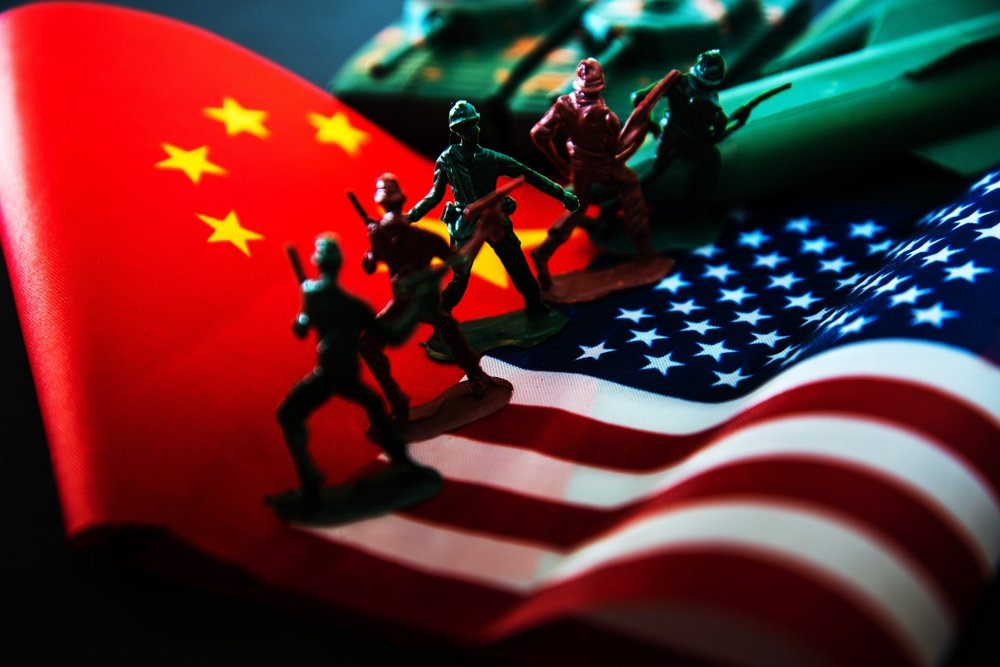
Despite China’s “all-weather” strategic partnership with Venezuela, Beijing’s response to the forcible seizure of President Nicolas Maduro has been strikingly measured. It has refused to contest American power in a theater of Washington’s choosing. Instead of escalating in the Caribbean, China appears to be internalizing the operational and political lessons of Caracas as it refines its long-term calculus for Taipei.
U.S. President Donald Trump inadvertently confirmed this shift when he remarked that the Venezuelan episode set no precedent for Taiwan, adding: “He [Xi] considers it to be a part of China, and that’s up to him what he’s going to be doing.” By leaving the initiative to Xi, Trump signaled that the real confrontation concerns the architecture of global power itself. Beijing’s apparently “mild” reaction is therefore a calculated exercise in temporal discipline.
This strategic patience rests on a deeper historical understanding: empire is a phase in civilizational development, not a permanent condition. From Rome to Britain, from the Abbasids to the Soviet Union, dominant powers rose by solving the strategic, economic and organizational problems of their time, and declined when the success generated contradictions they could no longer manage. Fourteenth-century scholar Ibn Khaldun described dynasties as possessing natural life cycles, while historian Arnold J. Toynbee saw decline as the loss of creative adaptability, and former U.S. President John F. Kennedy identified imperial overstretch as the economic mechanism of collapse.
Empires do not fall merely because they are defeated, but because the conditions that produced their rise no longer exist. In this sense, decline is not an exception to imperial history but its structural completion.
The United States today exhibits many of the classic symptoms of imperial senescence. Public debt has surpassed $35 trillion, political polarization has intensified, and social inequality has returned to levels comparable to the Gilded Age. Militarily, the United States remains formidable, yet increasingly constrained by overextension, rising alliance costs and a fraying domestic consensus on foreign commitments. Together, these trends mark a transition from uncontested dominance to contested primacy, which is the historical signature of an ageing hegemon.
When a hegemon can no longer secure clear military outcomes, its supremacy has already entered relative decline. China, by contrast, remains a rising power within its expansionary phase. Its economic scale, technological consolidation, military modernization and institutional coherence have produced a strategic environment in which American power can no longer achieve decisive victory in East Asia. China has not replaced the U.S., but it has denied its uncontested leadership.
Within this structural context, Taiwan emerges as a systemic test. For China, Taiwan represents the final unresolved symbol of civilizational reunification and strategic sovereignty. For the U.S., it represents the credibility anchor of its Asian alliance system. A Chinese victory would not merely alter borders, it would reshape the psychological architecture of global power. Yet, Beijing is driven less by ideological urgency than by timing. China understands that premature conflict risks mutual destruction, while indefinite delay risks internal stagnation. Taiwan, therefore, represents a strategic deadline.
Unlike previous rising powers, China does not require total military dominance. It needs only to demonstrate that American power can be denied, neutralized or forced into retreat. Even a scenario of mutual destruction or prolonged stalemate would favor China, as it would confirm that American supremacy is no longer absolute. In this sense, China has already achieved a functional parity of denial, that is a strategic equilibrium in which American victory is no longer guaranteed.
This does not imply that China will replace the U.S. as a permanent hegemon, since history offers no such promise. What rises will inevitably decline. China itself will one day confront demographic contraction, institutional rigidity and the same contradictions that plague all great powers. But in the current phase of the cycle, China is ascending while the U.S. is descending. War, in this framework, is a product of structural inevitability, the mechanism through which power transitions have historically been resolved.
Whether the Taiwan conflict ends in Chinese victory, American retreat or mutual destruction, its outcome will close the era of American unipolarity. Empires rarely collapse in a single battle; they erode when authority can no longer command obedience. Taiwan, therefore, is not merely a military theater but a referendum on who writes the next rules of global order. That contest, however, is underpinned not only by missiles and fleets, but by economic gravity.
In 2025, China’s nominal gross domestic product (GDP) stands at approximately $19.4 trillion, second only to the U.S., while on a purchasing power parity basis, it remains the world’s largest economy. It now accounts for nearly 30% of global manufacturing output and remains the dominant exporter. Chinese exports in 2025 were close to $3.8 trillion, against imports of roughly $2.58 trillion, generating a record trade surplus of nearly $1.2 trillion, despite renewed U.S. tariffs and a sharp decline in shipments to the American market. This surplus reflects not only China’s export resilience but its growing capacity to redirect trade toward Asia, Africa and Europe, reinforcing its structural centrality in the global economy even as internal imbalances persist.
By contrast, the U.S. faces mounting fiscal strain, with public debt exceeding 130% of GDP and rising interest costs crowding out strategic investment. Militarily, while Washington retains global superiority in aggregate spending, China has achieved credible regional denial capabilities in the Taiwan theater, where geography, proximity and logistics favor Beijing. Meanwhile, the dollar’s share of global reserves has fallen from nearly 70% in the 1990s to the high-50s today. Taken together, these trends signal not decline but transition: the consolidation of a G-2 world in which China is no longer an emerging power but an arrived one, and in which the U.S. will find it increasingly difficult to sustain hegemony without adjusting to new strategic realities.