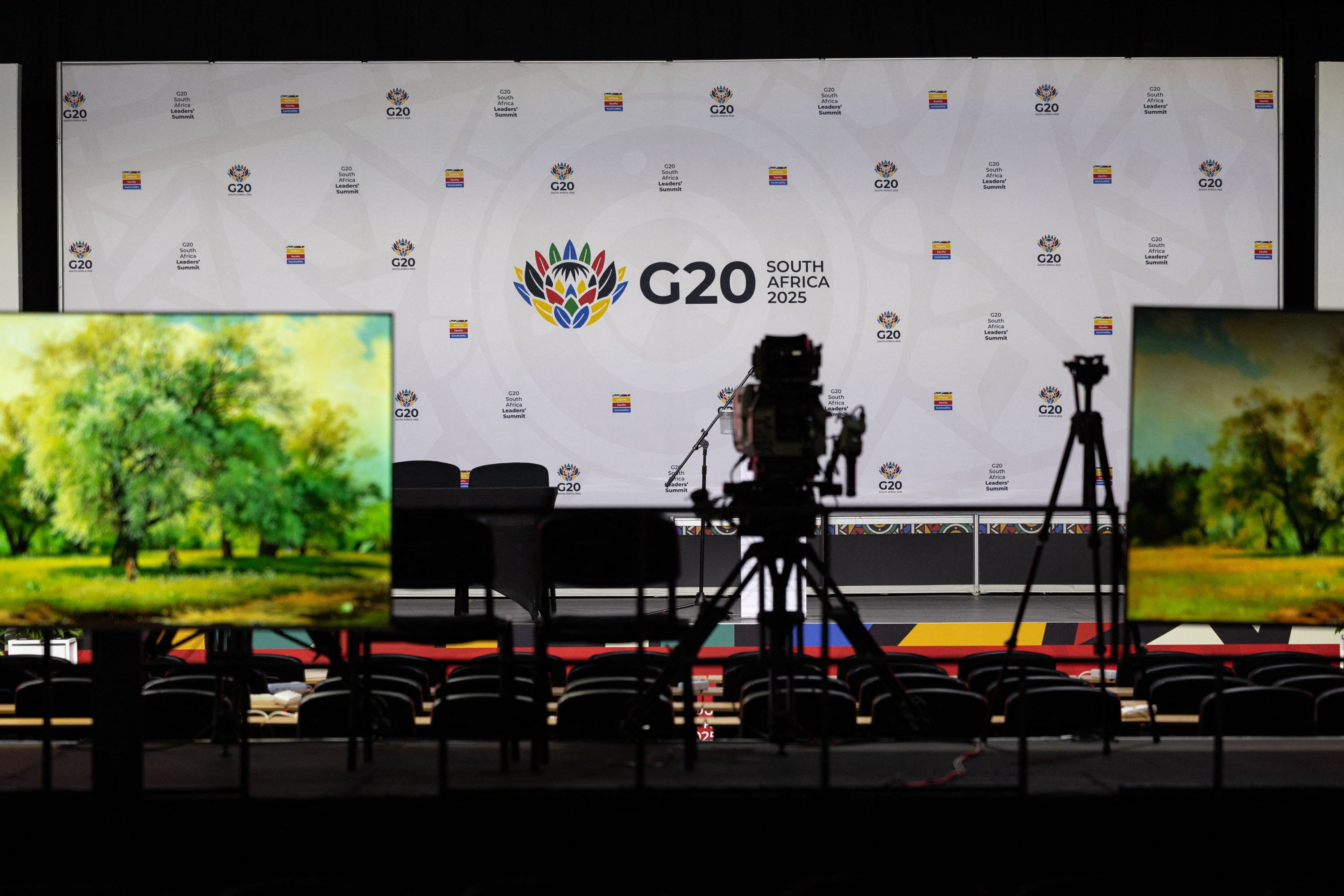
This year’s G-20 summit in South Africa is taking place without the leaders of the U.S., China and Russia. As expected, their absence diminishes the summit’s visibility and perceived importance in the global public sphere. Yet concerns about the G-20’s effectiveness are hardly new. There is a growing tendency to portray the forum as a relic of globalization’s “golden age,” just an organization simply no longer works. The G-20 is increasingly depicted as paralyzed by great-power rivalry, unable to generate inclusive or robust consensus, and far removed from the sense of urgency and shared purpose that characterized its response to the 2008 global financial crisis.
While this critique is mostly justified, it risks overlooking a deeper transformation. The G-20 may no longer function as the “executive board” of a globalized economy governed by neoliberal rules. Nonetheless, it can still evolve into a key interaction platform for contemporary power competition and for the politics of connectivity. This potential is particularly significant, especially for middle powers. The value of the G-20 today lies less in grand narratives or sweeping bargains and more in how it mediates complex patterns of interdependence. It remains one of the few arenas in which the global “center” and “periphery” can engage one another directly.
The G-20’s legitimacy was originally built on its numerical strength and functional relevance. Its members account for roughly 85% of global GDP, 75% of world trade and around two-thirds of the world’s population. During the period 2008-2010, these economic advantages enabled the G-20 to play a pivotal role in managing the global financial crisis, coordinating fiscal expansion, reforming the financial sector and taking a united stance against protectionism. Underpinning this role was a widely shared belief in the indispensability of the existing neoliberal order.
That belief has eroded considerably. Strategic rivalry between the U.S. and China, Russia’s invasion of Ukraine and the imposed sanctions, the weaponization of energy and food supplies, and also the politicization of supply chains have all reshaped the G-20’s role. The forum has shifted from being a mechanism that supports a shared globalization project to an arena in which competing visions of world order and of global connectivity confront one another. Member states remain deeply interdependent in terms of production, capital, data and technology, yet they increasingly diverge on how this interdependence should be managed and to whose benefit it should operate.
For this reason, a “connectivity-oriented” mission is crucial for the G-20. Understanding the new era requires attention to the infrastructures and standards through which interdependence – and thus competition – is organized. Subsea cables and 5G networks, digital payment systems and cloud services, energy pipelines, ports and railway corridors, development and climate funds have become central arenas of connectivity and geopolitical competition. The G-20 has gradually turned into a platform where rival connectivity initiatives interact, are debated and, at times, are reshaped.
While connectivity helps to explain why the G-20 can still perform a meaningful function, debates over representation and justice highlight its limits. Compared to the G-7, the G-20 is more inclusive, yet it remains a closed club that excludes the majority of the world’s states. For a long time, there was no permanent seat representing the African continent as a whole; small states and small-scale economies continue to rely on indirect channels of representation. This creates a legitimacy deficit, which is most evident in policy areas such as climate justice, food security and sovereign debt, in which these countries are among the most affected.
Despite these shortcomings, the G-20 has become an important stage for “middle powers” and for emerging coalitions from the global periphery. States can use their rotating presidencies and agenda-setting powers to foreground their own priorities. The forum thus generates both limitations and opportunities. The limitations stem from structural under-representation of smaller and poorer economies, particularly with respect to questions of fairness and voice. However, the opportunities lie in the fact that the G-20 remains one of the rare venues where middle powers can negotiate critical issues directly with great actors without relying on intermediary institutions.
The world that gave birth to the G-20 no longer exists. The assumption or idea that ever-deepening globalization was both inevitable and desirable is no longer a shared foundation for the forum’s work. Instead, the G-20 now operates in an environment marked by strategic rivalry, contested interdependence and increasingly vocal demands for justice from peripheral countries. In such a context, expecting the G-20 to deliver comprehensive, transformative “big outcomes” every year is unrealistic. But to say that the G2-0 is not important does not represent the whole story.
In the still-emerging world order, global connectivity – in its digital, physical and financial dimensions – is being renegotiated. In this setting, the G-20 can help ensure that the reconfiguration of rival but interconnected infrastructures does not lead to unmanaged fragmentation and the unrestrained weaponization of interdependence. Instead, the forum can facilitate a more diffuse yet negotiated process of minimal coordination and compatibility.
In other words, despite all its flaws, the G-20 remains one of the few platforms through which the birth pangs of a new international order can be managed – at least in some areas – through consultation rather than unilateral coercion. While the G-20 may have lost much of its original role and meaning as a product of U.S.-centered liberal hegemony, it can still play a significant part in shaping the new order, provided it adapts to the imperatives of connectivity politics.