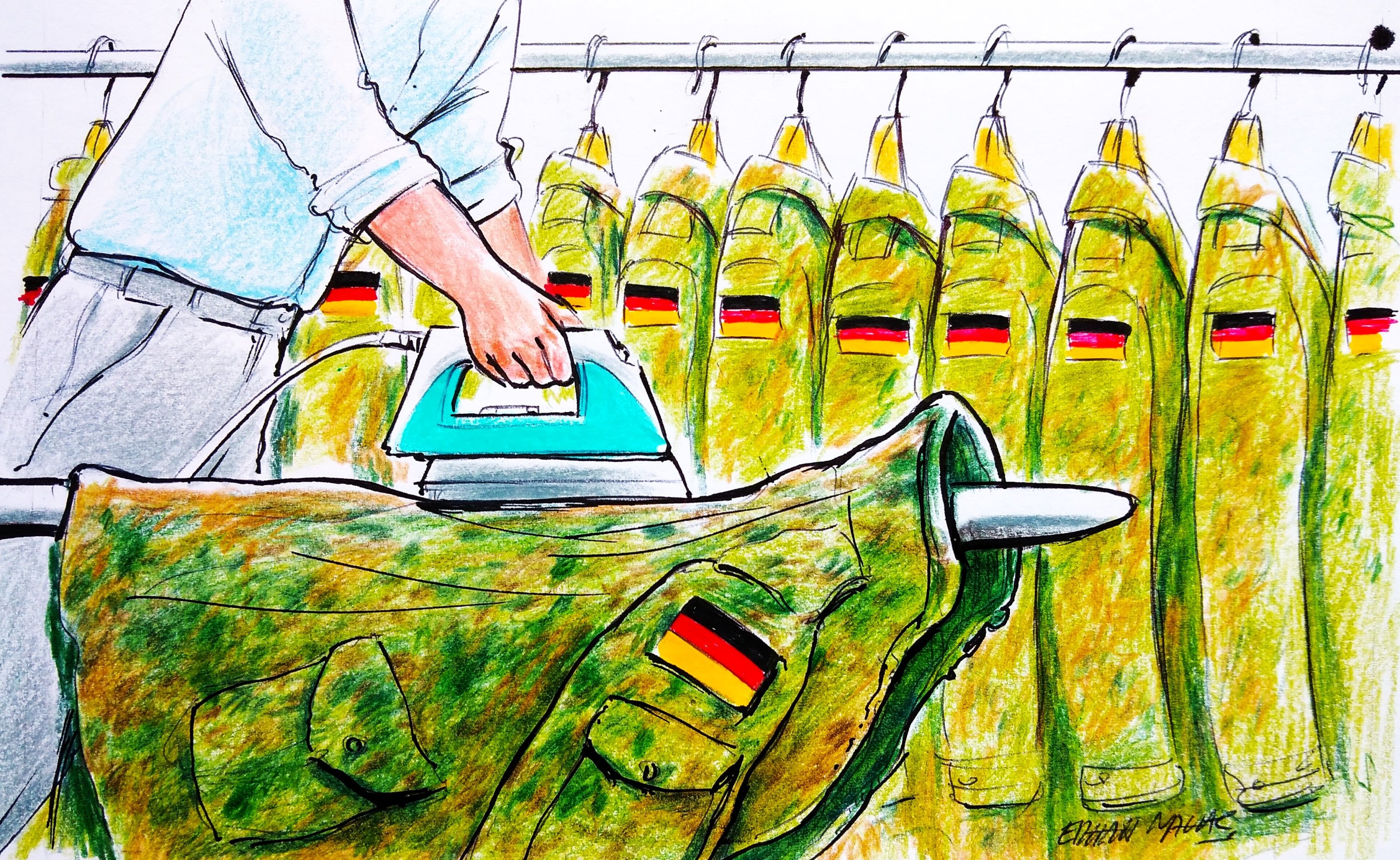
By making one of the most significant decisions of the 21st century, Germany has reinstated mandatory military service, previously discontinued in 2011 because it was considered a “strategic luxury,” in a new form. Approved by the Federal Parliament (Bundestag) on Dec. 5, 2025, this new conscription system may initially seem like a technical update to address the changing security landscape caused by the war in Ukraine, fulfill NATO commitments or resolve personnel shortages in the armed forces of Germany (Bundeswehr). However, in reality, it signifies something much more important. The change in Germany’s military service policy indicates not only a defense reform but also a deeper transformation of Germany’s foreign and security policy approach.
This decision shows that the “culture of restraint” (Kultur der Zurückhaltung), carefully built by Germany since World War II and long a core part of its foreign policy, is increasingly seen as unsustainable. The debate on “normalization,” which has continued since reunification in 1990 and has often been conducted implicitly, has now entered a new stage, for the first time, through a move that directly addresses the relationship between the state and society and the idea of national defense.
To understand Germany’s current defense responses, it is essential to analyze the strategic identity formed after the war. The Nazi era, World War II and the experience of genocide made military power, in the view of German political leaders, not just a strategic tool but one that was morally and politically problematic. This historical trauma intentionally limited Germany's ability to rebuild itself as a traditional power state.
Consequently, postwar German strategic culture developed within a framework characterized by deep skepticism toward the use of military force, a strong focus on multilateralism and a conscious avoidance of leadership roles in the international system. Germany defined itself as a “civilian power” (Zivilmacht), not by outright rejecting military tools, but by viewing them as exceptional instruments under strict political oversight and ongoing legitimacy checks. The principles of “never again” (nie wieder) and “never alone” (nie wieder allein) formed the normative foundation of this approach.
In this context, an important point should not be overlooked: Compulsory military service is not a recent development in Germany. From 1956 to 2011, conscription was implemented not as a tool for aggressive power projection but as part of a defense-focused military posture within NATO and under allied oversight. In this regard, conscription was long viewed not as conflicting with Germany’s culture of restraint but as a factor that contributed to its balance and stability.
The decision of Angela Merkel’s government in 2011 to suspend compulsory military service appears, in retrospect, as a product of the “end of history” fallacy. Berlin conceived the post-Cold War era as a security environment characterized by enduring peace and assumed that the armed forces should focus not on territorial defense, but on professional crisis management and humanitarian interventions.
The annexation of Crimea in 2014 unsettled this assumption, but the decisive rupture occurred on Feb. 24, 2022, with Russia’s full-scale invasion of Ukraine. The “turning point” (Zeitenwende) announced by former Chancellor Olaf Scholz represented not only the official acknowledgment of the significant strategic miscalculation made in 2011, but also a clear discursive break in Germany’s postwar foreign and security policy.
Yet despite its rhetorical force, the Zeitenwende remained limited in practice. Structural deficiencies within the Bundeswehr, persistent personnel shortages, bureaucratic bottlenecks and a broader societal reluctance toward military affairs constituted major obstacles to meaningful change. While the Zeitenwende articulated Germany’s intention to enhance its military capabilities, it proved insufficient to bring about a fundamental transformation of German strategic culture.
The new conscription model currently under discussion should be viewed as a step toward completing this previously unfinished transformation. Some observers describe the new approach that has taken shape under Chancellor Friedrich Merz as “Zeitenwende 2.0.” This second phase aims not only to implement significant increases in defense spending but also to reconstruct Germany's military power at the societal, institutional and cognitive levels.
The new military service system shaped by Defense Minister Boris Pistorius is based on the notion of “selective obligation in the digital age,” distinguishing it from traditional forms of conscription. While the state seeks to re-engage society in a renewed sense of defense awareness in response to the perceived Russian threat, it simultaneously aims to equip the Bundeswehr with the qualified human resources required for modern warfare.
Within this framework, the new conscription model occupies a central role. As of Jan. 1, 2026, all young people reaching the age of 18 will be addressed by a system presented as being grounded in voluntarism – offering a gross monthly salary of 2,600 euros ($3,075) – yet, for men, it establishes a mandatory registration and medical examination mechanism that effectively creates a potential mobilization infrastructure. It has been explicitly stated that compulsory military service may be reactivated should voluntary participation prove insufficient. In this respect, the regulation is intended not merely to increase troop numbers but to reframe military power as a legitimate, necessary and ordinary instrument of the state. Germany plans to expand its armed forces to 460,000 personnel, including reservists, by 2035, highlighting that the new conscription approach is part of a long-term strategy for sustained force development rather than a quick fix for immediate crises.
The primary driving force behind Germany’s sharp turn is undoubtedly Russia’s revisionist and expansionist policies. Berlin no longer perceives Russia merely as an energy supplier or a difficult diplomatic interlocutor, but increasingly frames it as an existential threat to Europe’s democratic order. Russia’s transition to a war economy, combined with its pressure on the Baltic states and Poland, has compelled Germany to retrieve the concept of conventional deterrence from the margins of its strategic thinking.
However, the issue is not confined to Russia alone. Signals emanating from Washington have also prompted Berlin to act with greater urgency. U.S. President Donald Trump’s rhetoric and the growing reorientation of U.S. foreign policy toward the Americas indicate that Europe’s security burden must increasingly be shouldered by Europeans themselves, above all by Germany. Merz’s pledge to transform the Bundeswehr into “the strongest conventional army in Europe” underscores Germany’s determination to move beyond a “free-rider” position under the American security umbrella.
Although students and youth organizations, in particular, have organized visible protests across the country against compulsory military service, the overall orientation of German public opinion shows a stronger level of support for the new conscription model than is often assumed. According to a public opinion survey published by the Berliner Morgenpost, approximately 68% of Germans support the reintroduction of compulsory military service, while the proportion opposed remains significantly lower.
Among the 18-29 age group, which would be directly affected by conscription, support is more limited but still constitutes a majority (53%), whereas 37% express opposition, and the remaining share appears undecided. The survey results further indicate that the idea of a “general service obligation,” encompassing civilian or social service alongside military service, enjoys even broader acceptance within society, with more than 70% of respondents favoring such an obligation regardless of gender. Taken together, these findings suggest that, despite the street protests surrounding compulsory military service, the steps taken by German political decision-makers do not entirely lack societal legitimacy. On the contrary, they appear to rest on a broad social foundation shaped by changing perceptions of security.
The return of compulsory military service to Germany’s political agenda does not symbolize a sudden militarization or merely a security reflex prompted by Russia. Instead, it signifies the latest, yet clearest, phase of the “normalization” debate that has evolved since reunification in 1990 and has long progressed cautiously. While the Russian threat might have accelerated this process, the key factor is a fundamental shift in Germany’s postwar strategic culture. Berlin is redefining military power not as a taboo cloaked in historical guilt, but as a legitimate and vital tool for safeguarding the democratic order. Thus, the new form of conscription is viewed not just as a means to recruit personnel but also as a way to rebuild the security relationship between the state and society in terms of national defense.
Although the “culture of restraint” that influenced German foreign policy for decades has not been entirely abandoned, the military restraint at its core is visibly weakening, with the "culture of restraint" gradually transforming into a “culture of responsibility” (Kultur der Verantwortung) that emphasizes controlled but decisive use of military force. In fact, Merz’s statement that “after the war, we will assume responsibility for the security of both Ukraine and the European continent” underscores that this change in outlook is being openly embraced at the political level.
Consequently, the debated compulsory military service model reflects not just a policy decision about the future of the armed forces but also a strategic choice, indicating what kind of power Germany aims to be. By moving beyond the protective but increasingly ineffective harbor of restraint, Berlin appears to have accepted a more active role in the harsher and more unpredictable waters of global politics.