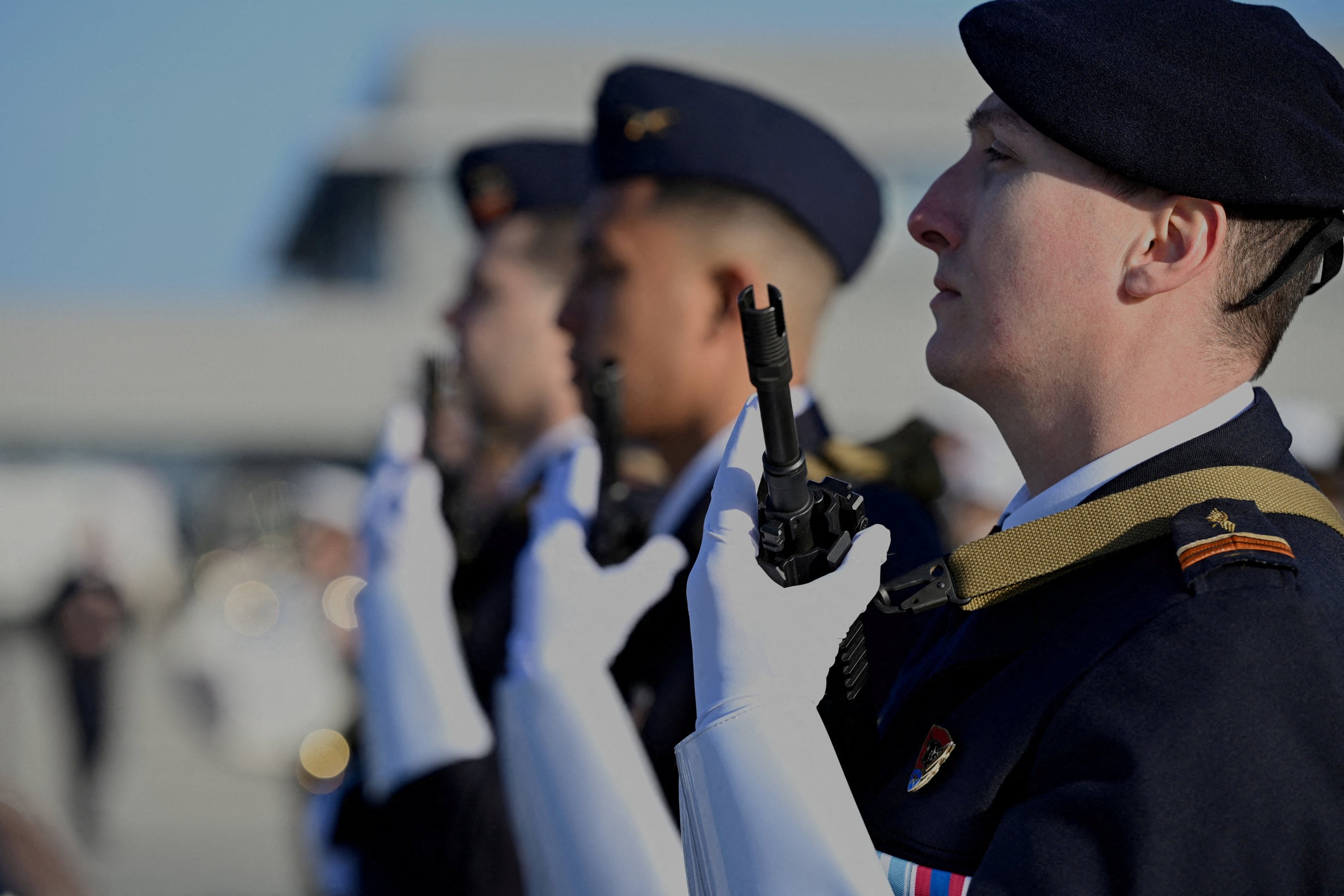
With global instability and rising national security threats, as well as declining hegemony and diplomatic prestige, France is entering a new era of rearmament and defense spending. French President Emmanuel Macron’s goal is for France to reach a defense budget of 64 billion euros ($74.28 billion) by 2030, with plans to achieve this figure three years ahead of schedule, by the end of his second term in 2027. Macron has outlined plans to increase the military budget for the 2026-2030 period by 36 billion euros, including an additional 3.5 billion for the defense budget starting in 2026. While French lawmakers and the minority government of Prime Minister Sebastien Lecornu remain in an ongoing dispute over the 2026 budget, the push for rearmament continues.
Last month, Macron decided to launch a next-generation aircraft carrier, replacing the Charles de Gaulle carrier with modern, adaptable technology in line with the new expansionist diplomacy style imposed by U.S. President Donald Trump. The New Generation Aircraft Carrier (PANG) nuclear-powered aircraft carrier is designed for rapid deployment in deterrence, coercion or intervention missions.
In addition to these, last fall, Macron announced that volunteers aged 18 and 19 would begin serving in a new 10-month military service program starting in 2026. He unveiled a national military service plan as France seeks to bolster its armed forces in response to growing concerns over Russia's threat to European nations, particularly beyond the war in Ukraine. "A new national service is set to be gradually established, starting next summer," Macron said in a speech at the Varces military base in the French Alps. Young volunteers will serve only on France's mainland and overseas territories, not in military operations abroad, Macron clarified.
Conscription, which France abolished in 1996, is not being considered. Macron stated that France aims to strengthen its defenses as Russia’s war in Ukraine poses a significant risk to the European continent. Currently, France's military comprises around 200,000 active personnel and over 40,000 reservists, making it the second-largest in the European Union, just behind Poland. France plans to increase the number of reservists to 100,000 by 2030.
In the context of international militarization and American interventionism, Paris aims to keep its focus on both Eastern and Western concerns. France is reviewing its 60-year-old military doctrine, especially in relation to its NATO allies. European NATO members are legitimately concerned about U.S. President Trump’s aggressive diplomacy, particularly in South America, the Middle East and Northern Europe. For example, in Greenland, European NATO members have symbolically stood firm in support of Nuuk’s territorial integrity and sovereignty, despite the region's unique status as an autonomous territory under Denmark's jurisdiction.
Symbolically, Macron decided to send 15 Alpine Chasseurs, infantry specializing in mountain warfare, to join Italian, German and Danish forces. This move sends a message of strategic solidarity with Denmark, an EU and NATO member, as France’s relationship with NATO has been historically complex. Sixty years ago, President Charles de Gaulle withdrew France from NATO’s integrated military structures and nuclear weapons program, though it remained a member of the Atlantic Pact. This was a reaction to Anglo-American dominance within the alliance and a shift in U.S. strategy to a flexible nuclear response that allowed for conflict in Europe using nuclear weapons.
Since then, French security and defense policy has been guided by the Gaullist principle: Whenever the West is under threat, France will stand in solidarity with democratic countries. However, in times of peace, it will seek to preserve its autonomy from the U.S. In 2007, President Nicolas Sarkozy emphasized that the EU and NATO are complementary, despite tensions over the 2003 U.S. military invasion of Iraq, which led to deep disagreements between the Bush administration and President Jacques Chirac, as well as Foreign Minister Dominique de Villepin.
Yet, in 2026, this relationship appears uncertain. The U.S. military and economic power are asserting themselves in Europe, while the EU, politically fragmented and economically weakened by the Ukraine war, struggles to dissuade Russian President Vladimir Putin, counterbalance China and handle the economic consequences of U.S.-imposed tariffs. Europe seems to be losing its influence in its own sphere and is increasingly becoming just a massive consumer market rather than a cohesive political and military entity.
In this dilemma, like the broader EU, France found itself cornered, caught between economic and financial arguments on the one hand and a legitimate national security threat to Europe's Eastern flank on the other. As a result, Macron has had to wave the deterrence flag to reassure his European partners. These developments could increasingly shape future actions, particularly in light of recent events in Greenland, where Moscow shares strategic concerns with Europeans.
Amid these developments, Paris is reviving its strategic autonomy from Washington, positioning itself as a pivotal European ally. France is securing its military equipment from national suppliers like Thales, Safran, Airbus and Dassault, which keeps France one of Europe’s largest defense industries.
The ongoing political battle in the French lower chamber (National Assembly), which remains a fragmented body after the 2024 elections, has made President Macron appear weakened. After dissolving the lower chamber, Macron faces a Parliament divided into 11 political blocs. France desperately needs a budget that will allow the president to implement his military policy, particularly to achieve his strategic objectives for European long-range strike capabilities and enhanced nuclear deterrence.
"With our German and British partners, we must move forward with determination on these deep-strike capabilities, which enhance our credibility and support our nuclear deterrence," Macron said.
Additionally, Macron has called for accelerating production of the SAMP/T air-defense system, which he claims is more effective than the American Patriot system. Increased production and deployment of the French-Italian system, including by other European countries, would strengthen strategic autonomy and reduce dependencies.
The central question remains: how far can Paris go on its own? France is facing a serious political crisis that could lead to an institutional crisis, with a fragmented society grappling with national identity issues, rising Islamophobia and a divided political class over leadership. Moreover, France has lost significant influence in Africa to Russia, China and Türkiye, while its European partners are increasingly reluctant to align with Paris. Washington, too, is no longer a reliable ally, as Trump’s "Peace Through Strength" doctrine turns the global focus to "America First."
In summary, the French elite is divided over Trump’s approach to geopolitics, and the new Pax Americana seems to be shaping a world in which the U.S. prioritizes its own interests over global stability. Can President Macron overcome France’s internal and external challenges? Will he be able to restore France’s position in the world and secure its future military strength? These questions will be crucial as France approaches the 2027 presidential election.