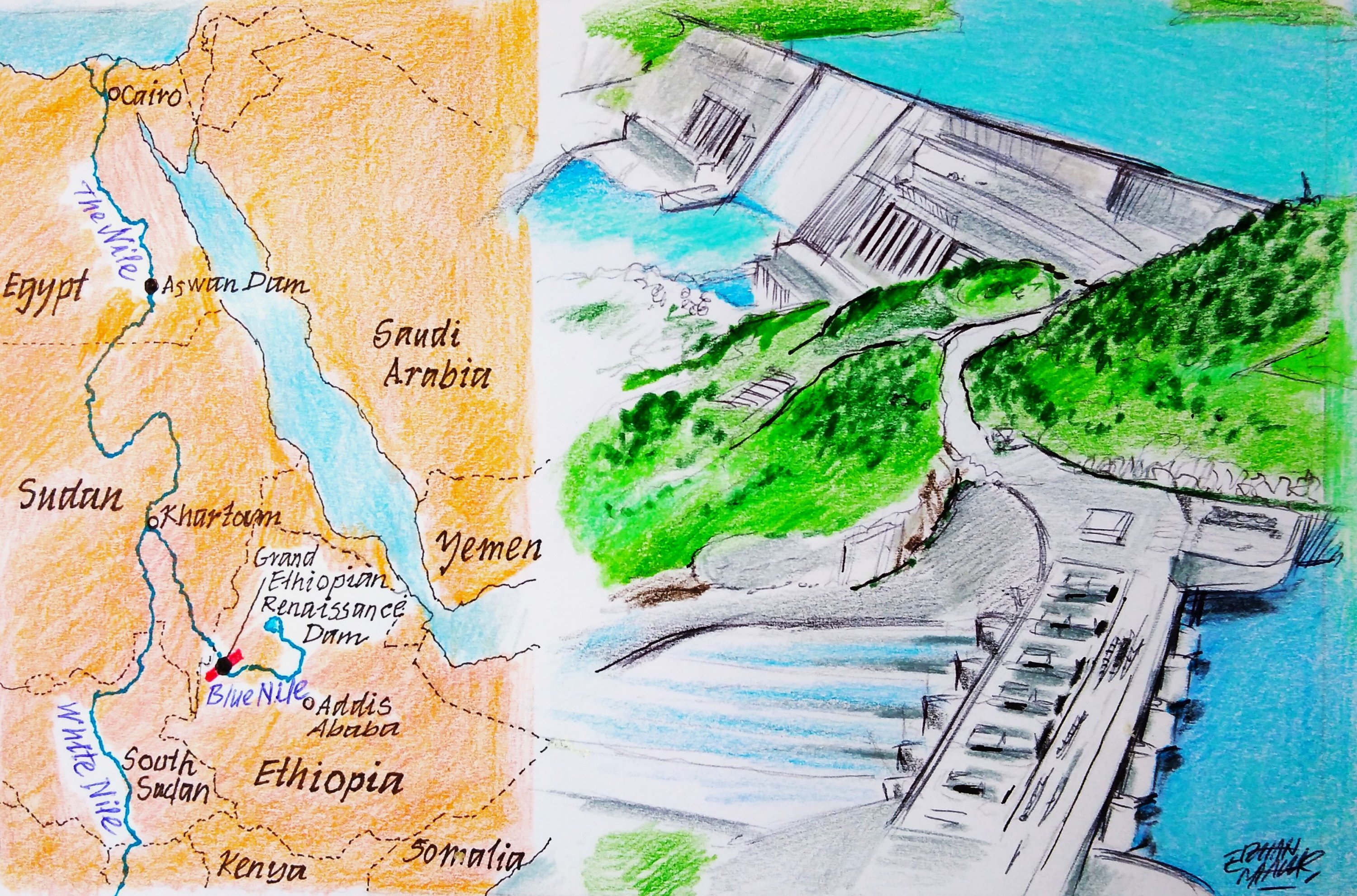
The Grand Ethiopian Renaissance Dam (GERD) is a hydroelectric dam built on the Abbay (Blue Nile) River, financed through a comprehensive mobilization effort involving all Ethiopian citizens. The GERD has long been an intergenerational dream of the Ethiopian people. However, it is the current generation – under the leadership of Prime Minister Abiy Ahmed, along with the collective contribution of his predecessors and the participation of the people – that has turned this long-held aspiration into a tangible reality.
The inauguration of the GERD on Sept. 9, 2025, marks a historic milestone, not just for Ethiopia but also for the Nile River basin countries and Africa as a whole. Often described as the continent’s largest hydropower project, the GERD represents more than a dam – it is a symbol of resilience, unity, hope and a demonstration of the dawn of Ethiopia's awakening and rejuvenation.
The GERD is more than a structure; it is a flagship project and national symbol that signifies a profound shift in the region's geopolitical dynamics. At a time when the international system has been biased and failed to deliver justice, Ethiopia has demonstrated what collective will can achieve and written a new chapter under the African sky, one that could match the victory of Adwa. Entirely funded and built through the collective sacrifices of Ethiopians from all walks of life, the project embodies a rare story of national solidarity and determination. Citizens and Ethiopian diasporas willingly bought bonds, donated from their modest earnings, and stood behind the project despite tremendous external pressure. Farmers, civil servants, merchants, students, civic and religious institutions, intellectuals, advocacy groups, and the diaspora, among others, contributed financially and morally to the project, turning what was once a dream into a powerful reality.
Thus, the GERD’s story is not only one of concrete and turbines, but of people and unity of purpose. It is Ethiopia’s answer to a long-cherished vision: harnessing the natural resources of the Blue Nile for sustainable growth and development, while contributing to the wider prosperity of the basin and East Africa. This spirit of unity reflects the broader African narrative of self-reliance and resilience. In this sense, the GERD is not only Ethiopia’s project but also a model for other African nations aspiring to develop their natural resource by mobilizing funds from their own coffer. It demonstrates that locally driven initiatives can overcome both financial and political preconditions and constraints.
The economic benefits of the GERD are vast and far-reaching. At full capacity, the dam is expected to generate more than $1 billion annually, a figure that represents both direct revenue and indirect economic stimulation. With a capacity of 5,150 megawatts (MW), the electric energy produced by the GERD will power a substantial number of households and industries, while reducing dependence on fossil fuels and significantly reducing greenhouse gas emissions.
By providing reliable electricity, the GERD will transform Ethiopia’s industrial base, enabling manufacturing and agricultural processing to flourish. Beyond industry, tourism is also set to benefit, as the dam becomes a landmark, drawing new visitors and serving as an important tourist destination in Ethiopia. In a world increasingly shaped by the green energy transition, the GERD places Ethiopia at the forefront of Africa’s sustainable development drive.
Far from being a source of division, the GERD has the potential to strengthen regional cooperation. By exporting surplus power to neighboring countries, Ethiopia is contributing to Africa’s interconnected future envisioned in the African Union’s Agenda 2063. Energy interdependence is expected to foster closer ties, reduce conflict, and promote shared prosperity across the Horn of Africa and beyond. This regional vision is not merely aspirational; it is already unfolding. Agreements for power exports to Sudan, Djibouti, and Kenya are part of Ethiopia’s strategy to transform the GERD into a cornerstone of African integration.
While Ethiopia celebrates the GERD’s inauguration, opposition from downstream countries, particularly Egypt and Sudan, remains a recurring challenge. Their concerns often draw on colonial-era treaties, notably the 1929 Anglo-Egyptian and 1959 Egypt-Sudan agreements, that allocated the Nile's waters exclusively to downstream states, despite their contribution being almost nil. However, these treaties – which were signed without the consent of upstream countries and disregarded their interests, particularly that of Ethiopia – are outdated, no longer serve the current reality and thus do not reflect modern international law.
Furthermore, the downstream riparian states have also invoked the notion of "natural" or "historical" rights over the Nile, attempting to maintain a monopoly over the river's use. To this end, downstream states have deployed various strategies: international diplomatic campaigns, securitization of the Nile issue at global forums, financing opposition groups and obstructing international funding for the GERD. These efforts, however, overlook a fundamental reality that the Nile is a shared international watercourse that must not solely serve Egypt and Sudan, but also the other nine riparian states of the basin, including Ethiopia.
In response, Ethiopia has pursued a balanced strategy, rooted in sovereignty, cooperation and regional integration. Standing on international water law that advocates for equitable and reasonable use and the obligation not to cause significant harm, Ethiopia, alongside other upstream nations, has championed the Nile Basin Cooperative Framework Agreement (CFA). Signed in 2010 and coming into force in 2024, the CFA represents a shift from outdated colonial treaties to a forward-looking, basin-wide governance system. Once fully implemented, the CFA and its institutional arm, the Nile Basin Commission (NBC), will provide a durable mechanism for cooperation and conflict resolution.
Moreover, Ethiopia has consistently emphasized its right to use the Nile for development while reaffirming its commitment to cooperative solutions. Ethiopia has engaged in trilateral negotiations with Egypt and Sudan, guided by the 2015 Declaration of Principles (DoPs), which commits all parties to peaceful dialogue and mutual benefit. By doing so, Ethiopia underscores its preference for diplomacy over confrontation. At the same time, Ethiopia has strengthened partnerships in the Horn of Africa and beyond, using the GERD as a platform to project stability and constructive influence in both the Nile Basin and the Red Sea region.
The GERD is a living symbol of Ethiopia’s determination to achieve economic transformation and prosperity, while embracing a future of clean energy, industrial growth, and regional solidarity. Its inauguration is not only a celebration for Ethiopia but also for Africa, a demonstration that collective will, rooted in justice and equity, can overcome even the weight of history.
As misconceptions give way to knowledge, the GERD’s story will stand as a reminder: the Nile is not the monopoly of a few, but the lifeline of many. Through cooperation, respect for international law and shared vision, the river can become a bridge to prosperity rather than a source of discord. The way forward is only cooperation based on a win-win principle. Ethiopia’s Renaissance Dam is thus much more than a hydropower project. It is a testament to African resilience, a beacon of progress, and an invitation to partnership on one of the world’s most iconic rivers, i.e., the Nile River.