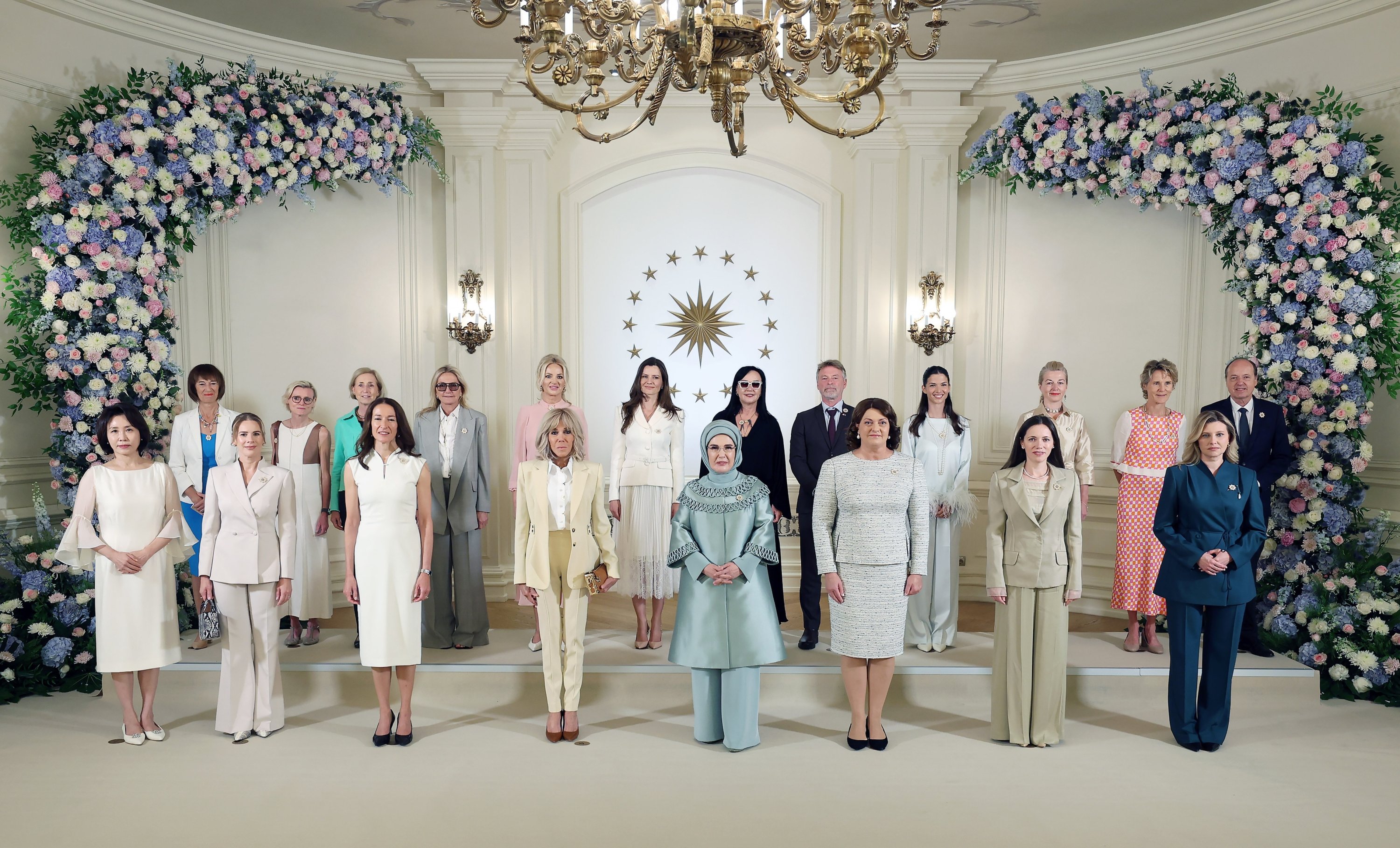
Twenty-two years ago, at the NATO summit held in Istanbul, Emine Erdoğan, wife of the host country's Prime Minister Recep Tayyip Erdoğan, was not invited to the official dinner hosted by the president of the time because of her headscarf. Last week, when the same summit convened once again in Türkiye, this time in Ankara, that uninvited figure of the past, first lady Emine Erdoğan, hosted 32 heads of state and government along with their spouses. This contrast has inevitably become a before-and-after narrative, and it should rightly be read that way. Yet, reducing the story to the personal vindication of a single leader or a single family would mean overlooking the far broader, international framework in which the matter actually sits.
Protocol is usually treated as a secondary detail in the literature of diplomacy. Yet, how states host one another, who is admitted to the table and who is left outside, often carries more political information than official communiques do. The protocol crisis that unfolded between Ankara and Istanbul in 2004 was exactly this kind of scene. At the time, the episode was presented as an almost exotic domestic matter unique to Türkiye. In fact, it was an early instance of a tension that much of the secular democratic world has still not fully resolved today: where does the visibility of religion in public life begin, and where does it end?
The most striking answer to this question comes, ironically, from France, a country that considers itself the cradle of modern democracy. While Türkiye was gradually lifting its headscarf restrictions, France was moving in exactly the opposite direction. The matter first surfaced in 1989 in Creil, near Paris, when three schoolgirls refused to remove their headscarves, and that small disciplinary incident quickly grew into a nationwide debate over laicism, the restrictive French version of secularism that Türkiye transplanted in its Constitution.
In 2004, a law banning the wearing of religious symbols in public schools came into force. In 2010, garments covering the face in public spaces were banned. In 2023, under the signature of Education Minister Gabriel Attal, even the abaya, a loose, long garment, was banned from schools on the grounds that it contravenes the French version of secularism. On the first day of the new school year, Sept. 4, 2023, 298 students wore the hijab; of these, 67 who refused to change despite warnings were sent home and not admitted to class. The appeal brought before the Council of State was rejected on puzzling grounds that the ban didn't violate the right to privacy or the right to education, although they were not allowed entry into school and were deprived of an education.
At the 2024 Paris Olympics, the French athletic delegation, under a rule applying to that delegation alone, wasn't permitted to wear headscarves. The debate is far from settled even today; the situation of headscarved mothers accompanying school trips, and the risk that private Islamic schools such as the Averroes lycee in Lille might lose state funding, are still being discussed in the corridors of parliament.
This is not a question that lends itself to easy polarization. The matter is far too layered to be reduced to a simple template of a free East versus a repressive West. France's interpretation of secularism has an internally coherent logic, rooted in its own historical context, in the 1905 law on the separation of church and state and in the Republican ideal of education. Yet, the question of how it can be explained that, in practice, this interpretation has consistently targeted the same group, Muslim women, remains on the table. The provisions on freedom of religion and conscience in the European Convention on Human Rights, along with the United Nations Human Rights Committee's interpretation of that provision as extending to religious dress, make the French model a contested one within the framework of international human rights law.
Türkiye's experience, at exactly this point, offers a compelling counterexample. Lifting the restriction led neither to the collapse of public order nor to the erosion of laicism. On the contrary, expanding the protocol to encompass every segment of society has made hosting an international summit considerably smoother. Welcoming 32 leaders and their spouses under the same roof signals a protocol maturity that would have been unimaginable 20 years ago. This is not merely a symbolic gesture; it is also an indicator of the host country's capacity for international representation.
In the shadow of the same summit, another protocol scene drew attention. In 2017, Fatma Betül Sayan Kaya, then minister of Family and Social Policies, traveled to Rotterdam to meet with Turkish citizens during the constitutional referendum process. Dutch authorities, however, didn't even allow her into the Turkish Consulate, blocked her vehicle and kept her waiting for hours, then declared her persona non grata and escorted her by police to the German border. In the years since, that image settled into Turkish public memory as an example of diplomatic humiliation.
This year, when Dutch Prime Minister Rob Jetten arrived in Ankara for the same summit, he was received with full official protocol, this time by Mahinur Özdemir Göktaş, who now holds the very same post of minister of Family and Social Services. The symbolic weight lies precisely here. The same ministerial office that was kept waiting at the door nine years ago is today the one opening the door. This scene constructs, in a single camera frame, a diplomatic narrative that is difficult to put into words.
Are these two scenes, the headscarf protocol and the memory of Rotterdam, truly a coincidence? I don't think so. In both cases, the matter is the reappearance, on the very same stage, of an institution once excluded or humiliated, now returning in a reversed role. Here, diplomacy becomes not merely a negotiation between states but a form of memory management. Historians of protocol likewise often emphasize that such symbolic encounters tend to leave a more lasting political memory than official statements do.
The images from the NATO summit in Ankara shouldn't be read merely as the personal vindication of a family or a ministry. The real question is the extent to which a state's official protocol can accommodate the diversity of its own citizens and guests. Who gets to sit at the diplomatic table is, in essence, a test of the maturity of each country's own democracy. And no one yet holds a certificate for having passed that test. Türkiye's journey has gone down as a concrete example showing that this test is an obstacle that can, with time and political will, be overcome.
As I write these lines, the same question keeps returning to me. How rare it truly is for a country to confront its own past this openly. That evening dinner at Dolmabahçe Palace remained, in the newspaper archives of its time, a minor protocol footnote; looking back on it today, it reads instead like the announcement that an era has ended.
Whether France will face a comparable reckoning in the years ahead will be a test not only of French politics but of how the whole of Europe answers its own test of pluralism. The table in Ankara, in this sense, is not merely a summit photograph; it is a visionary answer, offered on Türkiye's behalf, to the new protocol rules of a multipolar world, and a model of institutional flexibility that may yet be repeated in other capitals.