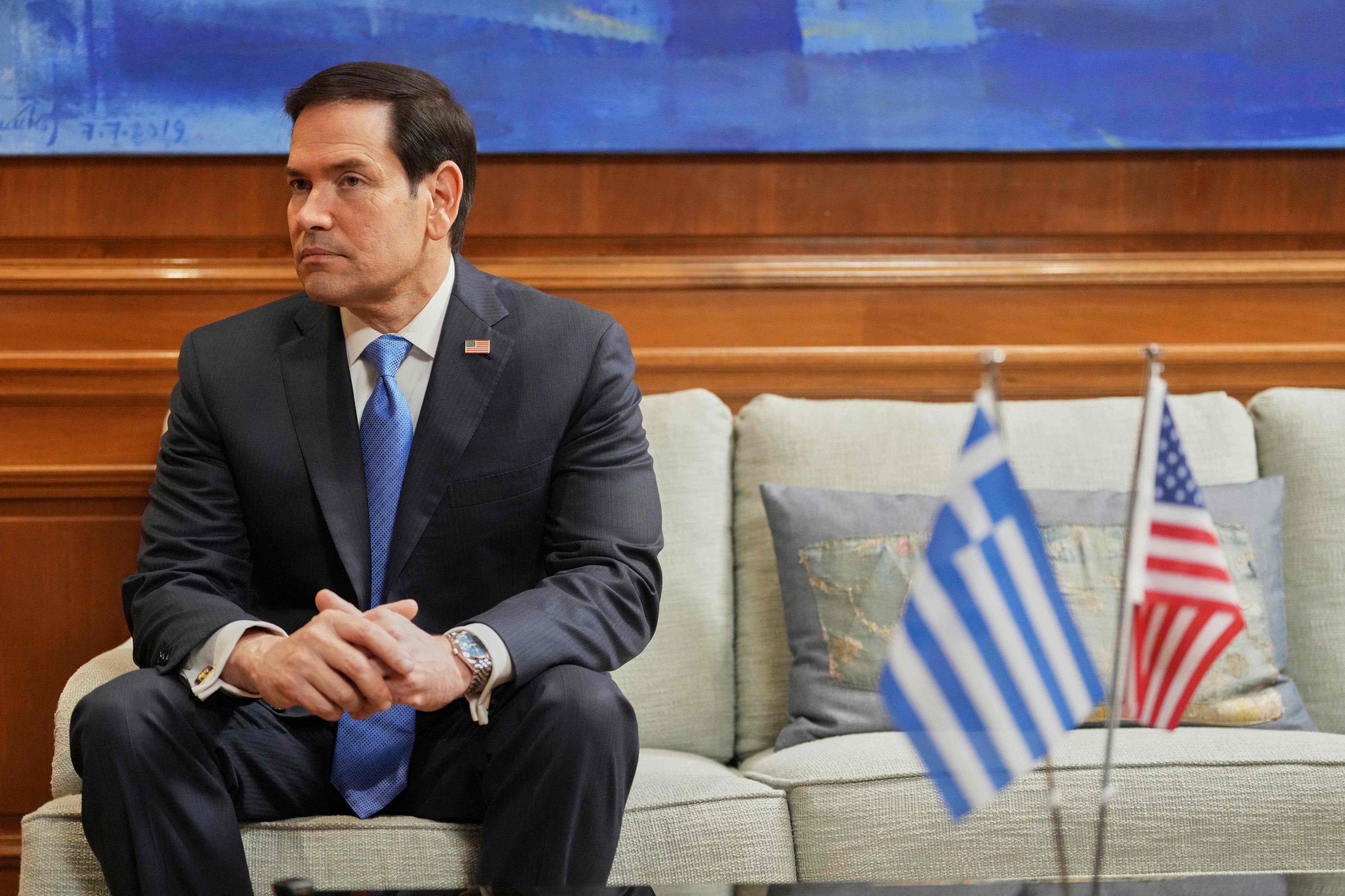
U.S. Secretary of State Marco Rubio’s recent Athens speech should be read not simply as another assertion of American power, but as evidence of a larger transformation. In less than two years, "America First" has evolved from a nationalist doctrine into a defense of Western civilization.
When U.S. President Donald Trump returned to office, the organizing idea was clear: American sovereignty, workers and national interest came first. His January 2025 America First Policy Directive instructed the State Department to put “America and American citizens first.” The administration’s subsequent review of U.S. foreign assistance reinforced the same message: Washington would no longer sustain an international apparatus merely because it promoted a supposedly universal political model.
But America First encountered a conceptual problem. Nationalism can explain why the United States should defend its own interests. It cannot explain why Europe’s identity, religion or political direction should be an American concern.
Rubio’s answer has increasingly been civilization.
At the Munich Security Conference in February, Rubio described Americans and Europeans as members of one, Western civilization, tied by history, Christian faith, culture, heritage and ancestry. More importantly, he attacked the post-Cold War “end of history”: the assumption that every society would eventually converge around liberal democracy, free trade, borderless integration and a rules-based international order. Rubio argued that this “dangerous delusion” had cost the West dearly through deindustrialization, dependence on foreign supply chains, weakened defense capacities and energy policies that constrained Western societies while competitors continued to pursue national power.
The underlying argument was that the West had become so committed to universalist abstractions that it had weakened its instinct for political and civilizational self-preservation. Athens takes this further.
Rubio calls for recovering a classical understanding of politics and statecraft “not just for our country, but for the whole of our civilization.” He argues that Western understandings of heroism, honour and duty are not universal to “all people in all times and in all places,” but products of a “distinct character” originating in Greece and subsequently developed through Rome, Christianity and the later Western experience.
America is therefore no longer the deepest political category. Western civilization is. This is also a striking move away from political theories of Francis Fukuyama and toward Samuel Huntington. Where Fukuyama expected convergence around liberal modernity, Huntington argued that distinct civilizations would become increasingly important actors in post-Cold War politics.
Yet, Rubio goes only partly toward pluriversality. He simultaneously calls the Western story “the greatest story ever known to man.” The result is hierarchical civilizational pluralism: different civilizations exist and need not become identical, but the West continues to regard its own experience as exceptional.
This evolution also reveals the limitations of America First itself. The movement began with aggressive nationalism: America, its borders, workers and interests. Munich added a strong religious-nationalist dimension by locating America inside a shared Christian civilization.
Athens now expands the genealogy again. Greece, Rome, Christianity, exploration, scientific achievement and the secular traditions of Western modernity are incorporated into a single Eurocentric historical narrative, which is storytelling about the last more than 2000 years, undermining the history of colonialism.
This is significant. Trumpism is no longer offering merely Christian nationalism. It is constructing a broader civilizational nationalism capable of incorporating both the religious and secular traditions of the West. But the aggressive nationalist core has not disappeared.
Persian scholar Fatemeh Shams has criticized Rubio’s reading of the Persian-Greek encounter for turning two deeply interconnected historical worlds into civilizational opposites. Persians and Greeks fought wars, but they also interacted through trade, diplomacy, philosophy, science, art and political thought. Her criticism exposes the danger in Rubio’s narrative.
Civilizations do not develop as sealed containers. Greek civilization itself emerged through extensive interaction with Egypt, Persia, Mesopotamia and the wider eastern Mediterranean. To rewrite that complex history primarily through the Persian Wars risks transforming history into contemporary political mythology.
That becomes especially troubling when Rubio contrasts ancient Greece with Persia while the U.S. is engaged in a major conflict with Iran. The contemporary enemy can easily become projected backward as an "eternal civilizational enemy."
Yet, the return of civilization is not uniquely American. China’s Global Civilization Initiative explicitly argues that different civilizations have generated different paths toward modernity and calls for equality and mutual learning between them. Russia’s foreign-policy thinking now officially describes the country as a “state-civilization.” In India, Hindutva and Modi-era foreign policy increasingly connect Indian power with civilizational recovery and the historical idea of Bharat. Research on Hindu nationalism and Indian foreign policy similarly shows how civilizational values have entered India’s understanding of its global role. Across the Muslim world, Islamic civilization remains an important language through which questions of political order, modernity and global hierarchy are debated.
Civilization has already returned to world politics. What is new is that Washington is also weaponizing the civilizational concept in the context of nationalist propaganda, while the expectation of a post-Cold War world is different. It should also keep in mind that genocide in Gaza showed the meaninglessness of Western universal values under the Judeo-Christian civilizational war.
There is nevertheless a material problem beneath this ideological transformation. The U.S. constructed the post-1945 order after winning a world war under conditions of extraordinary relative power. The collapse of the Soviet Union created another exceptional moment in which Washington stood without a peer competitor. Neither condition exists today.
The contrast between Venezuela and Iran illustrates the problem which also advanced with the trade competition with China.
January’s U.S. operation that captured Venezuelan President Nicolas Maduro displayed extraordinary American military reach and revived the image of swift, decisive American power.
But the prolonged confrontation with Iran has not reproduced that political outcome. Despite overwhelming American military capabilities, the conflict has imposed economic and strategic costs, while Washington has again turned toward negotiations rather than dictating an uncontested settlement.
Moreover, the trade war against China has not produced what the U.S. expected, which was clear during the meeting between President Trump and Chinese President Xi Jinping after the U.N. annual meeting.
The lesson is not that America is weak. It remains the most powerful individual state. It is that military superiority no longer automatically gives Washington the position it possessed in 1945 or 1991: the ability to arrive at the table as the unquestioned victor and determine the settlement.
Trumpism is trying to renegotiate a victor’s order without a new victory, and this may explain the ideological evolution itself. America First nationalism was never sufficient for the international role Washington still wanted to play.
To lead Europe, organize allies, and define a wider geopolitical community, America needed a story larger than America. Rubio has now supplied one: Western civilization. The question is whether this new doctrine can accommodate a genuinely plural world, or whether civilizational language will merely give aggressive nationalism a larger historical stage.