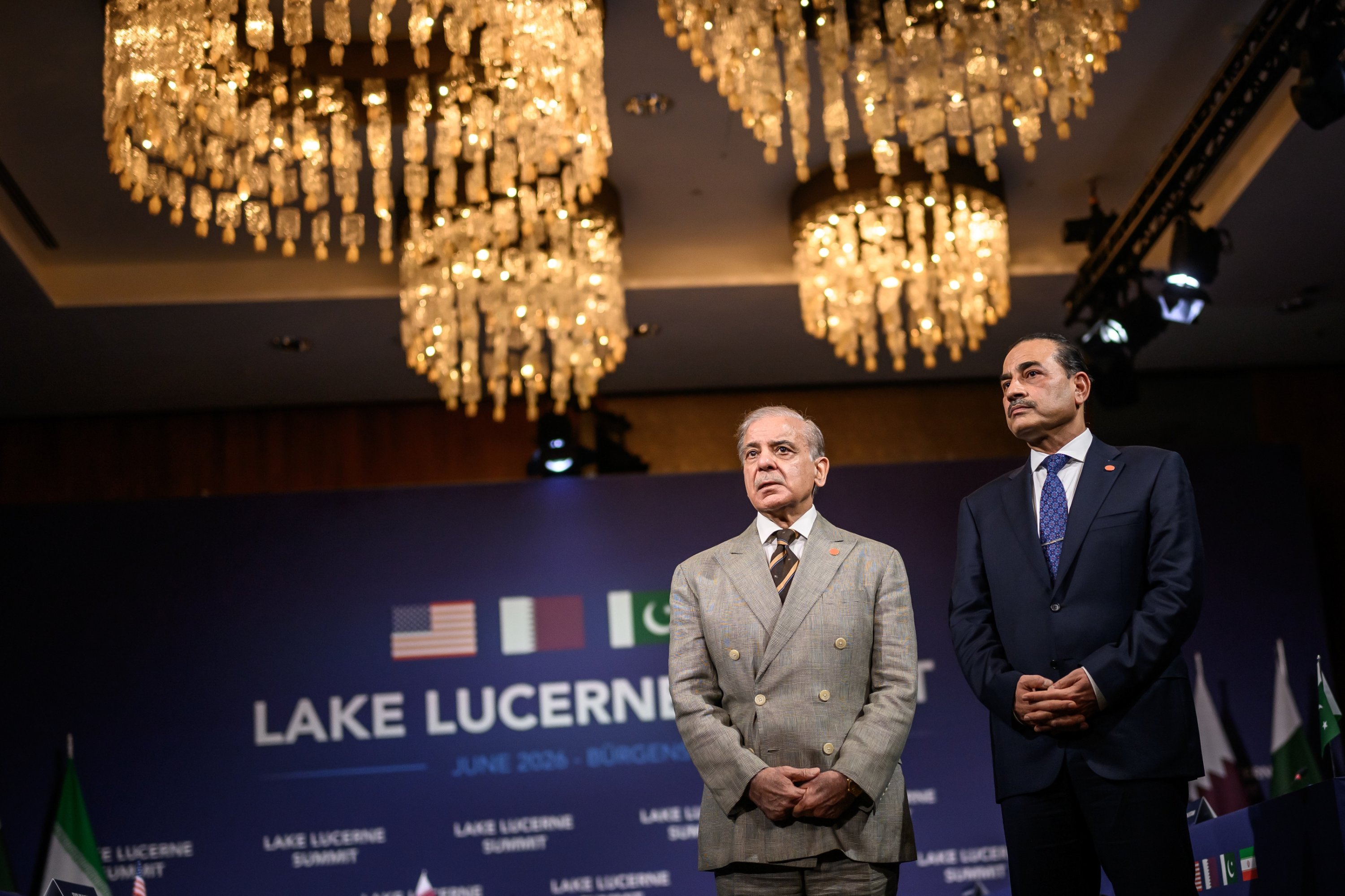
When U.S. Vice President JD Vance arrived in Switzerland this week for the highest-level direct American-Iranian engagement ever held on foreign soil, he paused before the cameras and confessed that few in Washington would have predicted a year ago.
"I have joked that I have two very important people in my life," he told reporters at the Bürgenstock Resort overlooking Lake Lucerne. "An Indian and a Pakistani. The Indian is my wife, and the Pakistani is Field Marshal Munir." He added that he had "probably talked to Field Marshal Munir more than anyone else over the last few months."
It was a remarkable tribute, and it told the story of how a conflict that began with assassinations and airstrikes has ended, for now, with a peace deal engineered almost entirely by a single Pakistani General, backed by the full weight of the nation he represented.
The memorandum of understanding (MoU) signed on June 17 by the U.S. and Iran extends the current cease-fire by 60 days, reopens the Strait of Hormuz, lifts the U.S. naval blockade on Iranian ports, delivers partial sanctions relief to Tehran and opens a dedicated nuclear negotiation track.
Mediators Pakistan and Qatar said both sides agreed to establish a high-level committee to provide political oversight, with negotiating groups focused on nuclear issues, sanctions and implementation. Pakistan's role was not incidental; it was structural. As the only country in the region that carried credibility with both Washington and Tehran, and that had no diplomatic baggage either side could object to, Pakistan was the table on which this deal was built. The war, for now, is over, and at the center of everything was Field Marshal Asim Munir.
The Munir-Trump relationship was established after the four-day India-Pakistan war in May 2025, when Pakistan backed Trump's claims that he had brokered a ceasefire that India rejected. Trump has since called Munir his "favorite field marshal," and credited him with preventing escalation to a potential nuclear confrontation. Behind Munir, however, stood the institutional weight of Pakistan itself, a state that had quietly spent years cultivating relationships on all sides of the region's fault lines.
A retired Pakistani chief of general staff told The Washington Times that Munir had "a decade of dealing with Iranian intelligence, Islamic Revolutionary Guard Corps (IRGC) commanders, foreign ministers and presidents."
He explained: "By virtue of the last 10 years in various appointments, director general of military intelligence, then director general of the Inter-Services Intelligence (ISI), then chief of army staff, he had personal connections at four levels: intelligence, armed forces, IRGC and political leadership. The Iranians knew he could talk to President Trump very frequently, compared to hardly anyone in the region who could."
Iran's own ambassador to Islamabad put it plainly, saying that Tehran would "do talks in Pakistan and nowhere else, because we trust Pakistan."
This dual trust from Washington and Tehran simultaneously is what made Munir irreplaceable, and what made Pakistan the only viable venue for the most consequential diplomacy of the decade. The traditional mediators, Qatar and Oman, had been knocked out by the conflict itself. Qatar had been struck by Israeli forces. Oman had been targeted by Iran. Pakistan, which does not recognize Israel and carries no baggage that Tehran would object to, became the only viable bridge.
Munir was the lead mediator from the moment the war began. When the deal was closest to collapsing, it was Munir who flew personally to Tehran in an 11th-hour effort to get the agreement across the line, meeting with senior IRGC commanders, as U.S. negotiators described the process as "agonizing," with drafts "going back and forth every day."
It was Munir who greeted Vance on the tarmac in Islamabad when the highest-level U.S.-Iran talks since 1979 were hosted on Pakistani soil. It was Munir who worked through the night on April 7-8, as Trump's deadline for Iran expired and markets collapsed, to deliver the first cease-fire.
Prime Minister Shahbaz Sharif, addressing Pakistan's National Assembly, was unambiguous about his role: "Throughout this period, he was awake all day and night. He sacrificed day and night to extinguish the flames of war. There were many moments when it felt like the negotiations would come to a halt, but the army chief did not give up."
At the Bürgenstock talks, Vance publicly credited Munir's "consistent efforts, perseverance and patience," while Sharif thanked both Trump and Vance before singling out the field marshal.
Hafiz Syed Asim Munir Ahmed Shah was commissioned into the 23rd Battalion of the Frontier Force Regiment in 1986, graduating from the Officers Training School in Mangla, where he received the Sword of Honour. He comes from a well-known Syed family with strong religious roots, and memorized the entire Holy Quran during a posting in Saudi Arabia, making him the first Hafiz-e-Quran ever to serve as Pakistan's Army Chief.
His path to the top was anything but smooth. He is the only army chief in Pakistan's history to have previously served as head of both Military Intelligence and the ISI. His tenure as ISI chief was cut short after eight months, reportedly on former Prime Minister Imran Khan's insistence, poisoning their relationship permanently.
When the Sharif government sought a new army chief in late 2022, Munir, who had nearly retired two days before the appointment, was chosen in part because of that bitter history. What followed was one of the most turbulent tenures in recent Pakistani history. But it was also, unexpectedly, the beginning of a diplomatic transformation.
In December 2025, Munir was appointed Pakistan's first-ever Chief of Defense Forces, giving him unified command over the Army, Air Force and Navy simultaneously. His Iran mediation has cemented an authority without precedent in Pakistan's history.
For Pakistan as a nation, the implications of successfully mediating between the U.S. and Iran to end the war are enormous. A country long viewed through the narrow lens of the Afghanistan war has repositioned itself as an indispensable diplomatic actor in the world's most volatile region. The man who was almost never made army chief, who was fired from the ISI, in the space of a single brutal conflict, made Pakistan the country the world called when it needed someone to stop a war.
The guns are silent. The tankers are moving through the strait again, and in Geneva this week, a field marshal from Rawalpindi stood alongside the representatives of two superpowers and watched an agreement he built, conversation by conversation, sleepless night by sleepless night, finally take hold.