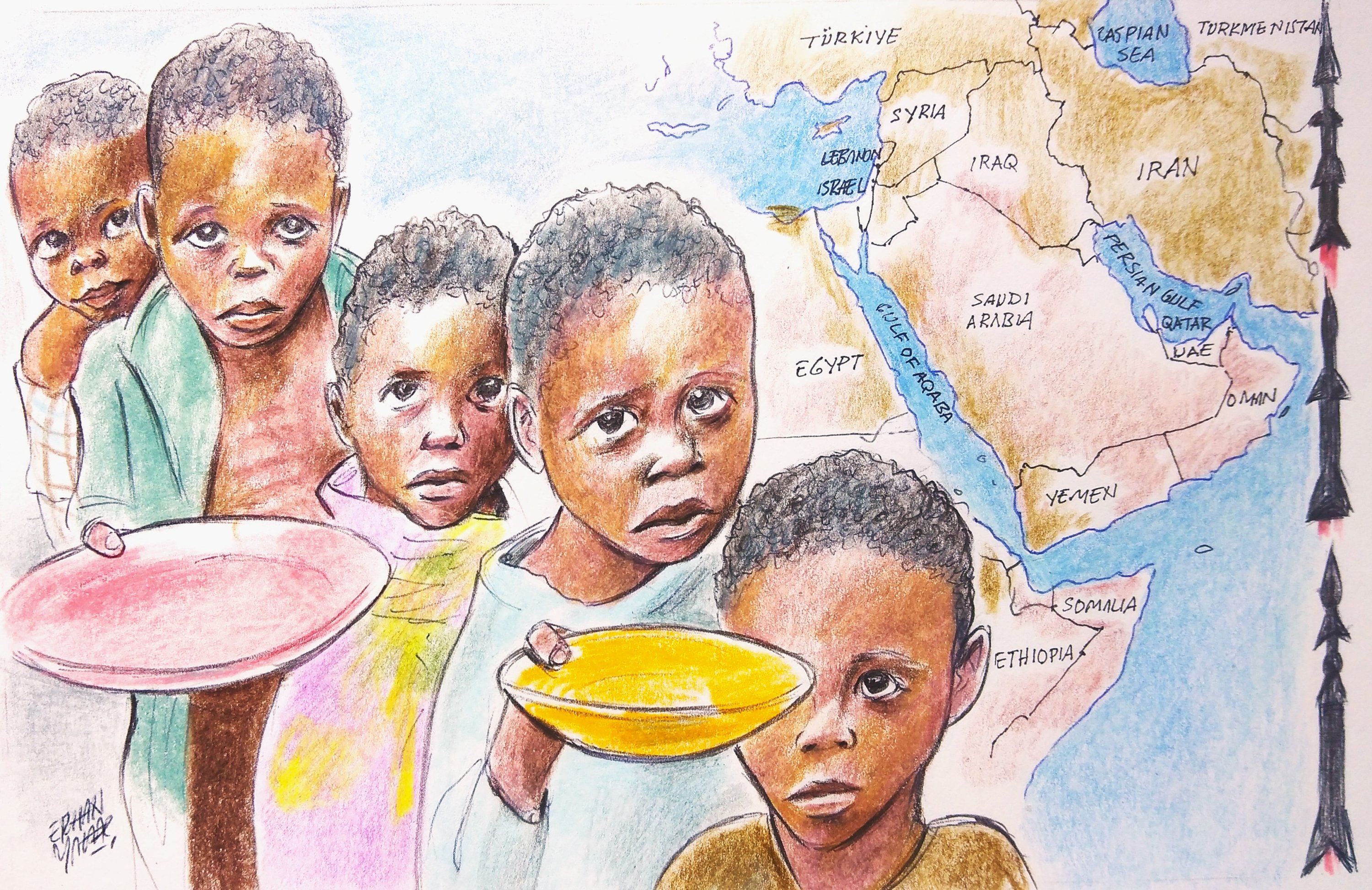
When the first large waves of airstrikes hit Iran at the end of February and missiles started flying back toward U.S. and Israeli positions, most headlines focused on the Gulf and the Levant. However, within a few days, the impact was visible somewhere else: at petrol stations in Lagos, Nairobi or Johannesburg, where fuel prices were adjusted upward as shipping and insurance costs jumped in response to the fighting.
It did not take long for African leaders to warn that this conflict would have “serious implications” for the continent’s energy security, food imports and fragile economies. The African Union and the Economic Community of West African States (ECOWAS) followed with statements stressing the risks to fuel supply, food prices and macroeconomic stability.
For people across Africa, the Iran war appeared on fuel pump displays and in the price of basic foodstuffs, not on abstract maps of the Strait of Hormuz. The same patterns that followed the Ukraine war, such as higher import bills, weaker currencies and tighter fiscal space, risk repeating themselves in a region that has had little time to recover from the last series of shocks. And as this pressure builds, middle powers that have invested heavily in African trade, corridors and security relationships, including Türkiye, face a practical question: how to protect those gains while trying to de-escalate a war they did not start?
The most immediate channel is energy. The serious disruption of traffic through the Strait of Hormuz, combined with attacks on refineries and liquified natural gas (LNG) facilities around the Gulf, has pushed global oil and gas prices sharply higher, with around 20% of the world's oil and LNG supply affected. Brent crude, for example, has now risen by more than 50% since the war began, trading above $110 a barrel by late March, turning what looked like a short‑lived spike into a sustained price shock. African economies that import most of their refined fuel, and that rely on maritime routes for crude and LNG, are directly exposed to this shock. Higher freight and insurance premiums add another layer of cost on top of the underlying commodity price.
South Africa’s latest fuel price adjustment illustrates this mechanism clearly. Officials in Pretoria explicitly referred to the increase in Brent crude and shipping costs, driven by uncertainty over the U.S.-Iran confrontation, as the main reason for a rise in regulated pump prices. The same pattern is visible elsewhere: Tanzania has also raised pump prices, with diesel seeing the sharpest increase, and Senegal’s prime minister has reportedly convened an emergency meeting to secure supplies and protect vulnerable consumers.
Similar debates are emerging in Nigeria, Kenya and other net importers, where higher fuel costs quickly feed into public transit fares, trucking rates and electricity tariffs in systems that still depend on diesel or heavy fuel oil. African airlines that rely on Gulf transit hubs are beginning to reroute or suspend some connections, adding time and fuel costs and, in some cases, leaving passengers stranded. This is happening in economies where inflation is still a political issue and where central banks have limited space to react after years of monetary tightening.
Currency weakness compounds the problem. Many African currencies have been under pressure since the shocks of COVID-19 and the Ukraine war. Another wave of risk aversion, triggered by the Iran conflict, encourages investors to pull back from emerging markets and pushes up the local‑currency cost of imported fuel and food. Finance ministries that were already managing debt repayments and social spending now face the prospect of higher subsidy bills or politically sensitive price hikes.
The Iran war also intersects with existing vulnerabilities in global trade routes. Renewed insecurity in the Red Sea and around the Suez passage, in combination with attacks and threats in and near the Strait of Hormuz, is prompting shipping companies to reconsider their routes. Major carriers have already suspended or reduced sailings through the Red Sea and Hormuz area, forcing more vessels around the Cape of Good Hope and prompting a rethink of established routes. Rerouting tankers and container ships around the Cape of Good Hope adds days to journey times and raises fuel and insurance costs, effects that eventually show up in African markets on both coasts.
Several North and East African countries depend heavily on imported wheat, fuel and fertilizers that transit through these corridors. Analysts have previously flagged the risk that the Iran conflict, operating on top of the unresolved consequences of the Ukraine war, could push food prices higher for a second time in just a few years.
Recent analysis also underlines how disruption around the Strait of Hormuz could restrict nitrogen fertilizer shipments that underpin roughly half of global food production, adding another channel through which higher costs can hit African farmers and consumers. For low-income households in countries such as Egypt, Sudan, Somalia or Kenya, even modest increases in bread and cooking oil prices can set off immediate pressure on family budgets.
For governments, these conditions translate into harder budget choices. Higher import bills for energy and food widen current account deficits and strain foreign exchange reserves. Weaker currencies then make external debt servicing more expensive. In this environment, some finance ministers will be forced to consider cuts to social programs or consumption subsidies at exactly the moment when citizens feel the economic shock most acutely. Others may opt to absorb the costs in the short term and accept a higher risk of debt distress in the medium term. Either way, fiscal policy space shrinks.
Market shocks of this kind do not land in a vacuum. They interact with existing political and social pressures across the continent: high youth unemployment, uneven post-pandemic recovery and discontent over governance. The Iran war brings another layer to this already complex picture.
Early signs are visible in public debates and, in some places, on the streets. A recent documentary on the crisis shows protests in northern Nigeria, where demonstrators link higher fuel costs to anger over events in Gaza and Iran. In parts of West and North Africa, activists and opposition figures have seized on rising fuel prices and the perception of double standards over Gaza and Iran to mobilize discontent.
The argument is clear: Local populations are paying for a conflict far away, while political elites maintain ties with Western or Gulf partners seen as part of the problem. At the same time, actors sympathetic to Iran or hostile to Western influence use the crisis to promote their specific narratives, framing the war as proof that global economic rules are stacked against the Global South.
This trend is not purely ideological. Households that see transport, food and electricity costs rising will look for explanations, and for someone to hold accountable. In fragile states or those already dealing with unrest, this search can translate into protests, lower trust in institutions and more volatile politics.
For governments that have relied on a mix of external defense alliances and limited social spending to keep a lid on tensions, the room for error becomes narrower. Commentators are already warning that if crude stays above current levels for several months, Africa could face another inflation wave and yet another external shock for still‑fragile post‑pandemic recoveries.
All of this has consequences for middle powers that have built major economic and security footprints in Africa. They cannot afford to treat the Iran war as a distant file when their airlines, contractors, banks and defense partnerships are plugged into African markets affected by the shock.
Türkiye is a prime example. Over the past two decades, Ankara has expanded its foreign network, trade volume, airline routes and security cooperation across the continent. Turkish companies are active in infrastructure, construction and manufacturing. Turkish Airlines connects dozens of African cities to Istanbul. Defense and training agreements have multiplied across regions from the Sahel to the Horn. These ties were designed to create mutual benefits and to position Türkiye as a reliable partner in an increasingly multipolar world.
Higher energy and shipping costs, combined with more fragile African partners, complicate this agenda. Projects that depend on affordable fuel and predictable trade routes become harder to sustain. Governments facing tighter budgets may delay payments, slow down new tenders or reconsider the scale of security cooperation. At the same time, there is a renewed demand for diplomatic initiatives that can help stabilize key corridors and signal that escalation has limits.
This is where Ankara’s current diplomacy around the Iran war fits in. Turkish officials have stated that they are engaging “with all parties” to stop the fighting and return to negotiations. That posture is partly about regional security in the narrow sense – preventing spillover into neighboring states and protecting Türkiye’s own borders. It is also about the larger ecosystem in which Turkish-African ties operate: energy markets, shipping lanes, investor sentiment and the political stability of partner governments.
In practical terms, the Iran war is turning Africa into an economic frontline of a confrontation it didn’t choose. Middle powers that have presented themselves as partners for African development and security will be judged on how they respond to this reality. Do they help manage the shock, support vulnerable economies and push consistently for de‑escalation? Or do they focus mainly on using the crisis to expand their own influence? For Türkiye and others in a similar position, the answer given in the next months will influence not only their reputation in Africa, but also the credibility of their wider middle‑power narrative.