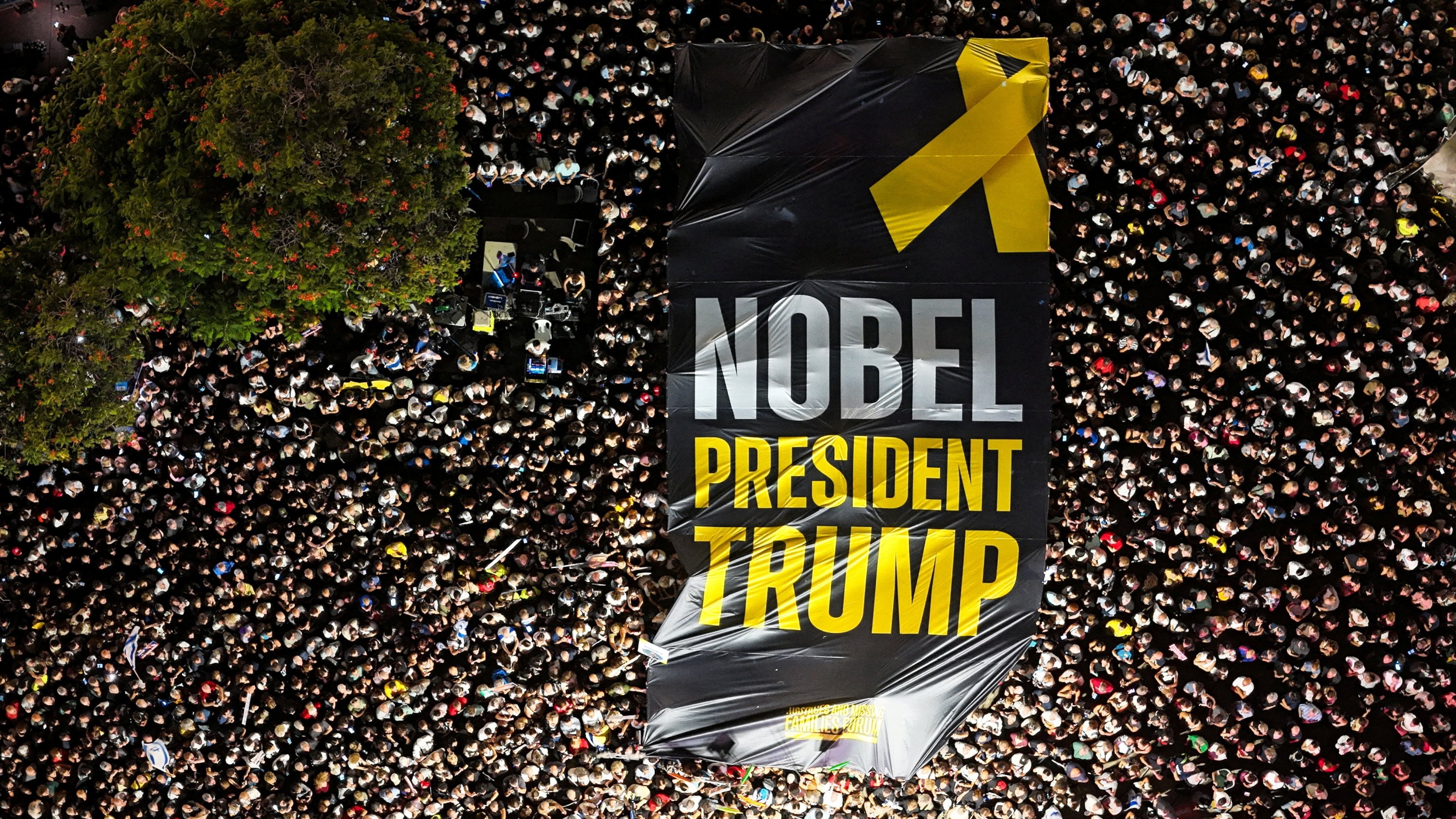
The 2025 Nobel Peace Prize, announced last Friday, was awarded to Maria Corina Machado, leader of the opposition in Venezuela. There was significant public interest in the outcome before the announcement, largely because U.S. President Donald Trump had been nominated for the prize by no fewer than four countries: Pakistan, Israel, Cambodia and Argentina.
The nominations for the prize are normally kept secret, but are foretold by those who make the nominations. In March 2025, the Nobel Committee disclosed that it received 338 nominations for the 2025 Nobel Peace Prize, of which 244 were for individuals and 94 for organizations.
The announcement of Machado as the winner was a snub to the supporters of President Trump. He had earlier said that he deserved the prize for ending the wars in the world, some of which could involve nuclear weapons. President Trump also did extraordinary groundwork in the margins of the U.N. General Assembly (UNGA) in New York to work on a peace plan for Gaza, which had the support of eight other countries. The plan was announced by him days before the Nobel Committee reached its decision and got the crucial agreement of Prime Minister Benjamin Netanyahu, as well as Hamas, on Oct. 9, to reach a permanent cease-fire, return all hostages, and begin the task of rebuilding Gaza under a neutral Palestinian administration supported by an international stabilization force. On the eve of the Nobel Committee’s announcement, President Trump also announced his intention to visit Israel and Egypt to seal the peace deal.
In the last 26 years since the start of this millennium, the Nobel Committee has awarded the coveted peace prize to six heads of state and government (President Kim Dae-jung of South Korea in 2000, U.S. President Jimmy Carter in 2002, President Martti Ahtisaari of Finland in 2008, U.S. President Barack Obama in 2009, President Juan Manuel Santos of Columbia in 2016, and Prime Minister Abiy Ahmed of Ethiopia in 2019); six international organizations (International Panel on Climate Change, the U.N., IAEA, WFP, EU and OPCW); and 14 individuals and NGOs representing human rights lawyers, peace and democracy activists, advocates for women’s rights, right to children’s education, end of sexual violence as a weapon of war and promotion of peace, reconciliation and economic development.
This year, the Nobel Committee has not done the prize any favor by selecting an opposition leader from 193 countries as the winner. If service to democracy were indeed its criteria for this year's prize, there were better examples to select an organization promoting democracy and good governance, or another opposition leader from the list of nominees before it. For example, Pakistan’s former Prime Minister Imran Khan, whose party’s ability to contest the 2024 general election on a level playing field was limited, as stated by the recently released Commonwealth election observation report, and who remains in jail. Compared to him, Ms. Machado was not allowed to contest the last election in Venezuela, so it is uncertain that she would have beaten President Nicolas Maduro in the poll. Additionally, she is not incarcerated in jail but is in voluntary hiding.
Even the decision of the Nobel Committee to award the peace prize to President Barack Obama in 2009 was not met with great welcome. Contrary to what the citation of the prize said: “for his extraordinary efforts to strengthen international diplomacy and cooperation between peoples,” President Obama did nothing for world peace except to make great speeches that raised the hopes of the international community about his contribution to peace, which fell short of popular expectations in Africa, Afghanistan and the Middle East.
Compared to him, President Trump did end the war in Afghanistan in his first term through initiating indirect negotiations with the Taliban, and in his second term intervening just in time to end the India-Pakistan war before it could go ugly and enabling quick and decisive resolution of conflicts between the Democratic Republic of the Congo and Rwanda, Cambodia and Thailand, Israel and Iran, Armenia and Azerbaijan, and Israel and Gaza. It is possible that if he ensures that the Israel-Gaza peace lasts, and an end to the Ukraine-Russia war is reached soon, he could still win this prize in 2026.
Coming back to this year’s choice for the Nobel Peace Prize, the most suitable candidate as an individual was U.N. Secretary-General Anthony Guterres, who sat through hundreds of hours of GA and SC sessions to find a solution to the world’s hot conflict zones, in particular Gaza, Somalia, Ukraine, Sudan, Yemen, Iran, Haiti and Myanmar.
In the category of organizations, the U.N. Relief and Works Agency for Palestine Refugees in the Near East (UNRWA) deserved the prize, whose funding was cut in the middle of a war and whose work is crucial for the Palestinians needing humanitarian assistance in the Israeli-occupied territories until a Palestinian state is established. Since the Gaza war started in October 2023, 237 UNRWA staff have been killed in the war, and its ability to work in its mandate territory has been crippled by Israel and the U.S.
Finally, the third most suitable contender for this year’s prize was Qatar, because of its successful mediation record in many conflict areas, not to mention its good offices for Afghanistan in 2021 and Gaza in 2024-25. Qatari diplomats have also done successful mediation in prisoner swaps and promoted peace dialogue in Lebanon, Venezuela, Sudan, Chad, Libya, Somalia and Eritrea. Qatar even took a hit from Israel in October 2025 when it was mediating President Trump’s earlier peace proposal with the Hamas team in Doha. However, after the Israeli airstrike, its Foreign Minister stated that Qatar will not retaliate, nor abandon its long-standing policy of mediation to bring about world peace.
It is not for anyone to tell the Nobel Committee how it should evaluate individuals or organizations, or who should have been nominated for the Peace Prize. However, by its very nature, the Peace Prize, unlike prizes in the fields of science or art, draws significant public interest. International and grassroots best practices that promote and strengthen peace – such as democracy, transparency, public accountability, free and fair elections, the rule of law, conflict resolution efforts, fundamental human rights, press freedoms, humanitarian interventions to prevent crimes against humanity, and respect for international covenants and institutions – are inherently matters of great public concern.
The Nobel Peace Prize should be awarded to individuals and institutions that have a global and strategically significant impact. Not recognizing deserving recipients does not diminish their achievements, but the Nobel Prize carries a global reputation, and its annual Peace Prize is a powerful tool to promote good practices and a broader worldview. We even find ourselves measuring our own or other nations’ worth by the number of awards the Nobel Committee has granted in a field that is critically important in our times. Let us work together to pursue the Nobel Committee’s goal of peace as the greatest hope and objective for all nations and individuals in the years to come.