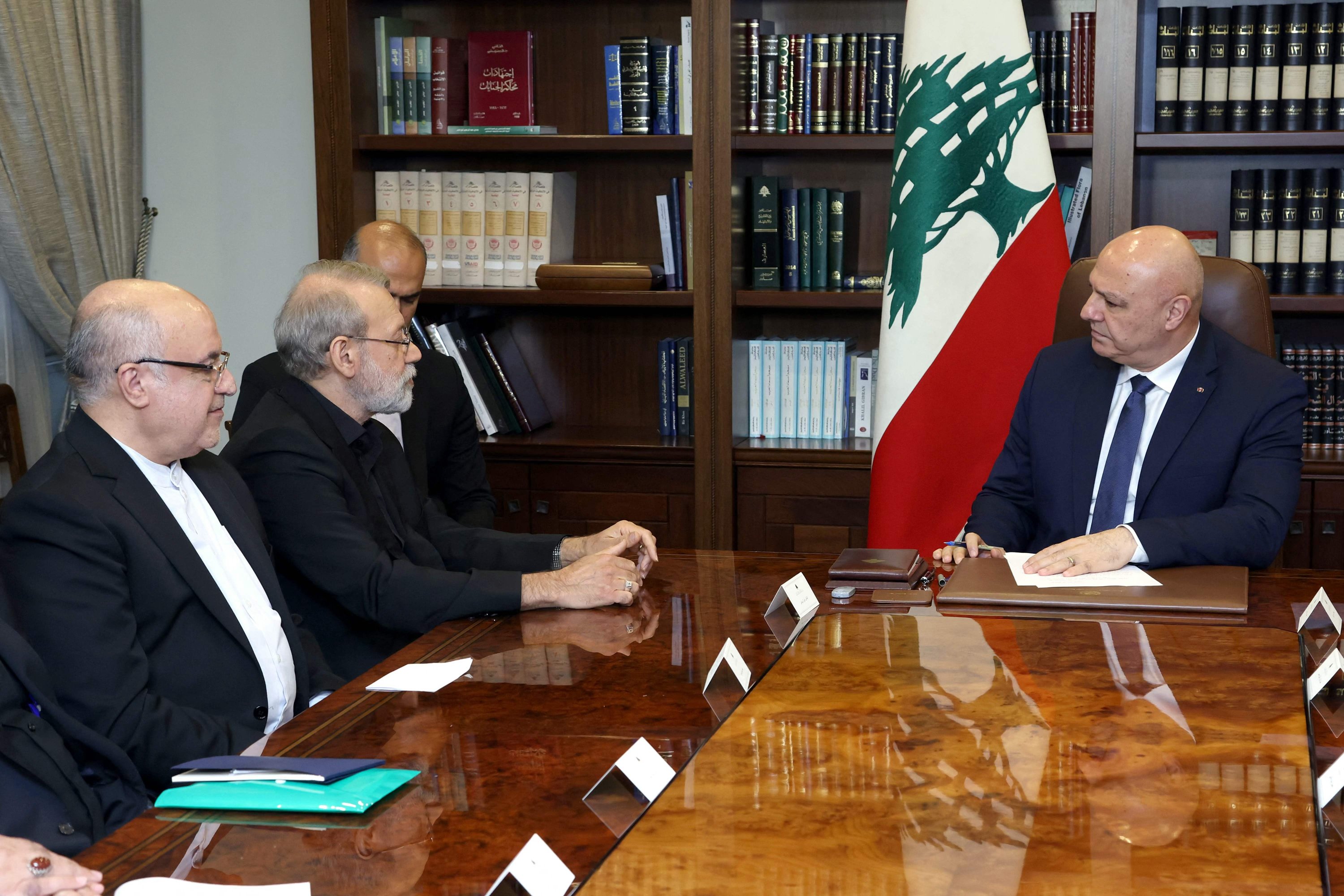
In the period following Oct. 7, as Middle Eastern politics undergo a reshaping, Lebanon has stood out as the most critical "status quo protection zone" for Iran. One of the fundamental pillars of Tehran's regional strategy has long been its influence and deterrence capacity in Lebanon, established through Hezbollah. Yet developments over the past year indicate that this pillar has been significantly compromised. Israel's relentless attacks have had a significant impact on Hezbollah's military capacity, while "the U.S.-led disarmament of Hezbollah" process has emerged as a direct threat to Iran’s presence in Lebanon.
In this context, the visit to Lebanon by Ali Larijani, secretary of Iran's Supreme National Security Council, is not merely a diplomatic engagement; it also symbolizes a measured revision of Iran's "Axis of Resistance" doctrine. The core of the visit lies in a strategic framework aimed at addressing mounting disarmament pressures on Hezbollah.
The Lebanese government's decision, within the framework of the U.S.-backed roadmap, to "place all weapons under state monopoly" has been a shocking development for Hezbollah and, consequently, Iran. The move directly affects both Lebanon’s internal political balance and Tehran’s regional security strategy. Hezbollah Secretary-General Naim Qassem's statement that "We will not lay down our arms as long as Israel does not withdraw and cease its attacks" was the clearest response to the pressure. His remarks, however, go beyond resistance and can also be read as a veiled threat of “internal conflict.”
At this point, Hezbollah, backed by Iran, appears to be taking a more assertive stance in Lebanese domestic politics. That position, however, faces strong opposition from the country’s political elite. President Joseph Aoun said, “Hezbollah laying down its arms is an internal matter for Lebanon. The principle of noninterference in internal affairs is a fundamental tenet of international relations.” The warning can be interpreted as a clear response to Tehran’s perceived influence. Prime Minister Nawaf Salam added that “no group other than the army can have weapons in Lebanon,” signaling that Hezbollah faces not only external pressure but also internal political pushback.
Israel’s stepped-up military operations since 2024 have clearly reduced Hezbollah’s military strength. Once regarded as one of the most formidable forces in the “Axis of Resistance,” Hezbollah has been forced into a more defensive posture. That shift has weakened not only the group’s deterrence but also one of Iran’s key levers in the region.
For Tehran, the main concern now is keeping Hezbollah politically influential despite its military decline. While its conventional armed resistance capacity has diminished, Hezbollah’s political weight still serves as a strategic tool for Iran. In this context, Larijani’s visit underscores the diplomatic and political backing meant to keep Hezbollah from being fully marginalized.
Laricani's visit can be considered as both a response to developments in Lebanon and a concrete manifestation of the change in Iran's "Axis of Resistance" doctrine. The substantial losses incurred by Tehran through its proxies during the 2024-2025 period, combined with the financial strain of Israeli attacks, have forced Iran to recalibrate its strategy.
This was made clear in Larijani’s remark: “Resistance groups do not require a patron. It is evident that Iran does not exercise any form of command over them.” The statement was more than diplomatic courtesy; it signaled a strategic shift. Iran is now pursuing a policy that gives its proxies greater autonomy in securing their own defenses while gradually scaling back direct support. The stated goals are twofold: to prioritize Iran’s national security and to reduce the vulnerabilities created by deep involvement in regional conflicts.
Iran’s priority in Lebanon has shifted from expansion to preserving the political and social order. Tehran aims to maintain a symbolic line of resistance against Israel and the United States. To do that, it must ensure Hezbollah’s political survival, even as the group faces military setbacks. Hezbollah’s role in Lebanon’s domestic politics continues to provide Iran with strategic depth.
The sustainability of this approach, however, is uncertain. Ongoing clashes in the region, particularly Israel’s intensified attacks and the Lebanese government’s push to disarm Hezbollah, have sharply narrowed the group’s room to maneuver. For now, Iran is trying to sustain its influence through political and diplomatic channels while reducing direct military aid.
Larijani’s trip represents a strategic effort to keep Iran from losing all ground in Lebanon. At the same time, it highlights a rhetorical shift: Tehran has been forced into a more measured version of its resistance narrative. For Iran, the struggle in Lebanon is no longer about gaining ground but about preserving its position and minimizing losses.
The period after Oct. 7 has tested Iran’s influence in Lebanon more severely than before. Pressure to disarm Hezbollah, the group’s declining military strength, and rising domestic opposition in Lebanon have all pushed Tehran to rethink its traditional strategy. Larijani’s visit marks the formal announcement of this new phase, at both the diplomatic and ideological levels: Iran is moving from claiming absolute patronage to offering conditional, measured support.
Whether this new approach stabilizes Lebanon or fuels further tensions remains uncertain. What is clear is that Iran now operates in Lebanon with a strategy of protection rather than expansion. This signals a significant shift in its regional policy.