Trade between China and Europe is vast, valued at over 750 billion-800 billion pounds ($1.01 trillion-$1.08 trillion) yearly in goods alone, but the arteries of this commerce are fragile. Approximately 60% of China-Europe container trade transits via the Suez Canal and Red Sea, passages that remain two of the world’s most critical and vulnerable chokepoints. The grounding of the container ship, Ever Given, in 2021 brought global supply chains to a halt. Since 2023, Houthi attacks in the Red Sea have again reminded the world how fragile the route is, driving up insurance costs and forcing some ships to reroute around Africa, stretching transit times to nearly a month.
Overland options are equally constrained. The Eurasian rail corridors that cut across Russia once offered a faster alternative, with travel times of 15 to 20 days, compared to 30-40 days by ship, but they are now politically toxic. Sanctions on Russia and Belarus, instability in Minsk and Ukraine’s long-range drone strikes on Russian infrastructure make investors wary. Even before the war, Russian rail had broad-gauge tracks incompatible with Europe’s standard gauge, forcing every container to reload at the Belarus-Poland border and congestion on the Trans-Siberian railway was already crowded with coal and oil shipments.
The Middle Corridor, stretching through Kazakhstan, across the Caspian Sea, into Azerbaijan, Georgia and Türkiye, has been promoted as an alternative option. It enjoys strong geopolitical support from the EU, Türkiye and NATO, yet multiple borders, fragmented regulations and the costly and unstable Caspian ferry crossing make it a bottleneck in itself. Even if improved, it remains vulnerable to pressure from both Russia and Iran, which flank its geography.
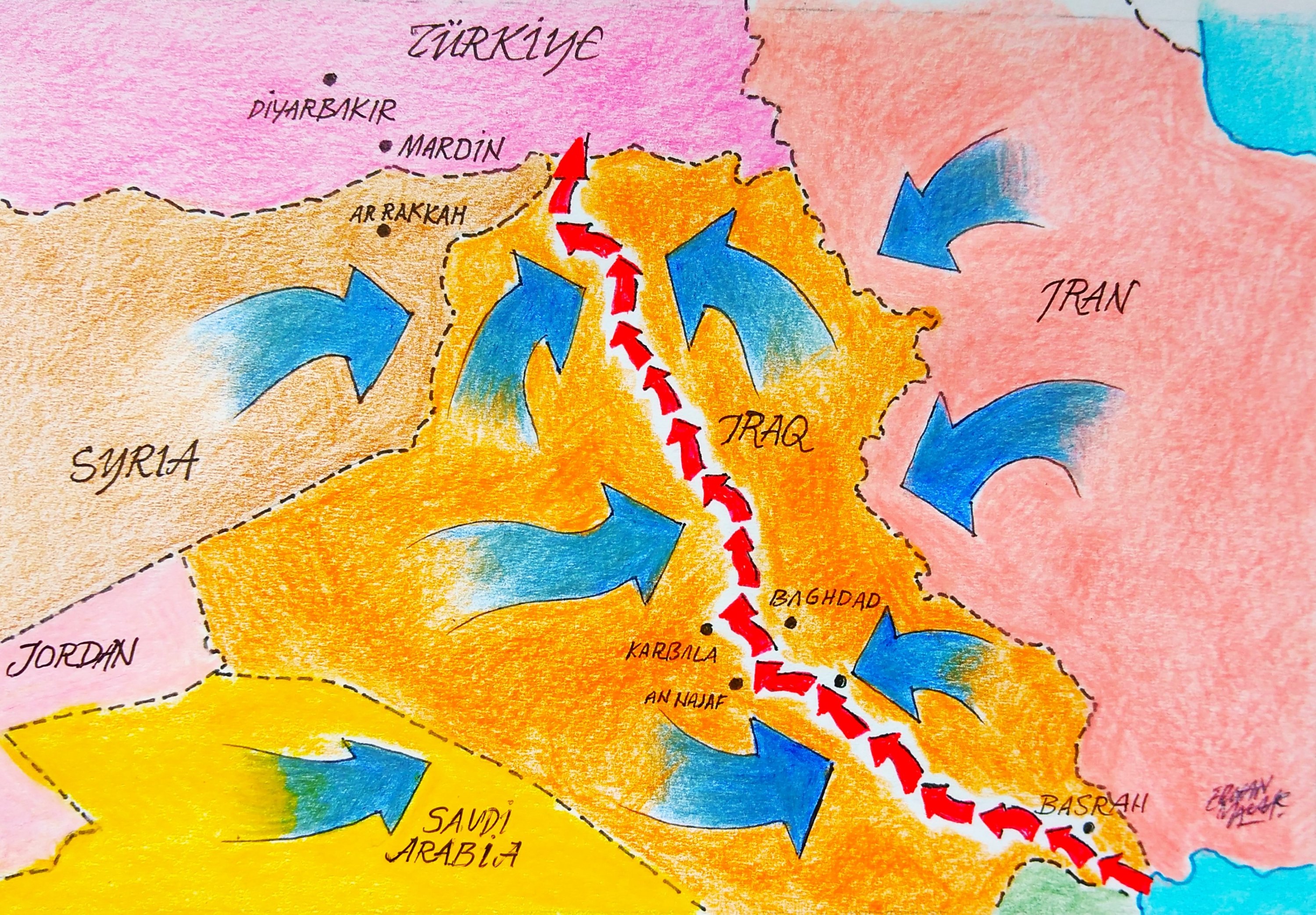
Faced with this map of constraints, Iraq has revived long-buried “Dry Canal” vision under a new name: the Development Road Project.
Iraq first floated the “Dry Canal” concept in the 1980s, but wars, sanctions, civil wars and terrorist organizations buried it. The project was formally announced in 2010, but budget shortages and conflicts delayed progress. In 2020, then-Prime Minister Mustafa al-Kadhimi relaunched momentum. In 2023, Prime Minister Mohammed Shia Al Sudani and President Recep Tayyip Erdoğan signed the Ankara Declaration. In April 2024, Erdoğan returned to Baghdad, where Iraq, Türkiye, Qatar and the UAE signed a quadrilateral memorandum of understanding.
At the heart of the Development Road lies the Grand Faw Port, under construction near Basra. Upon completion, it will be the largest container port in the Middle East with 90 berths, surpassing Dubai’s Jebel Ali. Iraq also plans to host a large naval base there, signaling that the project is about sovereignty as much as trade.
Pilot TIR (Transports Internationaux Routiers) operations between Türkiye’s Mersin port and Iraq’s Umm Qasr have already demonstrated the corridor’s feasibility, with sealed trucks crossing borders with minimal customs checks. They completed the journey in under a week. Compared to the 14-day route via the Red Sea or the 26-day route around Africa, the savings are substantial. For China-Europe trade, the Development Road could shave up to 15 days off maritime routes.
For Iraq, the project offers more than logistics. It is expected to generate $4 billion annually and create 100,000 jobs, directly addressing one of Iraq’s deepest challenges: its chronically high youth unemployment rate. In a country where disillusioned young men often become recruits for radical militias or Daesh offshoots, steady employment could be a bulwark against extremism.
The Development Road could also be Iraq’s ticket to economic diversification, moving beyond oil dependency. Industrial parks, free trade zones and logistics hubs planned along the corridor would tie Iraq into global supply chains, while new housing and urban centers could channel domestic growth. In the long run, Baghdad hopes the project will help address structural and climate-related challenges, from desertification to unsustainable reliance on hydrocarbons, by embedding Iraq in a more resilient economy. Strategically, it could give Iraq new independence, reducing dependence on oil rents and foreign aid, and strengthening Baghdad’s bargaining power vis-a-vis its neighbors.
The route must cross politically sensitive terrain. Contrary to popular belief, Türkiye has no direct border with the areas of Iraq under the federal government’s authority. The proposed Ovaköy crossing falls under the jurisdiction of the Kurdistan Regional Government (KRG). At least 11 kilometers (6.5 miles) of the corridor must run through KRG territory.
The current design skirts major Kurdish cities, which the KRG rejects. Irbil and Duhok argue the road should pass through their territories, a path that would be 32 kilometers shorter and arguably safer. Yet, this would give the KRG leverage over Baghdad, allowing it to use the corridor as a bargaining power in disputes over oil revenues and governance. If integrated well, the Development Road could stabilize Baghdad-Erbil relations; if mishandled, it could become another flashpoint.
The corridor will pass near Shiite heartlands, where Iran-backed militias operate and alongside Sunni areas vulnerable to Daesh remnants on the western flank. Long stretches of road and rail will be difficult to secure. Corruption in Iraq’s institutions compounds the problem, and training sufficient technical and security personnel will take years.
Geography adds further fragility. The Faw Peninsula is a narrow strip wedged between Kuwait and Iran. To the west lies the disputed Khor Abdullah waterway, where Kuwait’s Mubarak al-Kabeer Port threatens to compete with Faw. To the east, Iran’s restive Ahwaz region and the proximity of Iranian forces make the area militarily exposed. In any armed conflict, Faw, with its naval base, would be among the first targets. Iran, already excluded from most global transportation projects, has every incentive to destabilize the corridor while pushing for China’s Belt and Road routes through Pakistan and Iran.
The Development Road enters a crowded field. Alongside the Middle Corridor and the Trans-Siberian route, another rival is the India-Middle East-Europe Economic Corridor (IMEC), backed by the U.S. and the EU, which aims to link India with Europe via Gulf ports, Israel and Jordan. However, the Gaza War has crippled Arab-Israeli normalization, and this route will naturally have objections from many pro-Palestinian countries in the region.
For Egypt, the Development Road is a threat. The Suez Canal provides hard currency, and any route cutting 15 days off the Shanghai-Rotterdam trade undermines Cairo’s economic lifeline. For Kuwait, Faw’s rise poses a threat to Mubarak al-Kabeer Port. For Iran, the project sidelines its Gulf ports and risks tilting Iraq deeper into Ankara’s and the Gulf’s orbit. Each of these neighbors has incentives to resist or reshape the project.
Iran, Russia, and India promote their North-South Corridor, but sanctions, long distances, and the Caspian Sea limit its appeal. China’s Belt and Road Initiative (BRI) maintains multiple options, including a northern route via Russia, a middle route via the Caspian, a southern route via Iran, and a maritime route via the Suez Canal. For Beijing, redundancy is a strategy: every corridor counts.
The Development Road promises to diversify Iraq, promote youth employment, foster regional integration, and achieve strategic independence. It could stabilize relations with the KRG and provide Türkiye and the Gulf with a shared stake in Iraq’s stability.
Yet vulnerabilities are built into its geography. It sits on a tiny strip of coast flanked by rivals, within reach of Iranian militias and ethnic unrest, with domestic corruption and instability still unresolved. A corridor designed to bypass chokepoints could itself become a new one.
Still, the logic of global trade is inexorable. With Russia blocked, the Red Sea unsafe and the Suez vulnerable, every alternative matters, and China welcomes all new routes to keep its goods flowing to Europe. For Baghdad, the Development Road is not just a megaproject; it is a bet on the future of Iraq itself.