The Middle East has always been crucial for Italy, given its geographical proximity and carved-out interests. Historically, but especially in the most recent times, the Italian diplomatic activity, also under the European umbrella, has attempted to react to the new dynamics of the entire global system with particular repercussions on regional balances. In an increasingly complex global environment, given the high number of issues and actors, as well as the progressive erosion of great powers and the main international players, there are several challenges. Among the others, wars, tensions and conventional and hybrid threats contribute to regional and global instability and unpredictability, forcing diplomacy to experiment with new courses.
Today, the Middle East is the region that, more than any other, is unfortunately experiencing divisions, conflicts and humanitarian catastrophes, with the risk of further escalation. Although the peace process in Palestine has always been an unavoidable condition for any prospect of regional just and lasting peace, along with the Israeli war, we are currently witnessing a new historical phase undermining any tool of dialogue and any sustainable and inclusive solution. For a year now, Israel's war on Gaza, along with its enlargement to Lebanon and eventually to the region, proves the international ineffectiveness in creating the conditions for a cease-fire. In such a fractured and polarising framework, where the risk of further spillovers is tangible, Italy shows a peculiar diplomatic zeal aiming at ending the hostilities and creating solid conditions for the "two-state" solution to the Israeli-Palestinian conflict.
The humanitarian situation in Gaza, the stabilization of the Israeli-Lebanese border, including the safety of U.N. Interim Force in Lebanon (UNIFIL) personnel, the Syrian refugee crisis, and the containment of new humanitarian crises and related migratory flows are to be intended as pushing factors to the Italian government's efforts. In recent weeks, Italy has shown an increasing engagement in the regional dynamics, attributable to the Israeli attack on the UNIFIL base in Lebanon.
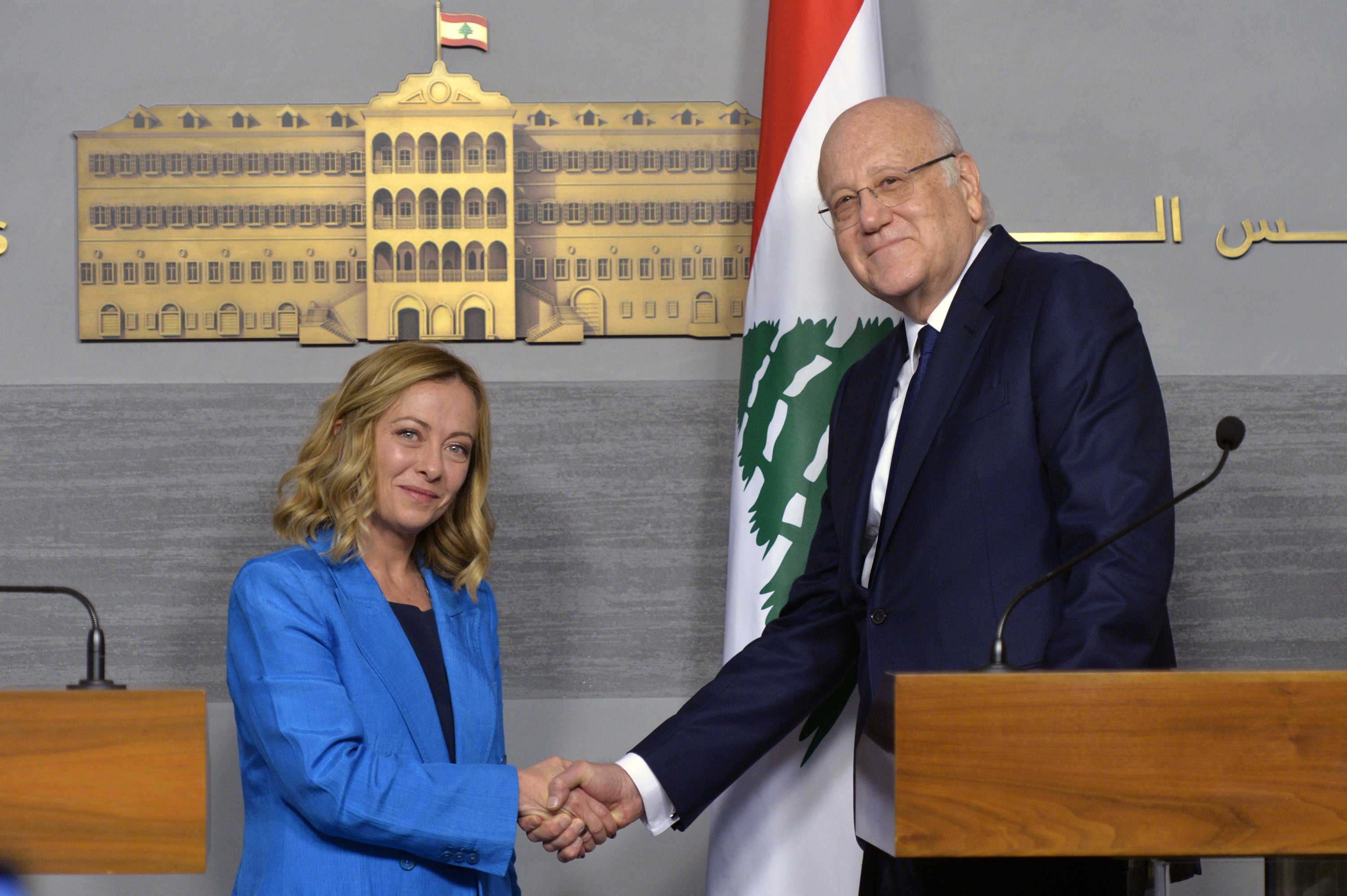
While Italian government officials harshly declared their disappointment with Israeli actions, carried out in violation of U.N. resolutions, Prime Minister Giorgia Meloni embarked on some trips to the Middle East. After participating in the EU-Gulf countries summit and at the European Council, Meloni traveled to Jordan, where she met King Abdallah II, and then she reached Lebanon, where she had a meeting with Lebanese Prime Minister Najib Mikati and the president of the National Assembly, Nabih Berri. The timing was significant as Meloni, in addition to representing Italy, also aimed to become a spokesperson for the EU.
The trip to Jordan is to be understood as an endorsement to a country considered fundamental for the stability of the region in its commitment to reducing tension but also in containing the humanitarian situation in Gaza, in delivering humanitarian aid and in preventing the worsening of the already dramatic situation. Meloni assured, "Italy's commitment to achieving a de-escalation and a cease-fire, even if temporary." She also reiterated the need for full implementation of U.N. Resolution 1701, which legitimizes the peacekeeping mission to assist the Lebanese army in keeping its southern border area with Israel free of weapons or armed personnel other than those of the Lebanese state.
In Lebanon, the proposal for a 21-day truce was put forward, and Meloni explicitly called for "an effort on the Israeli side," which was de facto declined. Actually, Italy's main concern is the safety of the Italian contingents in UNIFIL, which was deliberately hit by Israel. Since the Italian soldiers play an important role, the aim is to strengthen their presence in the training activity for the Lebanese armed forces. Hence, the safety of the soldiers both in UNIFIL and within the bilateral mission is an inviolable condition. And for Italy, it is intolerable that they become the target of Israel.
The Italian diplomatic efforts, in other words, aim at the full implementation of Resolution 1701, strengthening the full capacity of UNIFIL and the Lebanese Armed Forces. Those points were also reiterated by Foreign Minister Antonio Tajani, who, in parallel with Meloni's trips, paid a visit to Israel, where he met with Prime Minister Benyamin Netanyahu and Foreign Minister Israel Katz, while in Ramallah, he met with Palestinian Prime Minister Mohammad Mustafa. The main topic of discussion with Israel was the inviolability of UNIFIL personnel.
Besides, Tajani presented a plan for Lebanon aiming to reinforce the Lebanese army, which has already been trained by the Italian contingent in Beirut, and then to create a new UNIFIL buffer zone. Furthermore, particular attention was paid to the "Food for Gaza" project, which encountered the support of Israel, who apparently declared its commitment to allowing Italian trucks to carry food and medical supplies to the strip.
The Italian government is determined to support its soldiers in Lebanon who are stationed in UNIFIL. This is a mission that has proven to be complex from the start, but today, the implementation of the mandate is showing some limits. In Lebanon, there are over a thousand Italian soldiers, both in force in the UNIFIL and in the bilateral missions; they are more than half of all the Italian soldiers operating in the whole Middle East. This gives a dimension of the importance granted to Lebanon.
Indeed, to date, the presence of Italians in the missions in Lebanon has been a deterrent to the expansion of the conflict, and pivoting on this, Italy is investing in dialogue between the parties. Today, UNIFIL involves 10,000 soldiers from 47 different countries. Launched under the U.N. Security Council Resolution 425 (1978), the UNIFIL has seen Italian participation since 1979. Over the years, the mission has been regularly extended, and in 2022, the presence of the Italians was reduced to 1,169 soldiers, 368 land vehicles, seven aircraft and one ship. The tasks include assisting civilians by ensuring access to humanitarian aid and a safe return to displaced persons. Nevertheless, if hindered in carrying out its tasks or in case of danger and threat to its personnel, civilians and humanitarian workers, UNIFIL can intervene "with force."
Currently, UNIFIL operations are based on control through checkpoints, monitoring and observation through fixed posts and patrolling, all in coordination with the local armed forces. Actually, since the 2006 war to Oct. 7, 2023, the area has experienced a period of stability, but currently, the situation is quite fragile and at risk of further exacerbation due to the constant attacks and provocatory Israeli moves. All of this has created much alarm and rethinking of the rules of engagement since they do not provide safety conditions, as is underlined by the Italian government.
Besides UNIFIL, since March 2015, Italy has also been present in Mibil in a U.N.-supported mission, which is part of the intervention carried out by the "International Support Group for Lebanon" (ISG). The mission consists of 190 units that can also count on a naval vessel and an air vehicle. The aim is to provide support to Lebanon following the socio-economic consequences resulting from the conflict in Syria, which broke out in 2011.
The intervention aims to mitigate and avoid repercussions on the stability and security of the country, as decided by the international community. The main goal is supporting Lebanon, which, together with Türkiye, has suffered most of the consequences of the war in Syria. It is precisely in this last operational area that the Italian bilateral mission has set up a training center in southern Lebanon, which is managed by Alpine paratrooper instructors and Carabinieri.
As peacekeeping and capacity building are priorities in Italy's diplomatic agenda, after a request made by U.S. Secretary of State Blinken, the Italian government is also considering the possibility of sending 200 Carabinieri to train the Palestinian police forces in Jericho. However, nothing has been decided yet due to the complexity of the regional chessboard.
As Italy shows some balanced diplomatic attitude, it is worth mentioning that the dialogue with Israel has never halted. Nevertheless, in light of the most recent escalation in Lebanon, some criticism has emerged, including statements regarding the suspension of any new export license to Israel. As the region is becoming hot, Italy's engagement must be read through the lenses of the protection of national interest and the renewed attitude aimed at making Italy a European pivot in building dialogue and peace.