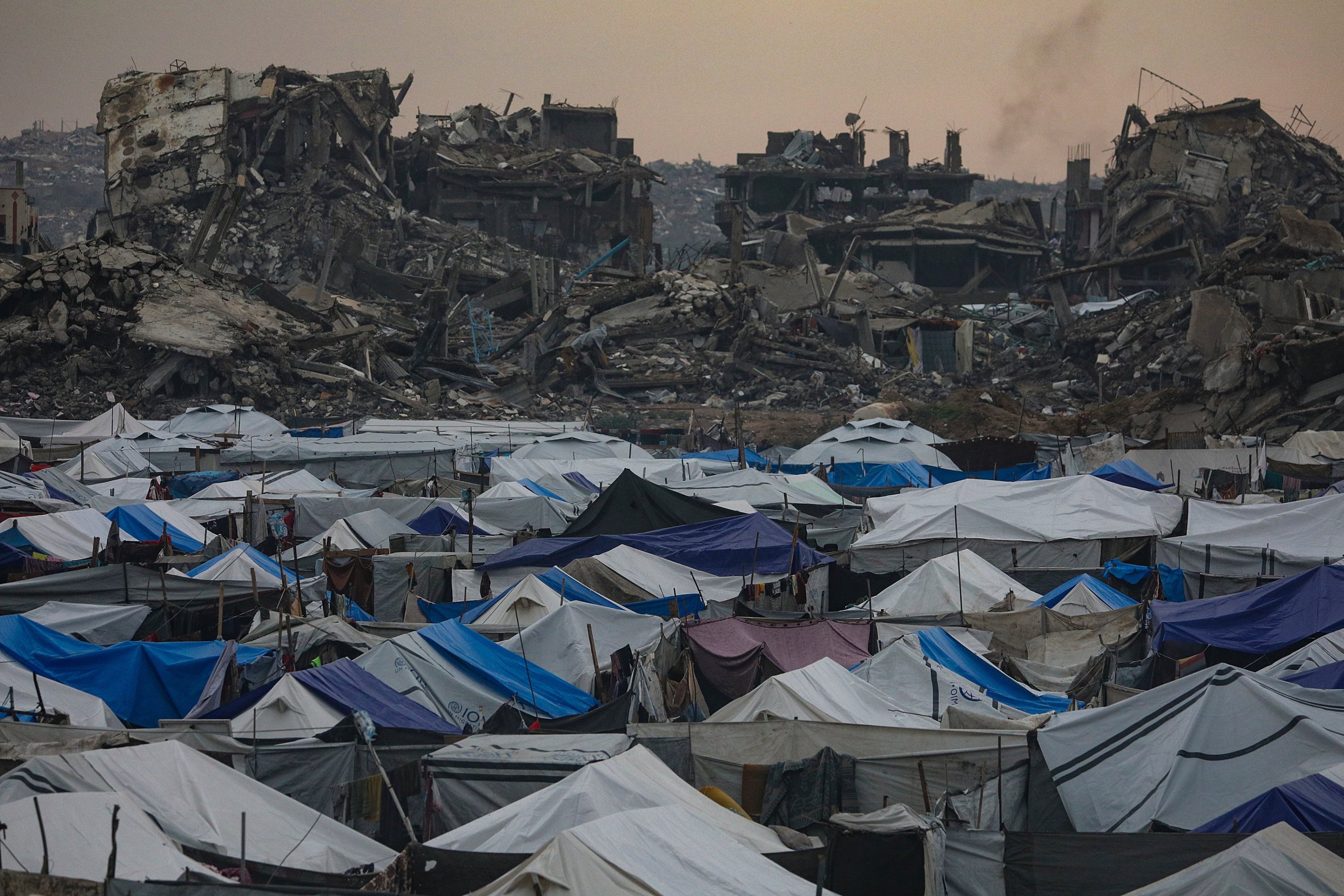
When the United Nations announced that Justice S. Muralidhar would lead its independent inquiry into human rights violations in Palestine, it was more than an international appointment.
It felt like the world had paused to acknowledge a jurist who built his reputation not on power or position, but on conscience. From taking on corporate giants in the Bhopal Gas Tragedy case (1984 toxic gas leak catastrophe that killed tens of thousands of people) to dispensing justice to the 2020 Delhi riots victims, Justice Muralidhar has walked a path few judges choose.
His new responsibility, however, sits on a much larger map: Gaza, Israel, East Jerusalem and the weight of history itself.
Across India’s legal community, the announcement drew joy, pride and relief. Many who have watched Justice Muralidhar closely felt this was long overdue. For years, he has been described as a judge who combines scholarship with compassion, intellect with humility and courage with judicial restraint. His appointment represents more than an international responsibility. It is a nod from the global community to a jurist who, despite political headwinds at home, never strayed from principle.
Sanjay Hegde, senior advocate at the Supreme Court of India, put it succinctly when I spoke with him. He remembered Justice Muralidhar’s role during the Delhi riots in 2020, when ambulances were sent into violence-scarred neighborhoods only after his urgent intervention, when he held a midnight hearing to save dozens of lives. “Because of that, he was later not brought to the Supreme Court of India,” Hegde said.
“His appointment as Chair of the three-member Independent International Commission of Inquiry on the Occupied Palestinian Territory is recognition of his achievement in human rights and his commitment to human causes of misery.”
Hegde’s words reflect a sentiment widely shared in Delhi’s legal circles: Muralidhar should have been in the Supreme Court, but the world has now given him a bench larger than any he was offered in India.
Born into a generation of lawyers who believed law exists to protect the powerless, Muralidhar began practice in Madras, in India’s south, in 1984 before shifting to the Supreme Court and the Delhi High Court three years later. His legal journey was not confined to courtrooms. He worked with victims of the Bhopal gas tragedy, people displaced by dams on the Narmada, prisoners on death row, the National Human Rights Commission, and the Election Commission of India. For him, law is a tool of justice for the vulnerable rather than a shield of comfort for the powerful.
Veteran journalist Qurban Ali, who has observed him closely for years, described his work with admiration: “Unfortunately, he was not allowed to reach the Supreme Court of India, but his value is now being recognized globally.” To him, Muralidhar’s role in the Palestine inquiry will test not just diplomatic patience but moral courage. “There will be political pressure, but his impartiality gives us hope. The world needs investigators who cannot be bent.”
His independence was never performative; it was lived. Long before such reforms became fashionable, he encouraged lawyers to stop addressing judges as "My Lord" or "Your Lordship." It was not a theatrical rebellion, but a quiet assertion of dignity, reflecting the way he understood the judicial role.
His writings strengthen that image. His recent book, “In Complete Justice? The Supreme Court at 75," examines the court with honesty and affection, while his earlier work, “Law, Poverty and Legal Aid: Access to Criminal Justice,” remains required reading for those studying criminal justice and inequality. His scholarship is not an academic display. It is grounded in the lived experience of those for whom law is either a lifeline or a dead end.
Leading a human-rights inquiry into the Israel-Palestine conflict is not an administrative honor. It is a responsibility that attracts both scrutiny and hostility. The world will watch every word and every conclusion he leads his commission toward. Nations will weigh diplomacy against morality. Victims will hope. Governments may resist. And political power will clash with legal truth.
Yet, this is where Justice Muralidhar seems least afraid.
In his farewell speech from the Delhi High Court, he drew a line between neutrality and justice. “Impartiality is non-compromisable,” he said.
“A judge must lean on the side of the vulnerable to achieve equality of arms.” That statement explains why the U.N. chose him and why millions now expect him to bring justice into a conflict defined by asymmetry.
For India, this is a moment of global reflection. While New Delhi deepens its relationship with Israel, one of its most respected jurists now leads a global inquiry into human rights violations by that very state. The duality is real, and the message is larger: India’s constitutional conscience still has global resonance.
The world does not often celebrate judges. They work without applause, write judgments that outlive them, and guard justice without the luxury of victory. But when a judge stands tall in the storm, the world notices.
Justice S. Muralidhar is now at such a moment. The inquiry he leads will be contested, criticized and politicized. Yet somewhere in the chaos, there lies the possibility of truth. He has carried integrity from Madras to Delhi, from Hashimpura to Odisha, and now from India to the world’s most fraught front line.
If justice has a flicker left in global public life, it will reflect in his work. And if his past is any guide, he will not look away. The world will be watching. More importantly, the vulnerable will be waiting.