Much of what shocks today was already there, simply unseen...
In a city cafe, between morning and afternoon, a man scrolls through his phone while his coffee cools without notice. News moves easily. Wars, markets, opinions, certainties all line up on a small screen. He looks informed, perhaps even settled in his views. Yet, when he stands up and leaves, nothing seems to follow him. No lasting question. No inner discomfort. Just motion.
Almost as a new habit of consumption, this scene is no longer unusual. It has become familiar. Almost expected.
Information is everywhere now. It arrives faster, sounds louder and asks for less effort than before. Still, understanding feels weaker. Names are familiar, arguments repeated, positions taken with ease. What is often missing is patience. Patience for causes, for limits, for meaning itself. This is not about intelligence. It is about depth, and how quietly it fades.
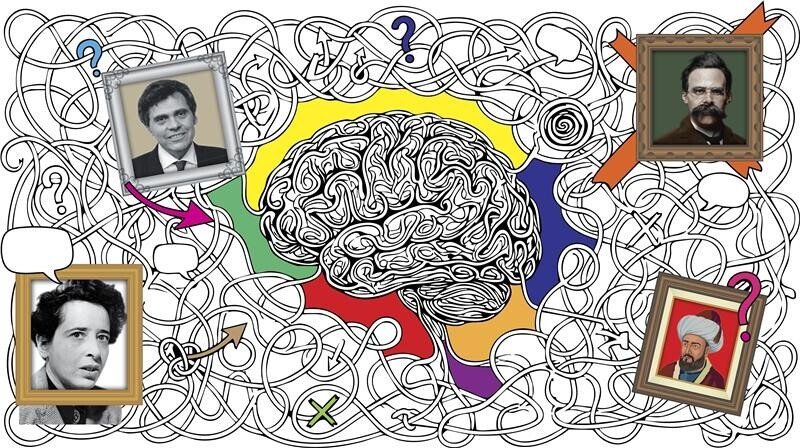
Writing in the late 11th century, Al-Ghazali, one of the greatest scholars of Islam, warned about such a danger. For him, learning was never about collecting information. It was a process of refinement. Knowledge that does not shape conduct or intention turns into a burden. His warning does not belong to another age alone. It feels close to daily habits. Information gathers quickly, like luggage packed in haste, while the destination slowly disappears.
The problem, then, is not information itself. It is speed. Everything arrives too quickly to settle. Reflection needs silence, yet silence has become rare. Opinions form before questions grow. Certainty is praised, hesitation seen as weakness. In such an environment, ignorance does not appear empty. It appears confident.
Much later, in 20th-century Europe, Hannah Arendt, a German-born thinker shaped by the political disasters of her time, focused on a different risk. Her concern was not the amount of information, but the suspension of thinking itself. When people stop examining what they hear and begin repeating it, judgment weakens. Responsibility does not collapse loudly. It fades. Harm no longer requires a strong belief. Habit becomes enough.
In the U.S., some decades later, Neil Postman noticed a similar shift. Writing in the late 20th century, he described how information detached from purpose turns into entertainment. Serious matters lose weight. Everything feels urgent, yet little feels important. Attention breaks apart. Meaning grows thin.
Even earlier, in 19th-century Germany, Friedrich Nietzsche, a name familiar to almost every reader, sensed another kind of exhaustion. A mind exposed to too much, too quickly, grows tired of meaning itself. When every view speaks at once, direction disappears. What remains is not openness, but fatigue.
These voices do not echo one another. They speak from different centuries and traditions. Still, they point toward a shared concern. Knowledge without balance weakens judgment. Information without pause flattens thought.
Older traditions, shaped long before modern technology, shared a simple understanding. Learning takes time. Not everything improves when accelerated. Some things require delay. Call it "hikmah" (the Islamic concept of wisdom), balance or judgment. The idea remains the same. Information should settle before it speaks.
There is an old saying, often linked to experienced teachers: if a question is asked too quickly, the answer should wait. It sounds simple. Living by is not.
Many believe the world has grown harsher and more divided. Some changes have certainly taken place. Yet, in many respects, much of what shocks today was already there, simply unseen. What truly changed is not human nature, but visibility. Events now reach us instantly, carried by technologies that place a permanent witness in every pocket.
The flow of information will not slow down. Nor should it. Access is not the problem. The absence of pause is. Understanding begins where speed ends.
Perhaps the response does not require grand solutions. Read less, but think about it longer. Speak less, but listen more closely. Allow uncertainty some space. Not every silence needs filling. Not every thought needs an audience. Knowing more was never the real challenge. Learning how to understand is.