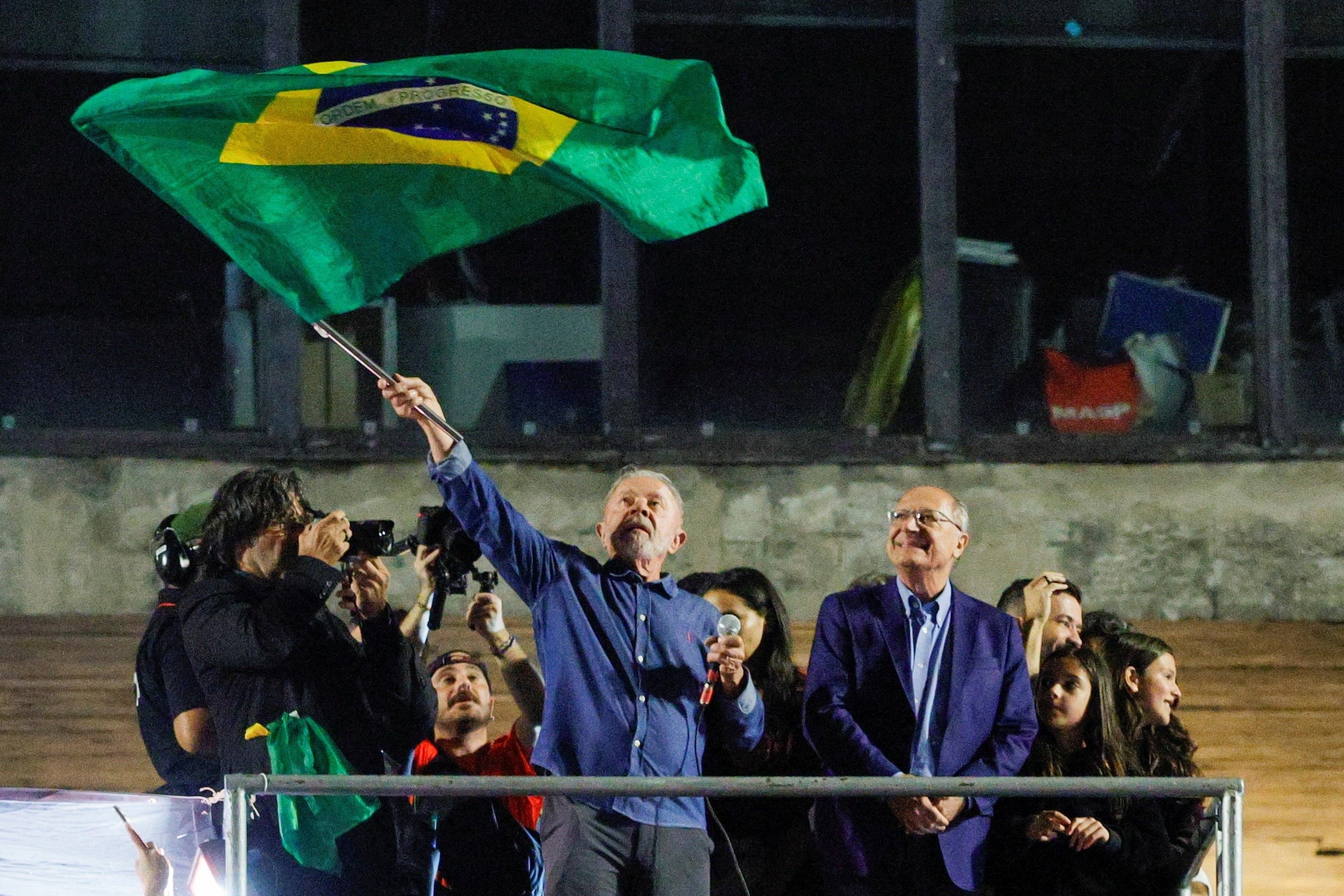
Brazil's leftist President Luiz Inacio Lula Da Silva’s historic reelection on Oct. 25 relieved critics of deepening U.S. influence and the rise of the far-right in the country.
Lula’s defeat of Flavio Bolsonaro, right-wing senator and son of former President Jair Bolsonaro, who is serving a 27-year prison sentence for plotting a coup, comes after a bitterly fought campaign. Bolsonaro led the first round with 47.03% of the vote, ahead of Lula, who received 45.16%. However, Lula won the runoff with 51.79%, defeating his rival, who received 48.21%. This marked the first time in Brazil’s history that a candidate who finished second in the first round went on to win the runoff.
For Brazil, Lula’s win means democratic stability, the preservation of geopolitical alliances and the enforcement of environmental laws. For Latin America, it means a departure from the recent regional trend where right-wing leaders won seven out of eight presidential races.
However, it does not signal an end to "Bolsonarismo," a far-right movement rooted in deep-seated anti-left sentiment, economic ultra-liberalism, social conservatism, institutional scepticism and hardline security populism, but rather its containment.
Although Lula’s victory protects Brazil’s strategic autonomy, domestic divisions and regional ideological isolation, amid expanding U.S. influence, impose structural constraints on its counterhegemonic ambitions.
Lula’s victory contained the far-right without dismantling the political machinery behind it. Flavio Bolsonaro’s 48.21% of the vote, after leading the first round, demonstrates that Bolsonarismo has survived Jair Bolsonaro’s imprisonment and remains capable of mobilizing nearly half the electorate. Its defeat at the ballot box is therefore not a political defeat. The movement retains a mass electoral base, financial resources and institutional footholds.
Bolsonaro’s Liberal Party (PL) secured the largest single-party representation in both chambers, with 121 deputies and 28 senators. However, legislative control will depend on alliances with the powerful Centrao and conservative caucuses representing agribusiness, evangelical constituencies, security interests and business sectors.
Their competing priorities threaten to dilute Lula’s agenda: Agribusiness lawmakers have opposed restrictions on deforestation and Indigenous land use, market-oriented legislators resist higher taxation and expanded state intervention, while conservative security blocs favor tougher policing and criminal legislation. These divisions could weaken Lula’s environmental protections, restrict industrial policy initiatives and social benefits, and shift the government's security agenda toward more punitive measures.
Lula’s promises to expand housing, provide university stipends and relieve household debt face additional fiscal obstacles. With public debt above 82% of GDP, high interest rates and mandatory expenditures consuming most federal resources, the government has limited room to finance new commitments regardless of congressional opposition. Conservative lawmakers can further narrow that space by resisting revenue measures and defending parliamentary control over budget allocations, forcing Lula to scale back proposals or negotiate costly concessions.
The stakes extend to Brazil’s democratic institutions. Bolsonaro’s allies have targeted Supreme Court Justice Alexandre de Moraes, whose role in prosecuting former president Jair Bolsonaro has made him a central antagonist of the right-wing movement. A sustained campaign against the court threatens to turn the judiciary into another battleground over the limits of executive and judicial power, further destabilizing an already polarized political system.
Although Lula retains executive authority over diplomacy, Congress can obstruct trade agreements and influence international commitments requiring legislative approval, while shaping the industrial, environmental and fiscal policies underpinning Brazil’s international position. Lula’s capacity to resist U.S. pressure and sustain an independent foreign policy will therefore depend partly on his ability to navigate a legislature in which his opponents retain considerable leverage.
Lula’s reelection disrupts Washington’s efforts to reassert U.S. primacy in the Western Hemisphere through U.S. President Donald Trump’s "Donroe Doctrine," which seeks to exclude rival powers such as China and Russia from the region and secure regional alignment with U.S. strategic priorities.
Across Latin America, the United States has used financial and economic leverage, political endorsements and security cooperation to strengthen right-wing governments aligned with its agenda. Trump used financial support to bolster Argentina’s Javier Milei ahead of elections, threatened to condition aid to Honduras on his preferred candidate’s victory and openly endorsed right-wing candidates in Colombia.
These tactics reward political alignment with Washington’s economic and security agenda, advancing a regional model built around market deregulation, austerity and punitive security policies. Lula remains one of the last bastions against this regional trajectory.
Washington’s pressure on Brazil has been both electoral and economic. The Trump administration pursued efforts to return the Bolsonaro family to power and reportedly earmarked $1 million for projects opposing what it characterized as judicial overreach and censorship by the Supreme Court. In 2025, Trump imposed a 50% tariff on most Brazilian imports, explicitly linking the measure to what he described as political persecution of Bolsonaro. These measures weaponized economic interdependence and financial leverage to pressure Brazil’s institutions while seeking to benefit the political forces opposing Lula.
Moreover, recent investigations found that Meta ran 1,613 irregular political ads in Brazil between July and September 2026, with 98.1% of ads with identifiable funding origins linked to the U.S. Separately, researchers also found that Meta approved AI-generated election disinformation submitted from a U.S. account, including false content involving Trump and Flavio Bolsonaro. These findings exposed potential channels for foreign interference through U.S.-based political advertising and Meta’s failure to prevent electoral manipulation.
Lula made sovereignty central to his campaign, turning resistance to U.S. interference into a defence of Brazil’s self-determination. His victory preserves Brazil’s commitment to BRICS and its strategic partnership with China, which accounts for nearly 29% of Brazilian exports, compared with approximately 11% destined for the U.S. But commercial diversification does not remove Brazil’s exposure to U.S. tariffs, investment and technology.
The contradiction is that Lula must defend strategic autonomy without sacrificing the economic recovery and social programs on which his domestic support depends. If resistance to U.S. pressure imposes substantial economic costs, the sovereignty coalition that secured his re-election could fracture. His victory denies Washington an aligned government in Brazil, but sustaining that alternative requires turning diplomatic independence into tangible domestic benefits.