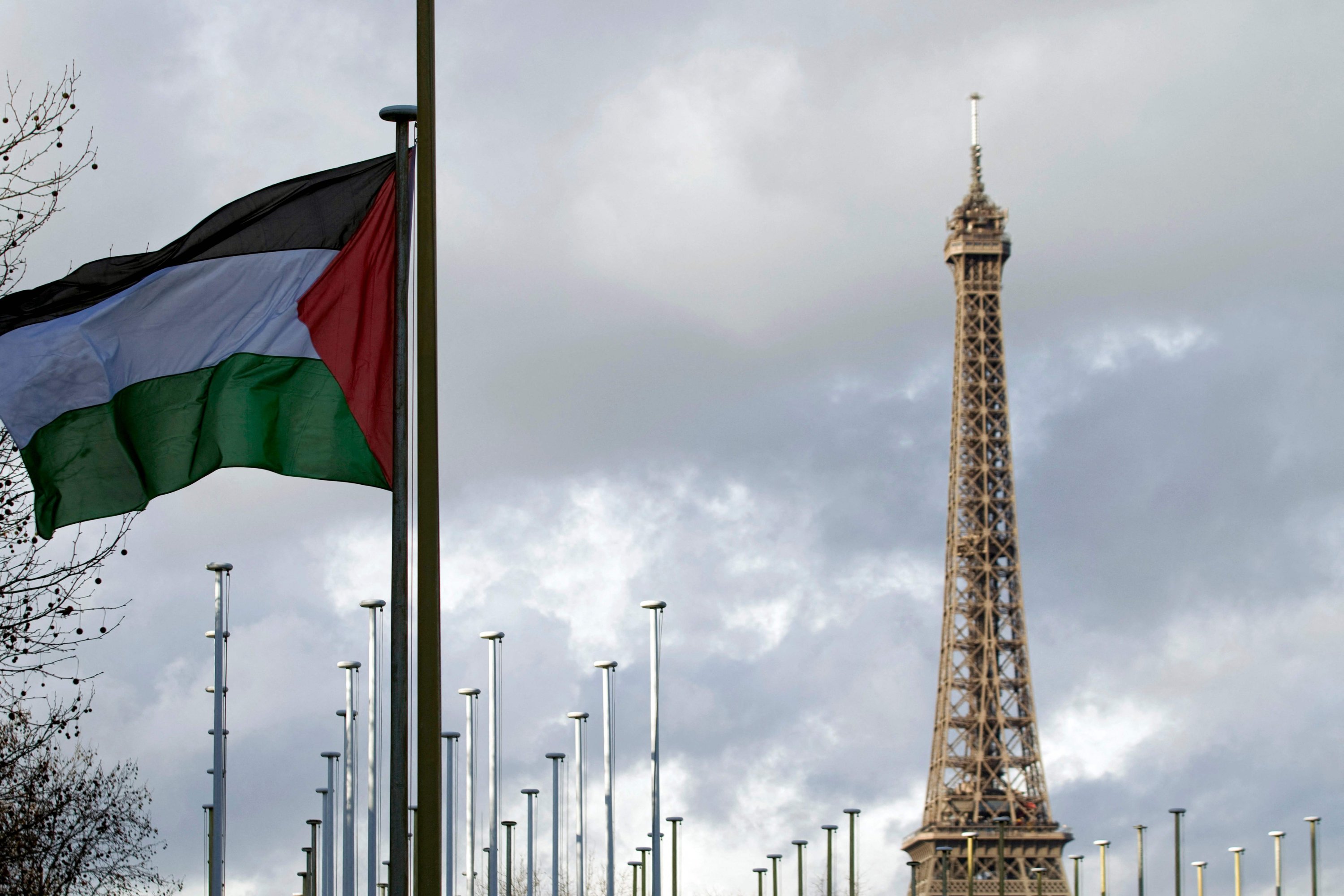
French President Emmanuel Macron has once again caught both domestic and international audiences off guard. In a surprise announcement, he declared that France will formally recognize the State of Palestine this coming September. The decision sent shock waves through the Western bloc, raising eyebrows in Washington, Brussels and Tel Aviv alike. Long seen as a key player in EU diplomacy and a close ally of the U.S., France’s pivot marks a potentially historic shift in European positioning on the Israeli-Palestinian conflict.
The burning question now is: Why now? Is this Macron’s bold attempt to reassert France's leftist political legacy, reminiscent of François Mitterand's dissident stance since the beginning of the Israeli-Palestinian conflict? Or is it a calculated political move amid mounting domestic pressure and growing pro-Palestinian sentiment within France?
Either way, the announcement could mark a turning point or perhaps an endgame for the Palestinian cause in France. As September approaches, all eyes will be on Paris.
France is politically, socially and economically ablaze. The recent nomination of François Bayrou as prime minister has done little to calm the storm. Rather than offering a lifeline, it has become the latest gamble by Macron, whose leadership appears increasingly strained under the weight of mounting public debt and collapsing public confidence.
After years of fiscal recklessness, France is now facing a financial crisis that it can no longer ignore. The once-proud republic finds itself pleading with its own citizens – asking for personal financial contributions to keep the country afloat. A desperate measure, evocative of an empire in decline. Macron’s appointment of Bayrou, once seen as a seasoned centrist capable of bridging political divides, has backfired. Instead of harmonizing party lines and national expectations, the move has deepened the crisis. No clear policy synthesis has emerged, and the French public remains unconvinced and unwilling to bear the burdens demanded of them. Macron’s latest appeals to civic duty evoke uncomfortable historical parallels. Just as the Roman Empire faltered when citizens refused to uphold their obligations after Rome was ransacked, France today risks a similar unravelling. If the state’s legitimacy hinges on public trust and participation, then that social contract is on increasingly shaky ground.
Cornered at home, Macron appears to be taking the battle abroad. His sudden push for foreign policy stunts – such as recognizing Palestine – might be less about conviction and more about distraction. As domestic fires rage, international diplomacy becomes a convenient stage for an embattled leader seeking a legacy beyond economic collapse. Whether this strategy buys Macron time or marks the twilight of Macronism remains to be seen. But one thing is clear: When a nation begins asking its citizens for bailouts, the crisis has moved far beyond politics.
When Macron looks into the metaphorical backpack of his political journey, he finds not a coherent ideology, but a vague blend of centrist-left rhetoric and opportunism. His 2017 rise to power was rooted not in a clearly defined doctrine, but in a vacuum – an unideological campaign that capitalized on public fatigue with traditional parties. Macron’s party, Renaissance (formerly La République En Marche), lacks any firm sociological or political grounding. It floats, adjusting its sails with the winds of public sentiment rather than anchoring to a consistent vision. Having lost his majority in the National Assembly, Macron now governs in an increasingly fragmented political landscape. French politics has seen the resurgence of both far-right and far-left forces – ideological specters that had been dormant for nearly a century. In his last campaign, Macron tilted toward the right, flirting with Islamophobic and Turkophobic discourse in a bid to attract the far-right electorate. The result? Minimal gains and growing criticism from civil society and minority groups.
Now, the centrist president appears to be reaching into the toolbox of symbolic politics once again. His recent declaration to recognize the State of Palestine by September is more than a diplomatic gesture – it is a calculated move to win back disillusioned center-left and undecided voters. It is, in some ways, a return to the "forgotten memory" of Macron's earlier liberal image – one rooted in human rights, multilateralism and a modernized foreign policy. And yet, an enduring tension remains between image and intent. Despite his early moniker, "le banquier de Rothschild," Macron seeks to reshape France's image abroad through moralistic stances. But if his track record is anything to go by – particularly in Libya, Lebanon or the Sahel – his commitment to those ideals often wavers when confronted by realpolitik. As France struggles to redefine its role on the world stage and at home, Macron’s foreign policy moves may earn applause abroad. But unless accompanied by a consistent domestic narrative and a renewed social contract, they risk being seen as yet another performance by a president more comfortable in the international spotlight than domestic resolution.
Former President François Hollande hailed France’s planned recognition of Palestine as a historic inflection point – one that could inspire other nations to recalibrate their Middle East policy and affirm both Palestinian and Israeli legitimacy. On the left, Mathilde Panot of La France Insoumise urged that recognition must not remain symbolic but serve as a catalyst for sustained diplomatic engagement and accountability. Jean‑Luc Melenchon echoed this sentiment, framing the move as part of a broader struggle for justice and international credibility under a future left-led government. Meanwhile, criticism from the right was swift. Sebastien Chenu of the National Rally slammed the decision as premature, citing Hamas' continued presence as incompatible with legitimate statehood. Gerard Larcher, president of the Senate and senior figure in The Republicans, warned that unresolved hostage crises in Gaza render Macron’s timing politically tone-deaf and strategically flawed. The divide reflects not just differing views on Palestine – but fundamentally clashing visions of France’s global role.
Whether Macron will follow through on his promises tout au droit – to the very end – is still uncertain. What is clear, however, is that unideological governance in an ideologically reawakened France has its limits.