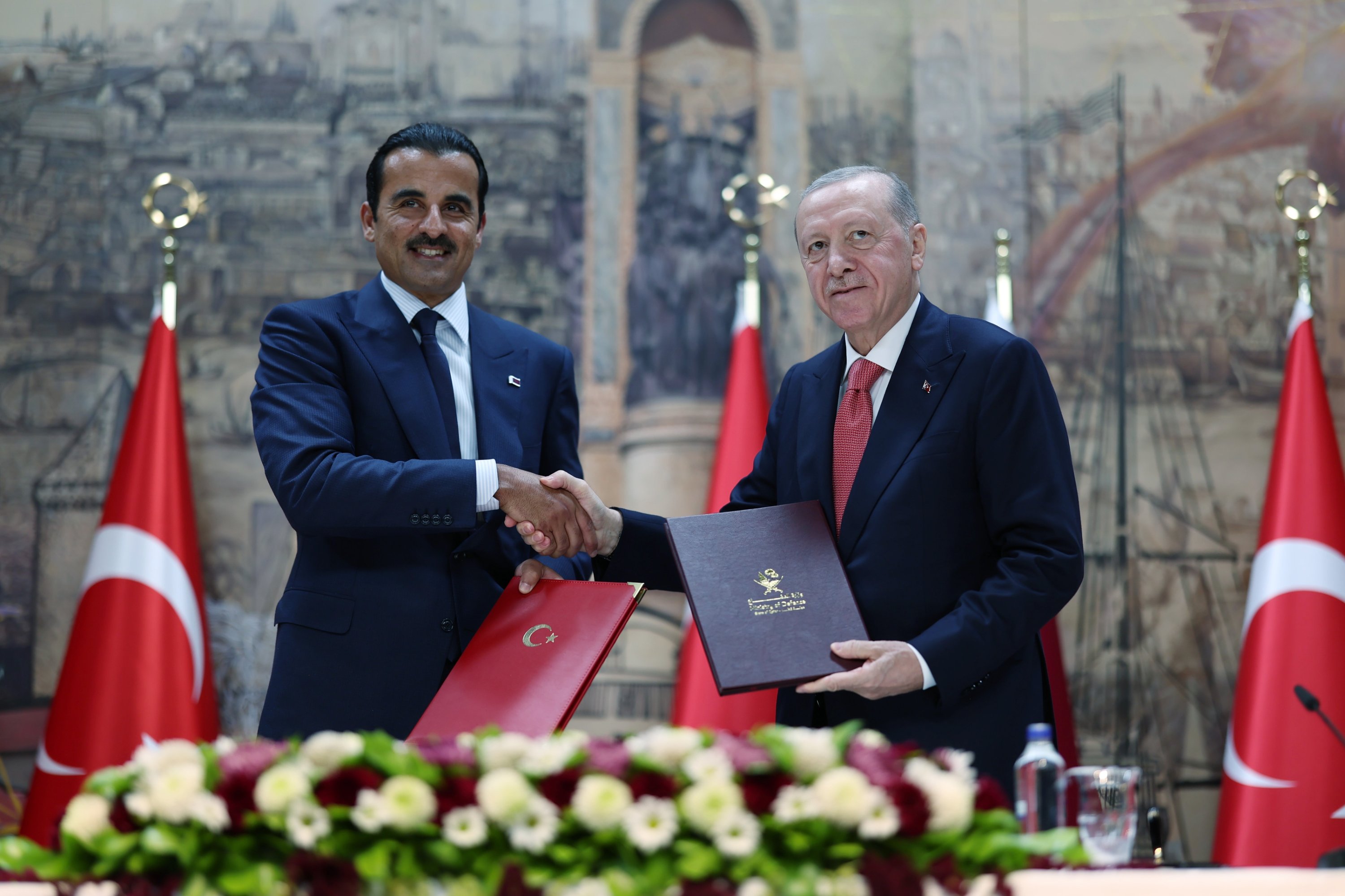
The recent Turkish-Qatari defense agreement reflects both regional security transformations and a partnership built on shared interests, trust and mutual support. The Mecca agreement, Badr Memorandum and Istanbul Agreement represent distinct security and industrial arrangements, raising questions beyond bilateral relations: Is the region developing more institutionalized deterrence networks? How do political commitments complement military and industrial capabilities? Can Ankara and Doha translate their rapprochement into effective responses to threats? These questions matter because agreements derive their value not from declarations but from credible commitments and implementation when crises put them to the test.
For approximately two decades, Türkiye and Qatar have enjoyed growing relations and political convergence on numerous regional and international issues. Their rapprochement accelerated in 2008, but the transition toward an institutional and military partnership began in December 2014, with the establishment of the Supreme Strategic Committee and the military cooperation framework that subsequently underpinned the Turkish military presence in Doha.
The two sides have held 12 Supreme Strategic Committee meetings and signed memoranda of understanding covering trade, education, culture and other areas. Their relationship has also weathered successive crises, deepening political, economic and defense ties.
Further development was therefore unsurprising, particularly in defense and security, amid global and regional developments and escalating uncertainty. The U.S. Al Udeid Air Base in Qatar came under Iranian missile attacks this year, while Israel struck the Hamas leadership in Doha in September 2025 despite Qatar’s mediation of a Gaza cease-fire. Fears of renewed war in the Gulf persist. Thus, the development of Turkish-Qatari relations also reflects both countries’ assessments of their regional and international environment.
In this context, Türkiye and Qatar signed their defense agreement in Istanbul on Nov. 13. Both sides said it aims to strengthen collective defense and regional security, establish a common position toward external armed attacks targeting either or both countries and expand consultations and defense-industrial cooperation. President Recep Tayyip Erdoğan’s subsequent statement that both countries would continue working to prevent renewed war in the Gulf directly connects the agreement to an unstable security environment and expectations of further escalation.
The agreement followed the Badr Memorandum, signed in Doha on Oct. 21 by Türkiye, Qatar, Pakistan and Indonesia, focusing on military production, technical training, research and development and defense capabilities. Within a month, cooperation thus advanced from a defense-industrial and technical framework to a bilateral defense treaty. Notably, the Turkish-Qatari agreement welcomed the Badr Memorandum as a foundation for defense production and infrastructure, reinforcing the industrial-security connection. Their relationship therefore extends beyond timing: It reflects an evolving security approach linking near-term deterrence with industrial development, human resources and capacity-building.
Regional arrangements are advancing rapidly through the Mecca agreement, the Badr Memorandum and the Turkish-Qatari defense agreement. Although not unified, they share a context and perform complementary functions involving political and security commitments, industrial capacity-building, collective or bilateral responses to attacks and unified positions.
Türkiye is clearly working to institutionalize its security responsibilities. Its experience as an active NATO member could inform its multilateral and bilateral defense relationships, without implying the creation of a regional NATO. The agreement with Qatar followed the Mecca agreement with Saudi Arabia and Pakistan, suggesting a consistent direction. These partnerships remain institutionally separate, but their objectives serve an overarching strategy.
Public statements refer to a unified position toward external aggression. However, the joint communique did not specify the military commitments the parties would undertake following an attack or the procedures for activating them. While cooperation in intelligence and logistics is promised, translating it into action that meets both sides’ expectations remains untested. Operational requirements must also be addressed to transform existing cooperation into readiness for potential attacks.
As with the Mecca agreement, success requires a shared definition of threats and the limits of each party’s involvement, particularly as threats evolve. Multiple understandings and alliances also require coordination and clarity regarding cooperation among the new structures. Successful coordination could eventually facilitate their unification, including possible mergers once these alliances become established and demonstrate their effectiveness.
These alliances both emerge from political alignment and help sustain it. Discussions accompanying the agreement addressed the Israeli occupation’s attacks on Gaza and its humanitarian situation, developments in Syria and the latest situation in Libya. President Erdoğan and Qatar’s emir, Sheikh Tamim bin Hamad, also emphasized resolving the Iran-U.S. conflict through diplomacy. Practical coordination with other regional states could help overcome the weakness of regional institutions, whose limited influence over conflicts and crises has been exposed by events.
Ultimately, the agreement advances Turkish-Qatari cooperation in managing security risks without establishing a complete joint defense system or unified regional alliance. Its importance lies in connecting accumulated political and institutional trust with coordinated responses and the industrial capabilities and human resources needed to sustain them.
Success depends on clear commitments, timely decisions, shared threat assessments, defined responses and coordination with other partnerships. Integration among the Mecca agreement, the Badr Memorandum and bilateral agreements requires practical work; converging objectives alone cannot deliver it.
The decisive test is credible protection of sovereignty without ill-calculated confrontation. Success could make this partnership a catalyst for regional coordination that combines deterrence and diplomacy while expanding regional states’ capacity to manage their security and shape their choices independently.