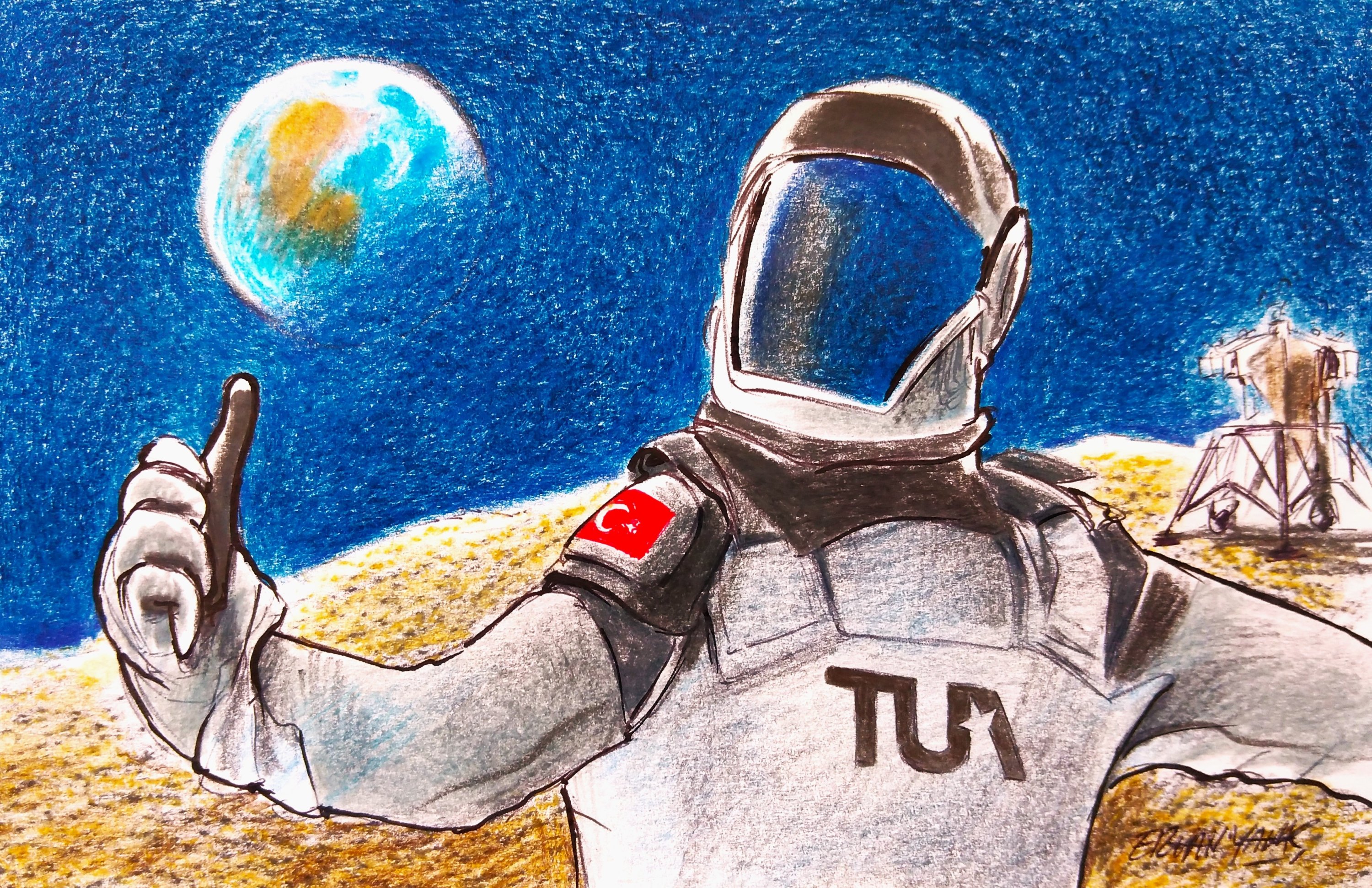
The new lunar race is about far more than flags. It will determine who shapes the laws, infrastructure and economy of humanity's next frontier.
The next borders of power will not be drawn only on Earth. They are already taking shape in orbit, at the Earth-moon Lagrange points and around the lunar south pole. These will not be borders in the traditional sense: the 1967 Outer Space Treaty prohibits national appropriation of outer space and celestial bodies. Yet, access, infrastructure, technical standards and operational practice can create strategic realities long before diplomats agree on new legal language.
That is why Türkiye's accession to the Artemis Accords on Aug. 31, 2026, as the 71st signatory is more consequential than a ceremonial signature. It places Türkiye inside one of the central debates of this century: who will write the rules for sustained human and commercial activity beyond Earth?
The scale of what is coming is easy to underestimate. The European Space Agency cites forecasts of more than 400 lunar missions between 2022 and 2032. A PwC assessment projects that markets for lunar goods and services could reach a cumulative $170 billion by 2040, including roughly $100 billion in lunar transportation. These figures are forecasts, not guarantees. But they reveal the direction of travel: the moon is moving from an occasional destination to an emerging domain of infrastructure, logistics, science and commerce.
The competition is particularly intense at the lunar south pole. Permanently shadowed regions may contain water ice, a resource that could support crews and potentially be processed into oxygen and rocket propellant. Areas with favorable sunlight could support power generation. Scientifically valuable terrain, safe landing corridors and communications access are limited. NASA has refined its Artemis III planning to nine candidate landing regions near the south pole. Other national programs are studying the same broad geography. On a celestial body with no sovereign territory, proximity itself is becoming politically significant.
The debate over lunar access begins with an older and still unanswered question: where does space itself legally begin? International law has never established a universally binding altitude at which sovereign airspace ends and outer space begins. The Karman line at 100 kilometers (62.14 miles) is widely used as a practical reference, while some national practices apply a lower threshold. This ambiguity has not stopped orbital activity, but it reveals a recurring pattern: technology creates strategic realities faster than law creates consensus. On the moon, the problem is no longer a vertical line between air and space. It is the emergence of functional boundaries between operations competing for the same terrain, resources and infrastructure.
The Artemis Accords attempt to convert broad treaty principles into operational conduct. They reinforce peaceful purposes, transparency, interoperability, emergency assistance, registration, open scientific data, preservation of space heritage, responsible resource use and debris mitigation. Most controversially, they provide for temporary "safety zones" to coordinate activities and avoid harmful interference.
Safety zones must not become sovereignty by another name. Under the Outer Space Treaty, no state may claim the moon by occupation, use or any other means. The Artemis framework itself states that such zones should be based on scientific and engineering criteria, remain temporary and respect free access and due regard. Yet, the practical questions are difficult. How large may a zone be? How long may it remain? What happens when two missions seek access to the same ice-bearing crater or communications corridor? Who decides whether coordination is necessary or exclusion is excessive?
These are not abstract legal puzzles. Their answers will influence investment, insurance, mission design and, ultimately, power. The first actors to build navigation networks, communications relays, landing services, energy systems and surface logistics will not own the moon. They may nevertheless shape the conditions under which others can reach and use it. Infrastructure becomes influence. Standards become strategy. Repeated practice can harden into rules.
For Türkiye, the conclusion is clear: the Artemis Accords must not be treated as the end of a diplomatic process, but as an entry point into rule-making. Signing gives Türkiye a seat at the table. Technological contribution will determine the weight of its voice.
Türkiye does not enter this arena empty-handed. The National Space Program and the Lunar Research Program (AYAP) are developing capabilities in spacecraft design, propulsion, guidance and navigation, communications, materials, mission operations and scientific payloads. AYAP matters because a country that reaches the moon through its own engineering capacity enters negotiations differently from one that arrives with political statements alone.
Industry and Technology Minister Mehmet Fatih Kacır's announcement on Sept. 16 gave this ambition tangible form. Türkiye's first lunar spacecraft has completed assembly and integration and entered environmental testing. Built with more than 80% domestic content, it is targeted for launch in early 2027. The Artemis signature and AYAP now tell the same story: Türkiye wants to help shape lunar cooperation while developing the capability to reach the moon through its own engineering.
Türkiye should now link AYAP directly to a focused lunar strategy. It should identify two or three fields in which it can become indispensable: precision timing and navigation, resilient communications, autonomous mobility, scientific instrumentation, advanced materials, or small-payload delivery. Its aerospace and defense companies should be prepared for lunar supply chains. Its universities should be connected to international payload calls and planetary research networks. Its startups should be encouraged to design for the cislunar economy, not merely for today's satellite market.
The economic argument is compelling, but Türkiye's potential role is larger than market share. Positioned between Europe, Asia and the wider Global South, Türkiye can advocate a lunar order that remains open to emerging space nations. Seventy-one Artemis signatories represent considerable diplomatic momentum. Its legitimacy, however, will depend on whether cooperation delivers real access, shared knowledge and new capabilities, rather than creating a permanent divide between rule-makers and rule-takers.
Türkiye can champion three principles. First, safety zones must remain transparent, proportional, temporary and non-exclusive. Second, the use of lunar resources must comply with international law and must not quietly evolve into territorial control. Third, scientific data, interoperability and capacity building must ensure that the benefits of lunar activity extend beyond the states and companies able to arrive first.
This position would combine national ambition with international responsibility. Türkiye need not choose between strategic autonomy and cooperation. AYAP can strengthen national capabilities while Artemis partnerships multiply their scientific and economic impact. In fact, a country contributes most effectively to international cooperation when it brings something of its own to the table.
Artemis is not the only framework shaping the next phase of lunar cooperation. The China-Russia-led International Lunar Research Station (ILRS) represents another emerging architecture for long-term scientific activity on and around the moon. For Türkiye, the existence of parallel frameworks reinforces a broader point: strategic autonomy in space should mean the capacity to engage across different partnerships while remaining anchored in international law, peaceful use, and scientific cooperation.
That ambition now reaches a global stage. Türkiye is hosting the 77th International Astronautical Congress (IAC) in Antalya from Oct. 5-9, 2026, under the theme "The World Needs More Space." The motto is especially relevant to the lunar debate. The world needs not only more access to space, but more space for cooperation, for emerging nations to participate in rule-making and for competing technological ecosystems to remain in dialogue. Hosting IAC 2026 allows Türkiye to show that its space ambitions extend beyond reaching new destinations to helping convene the conversations that will determine how those destinations are explored and governed.
The moon will be humanity's first test of whether rules can precede conflict. On Earth, regulation too often arrived only after borders hardened, resources were contested and environmental damage became irreversible. Humanity does not have to repeat that sequence beyond its home planet.
In the Apollo era, power was measured by who planted a flag first. In the Artemis era, it will increasingly be measured by who builds the systems others rely on, who convenes the partnerships others join and who shapes the rules others follow. Türkiye has entered that arena. AYAP can provide technological credibility, Artemis a platform for cooperation, and IAC 2026 a global stage for diplomacy and debate. The next objective must therefore be larger than reaching the moon: Türkiye must arrive with the technology, diplomatic influence and legal vision needed to help define what happens there next. The world needs more space. Türkiye should help determine what kind of space that will be.