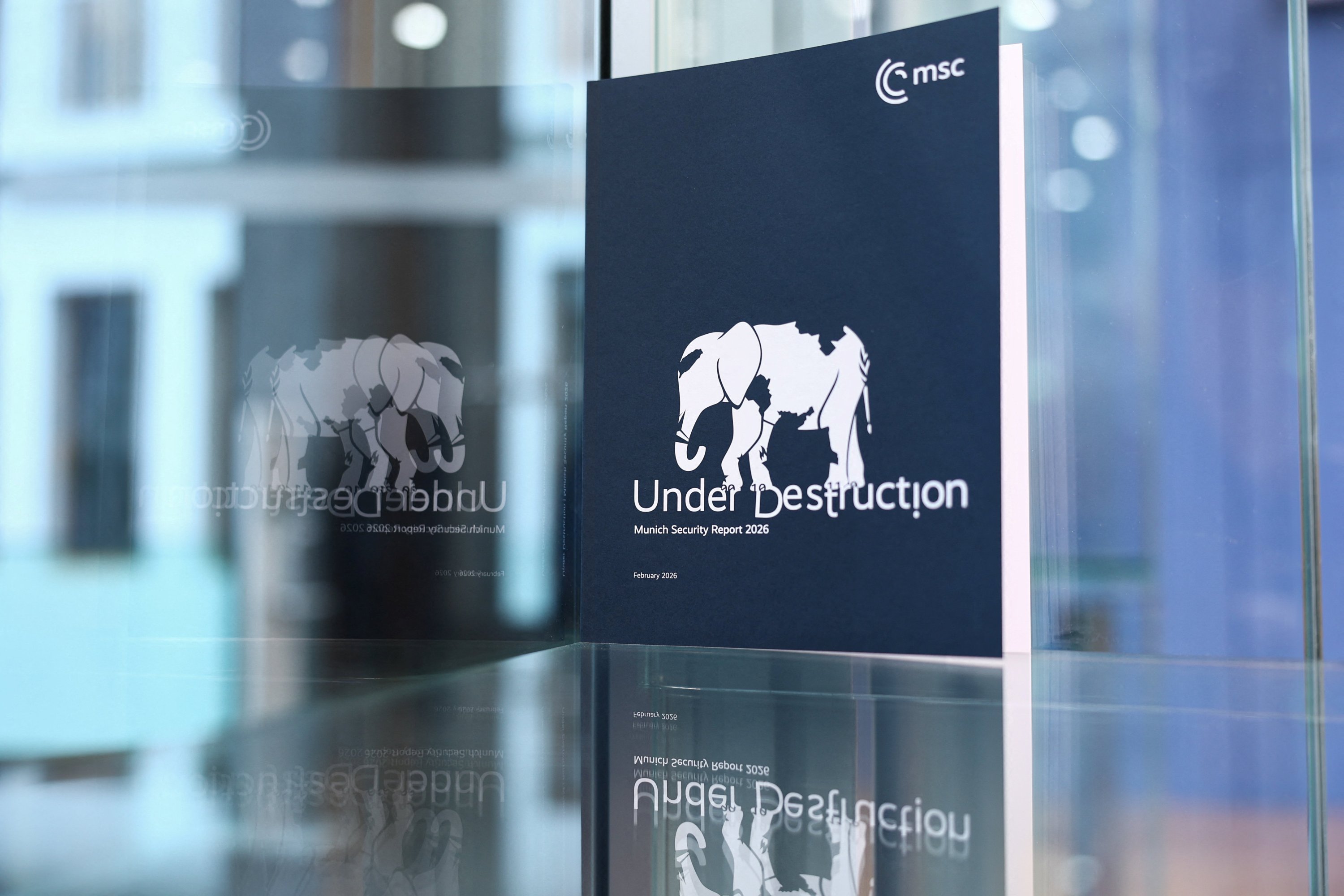
The Munich Security Conference has long functioned as a central platform for international security debates, particularly as a forum through which threat perceptions within the trans-Atlantic alliance are articulated from a European perspective. In this sense, it has served as a global compass. The significance of both the annual conference and its pre-conference report, which outlines the year’s central theme, has historically derived from this role.
This year’s report, however, is markedly different. Published under the theme “Under Destruction”, it emphasizes what Europe now faces and also what it describes as fragmentation within the West. Accordingly, at least this year, the conference has shifted from being a platform focused primarily on external threats to one centered on epistemic, ideological and strategic fragmentation within the West itself. Particularly noteworthy is the report’s characterization of this internal division as a crisis and, indeed, as one of the most significant risks confronting Europe.
In the post-Cold War era, the liberal international order and liberal democracies functioned as the normative reference point of global politics in a distinctly West-centric manner. Today, however, this situation no longer holds. What the report implicitly underscores is precisely this point: The liberal international order has lost its hegemonic position, while alternative political systems have begun to rise.
This ontological crisis is the result of a chain reaction. When a hegemonic order is shaken, it loses authority and, consequently, legitimacy. The reverse dynamic is equally plausible. The critical issue, therefore, lies not merely in shifting power balances but in the erosion of the foundations of legitimacy. The liberal international order derived its normative authority from the intellectual, military and economic superiority of the U.S. International law, human rights discourse and multilateral institutions constituted the instruments through which this normative capacity was operationalized.
The global questioning of these norms, especially in response to what has been perceived as their unequal or selective application, has long constituted an external challenge to the order. Yet the report stresses that with the U.S., at least during the Trump period, partially retreating from leadership of this order, internal challenges have become more visible and more consequential. In cliched-Gramscian terms, this constitutes what is often described as a hegemonic crisis: the order persists, no new hegemon has yet replaced it, but it has nonetheless lost both power and legitimacy.
The divergence between Europe and the U.S. should therefore be understood as a manifestation of the broader normative fragmentation within the West. Tensions in trans-Atlantic relations increasingly stem from disagreements over values more than differences in policy interests. Moreover, even within Europe, although major institutions attempt to preserve a unified normative position, domestic political arenas exhibit growing divergence. It is thus increasingly evident that the West can no longer be treated as a homogeneous actor.
The Munich Security Conference report frames this division as one between two distinct political ontologies. On one side stands a liberal-internationalist approach grounded in universal norms; on the other, a nationalist-illiberal approach centered on sovereignty, identity and national priorities. Crucially, this distinction diverges from classical ideological polarization. The divide concerns not economic or policy preferences but the source of political legitimacy itself. For liberals, legitimacy derives from law and normativity; for nationalists, it stems from identity and society.
While this interpretation is more accurate than earlier readings, it remains incomplete. A significant factor behind the emergence of this internal divide has been Western elites’ misreading of socio-political transformation. Anti-liberal movements were long interpreted as temporary populist waves rather than as indicators of structural change. As a result, the liberal center failed to correctly assess both domestic societal expectations and the direction of global politics. The present crisis, therefore, cannot be explained solely by the rise of external actors. Its deeper cause lies in the liberal order’s diminishing capacity to generate consent from within. What remains missing is a sustained willingness on the part of liberalism to engage in genuine self-critique.
Understanding this fragmentation and hegemonic crisis is essential for interpreting both the present and future trajectory of international politics. The international system is currently moving through a transitional phase characterized by uncertainty and by the attempts of multiple actors to construct and dominate their own preferred orders. For this reason, it is still premature to speak definitively of a bipolar or multipolar system. Instead, it is more accurate to describe this transitional moment, one in which the liberal order is receding while a new order has yet to be consolidated, as a “post-liberal” era.
The defining feature of this post-liberal period is the shift in political legitimacy from universal norms toward national-local values. This transformation may be conceptualized through the notion of the “politics of self-valorization,” which refers to societies’ increasing reliance on their own cultural and national reference points in response to inequalities and identity erosion associated with (neo)liberal globalization.
A key driver of this trend has been the declining credibility of liberal democracies’ promises of prosperity, freedom and justice among broad segments of society. The inability of traditional establishment parties to meet societal expectations has deepened crises of representation. Consequently, new political actors are advancing alternative visions of order.
These struggles also unfold through conceptual power. One of the principal advantages of the liberal order has been its ability to define and categorize its rivals. Alternative models have often been delegitimized through labels such as “authoritarian,” “populist” or “backsliding democracy.” Yet this conceptual monopoly is now weakening. Emerging actors are generating their own concepts, narratives and normative frameworks.
As a result, a new plane of international politics is taking shape, one in which each actor produces its own politics of self-valorization, and thus its own normative order. This suggests that the trajectory of the international system may evolve toward what might be termed a multi-order configuration.
The transformation currently unfolding is deeper than a conventional power transition. What is at stake is a shift in the normative foundations of the international system. The world is no longer structured around a single model; rather, it is moving toward a plural configuration in which multiple political and cultural projects compete simultaneously.
The Munich Security Conference and its latest report, even if not explicitly acknowledging it, reflect Europe’s attempt to interpret its own normative decline, an attempt to grapple with a reality that can no longer be denied.