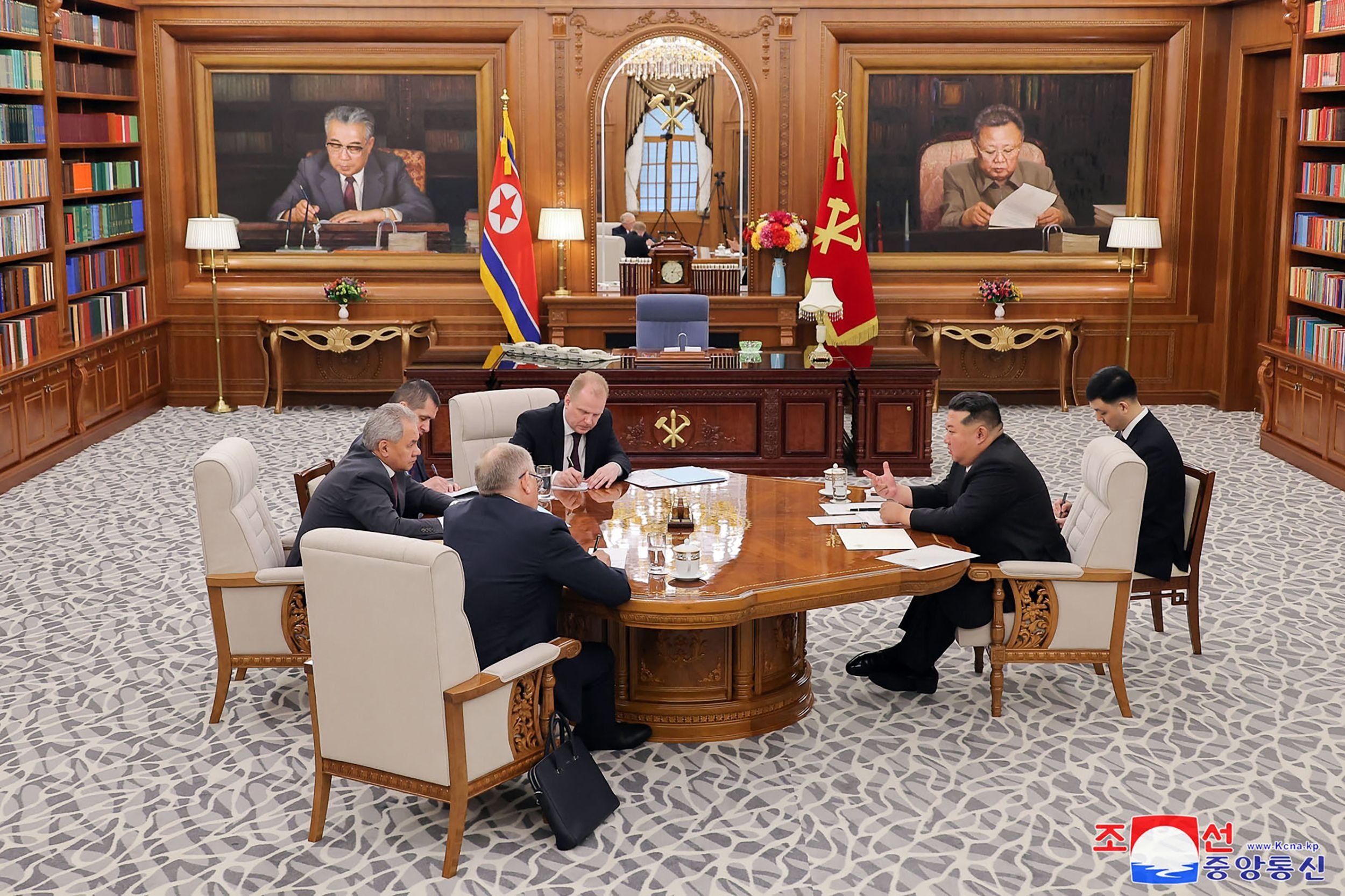
As the Russia-Ukraine war enters its third year, alarming developments are reshaping not only Eastern Europe but the entire Eurasian strategic landscape. Among these, perhaps the most provocative is the now-confirmed deployment of North Korean troops to support Russian forces, including their involvement in combat operations near Russia’s Kursk region.
While this may seem like a surprising turn, it is in fact the culmination of a deepening alliance between two authoritarian regimes that have both been heavily sanctioned and increasingly isolated by the West. Russia's desperate need for manpower, driven by mounting battlefield casualties and growing domestic resistance to conscription, has led Moscow to turn to North Korea for not only ammunition and equipment but now even personnel.
For North Korea, this marks a historic shift. Since the Korean War ended in 1953, Pyongyang has avoided committing troops abroad. But Ukraine offers something unique: a live battlefield laboratory where North Korean soldiers can acquire invaluable combat experience against Western-supplied technologies and tactics. This is not merely symbolic. North Korean forces now gain exposure to advanced electronic warfare, drone operations, hybrid warfare doctrines, and command-and-control systems that could dramatically modernize their military thinking.
Just as critically, North Korea is believed to be receiving advanced Russian military technologies in return, including satellite reconnaissance, intercontinental missile systems and submarine-based nuclear platforms. This could fundamentally accelerate Pyongyang's ambitions for a fully operational nuclear triad, directly threatening security across East Asia.
But the repercussions are not limited to the Korean Peninsula.
The deployment of non-European foreign troops into the European theater challenges the foundations of international law and undermines post-Cold War security norms. Russia’s growing willingness to bypass sanctions through these partnerships, while shielding itself and North Korea from accountability via its veto power at the United Nations Security Council, further erodes global diplomatic institutions that have preserved peace for decades.
For South Korea, the immediate security threat is obvious. The very forces now deployed to Ukraine may return home with dangerous new capabilities. But Türkiye, though geographically distant from East Asia, faces equally important long-term concerns. Straddling Europe and Asia and holding a unique diplomatic status as one of the few nations maintaining ambassador-level relations with both North and South Korea, Türkiye finds itself in a rare position of potential influence.
While most embassies to North Korea operate out of Beijing, Türkiye’s ambassador to Pyongyang remains concurrently accredited from Seoul. This gives Ankara a potentially crucial backchannel role in de-escalation diplomacy, especially at a time when North Korea’s traditional diplomatic channels have nearly collapsed since the pandemic.
Moreover, Türkiye’s geostrategic role as NATO’s southeastern flank and Black Sea power draws it into the larger Eurasian power game emerging from this conflict. If North Korea's operational presence in Ukraine deepens, NATO’s eastern flank may be forced to reckon with security threats from both east and south simultaneously.
The historical friendship between Türkiye and South Korea – born from shared sacrifices in the Korean War – now acquires a renewed strategic meaning. Both countries are mid-sized powers navigating in a dangerous multipolar world, balancing complex relations with the U.S., China, Russia and Europe.
At this critical juncture, South Korea and Türkiye should not limit their response to diplomatic coordination alone. The time has come for both nations to initiate negotiations for a comprehensive bilateral strategic security and defense cooperation agreement. Such a framework could formalize their partnership across multiple domains, including intelligence sharing, defense technology collaboration, cybersecurity, early warning systems, ballistic missile defense and hybrid warfare capabilities.
Building upon their already existing military-technical cooperation – particularly in fields such as aerospace, drone technology, naval platforms and defense electronics – both countries could elevate their cooperation to a true strategic alliance. This would not only enhance their respective national security but also contribute to wider regional stability from the Black Sea to the Sea of Japan.
In addition, a formalized South Korea-Türkiye Security Dialogue Platform could be institutionalized, providing a permanent bilateral mechanism to assess emerging threats, coordinate crisis responses, and synchronize strategic forecasting across Eurasian theaters.
This new North Korea-Russia military alignment is not just a problem for Seoul or Brussels. It is a trilateral Eurasian challenge that links the future stability of Eastern Europe, the Korean Peninsula and the broader Indo-Pacific system. It demands creative joint action.
The world is entering an era where the boundaries between regional conflicts blur into global fault lines. The Russia-North Korea axis may well be the first flashpoint of this emerging order. Regional powers like Türkiye and South Korea, with their unique combination of historical ties, geographic reach, and diplomatic flexibility, must take the lead in confronting these new challenges.
The time to act is now.