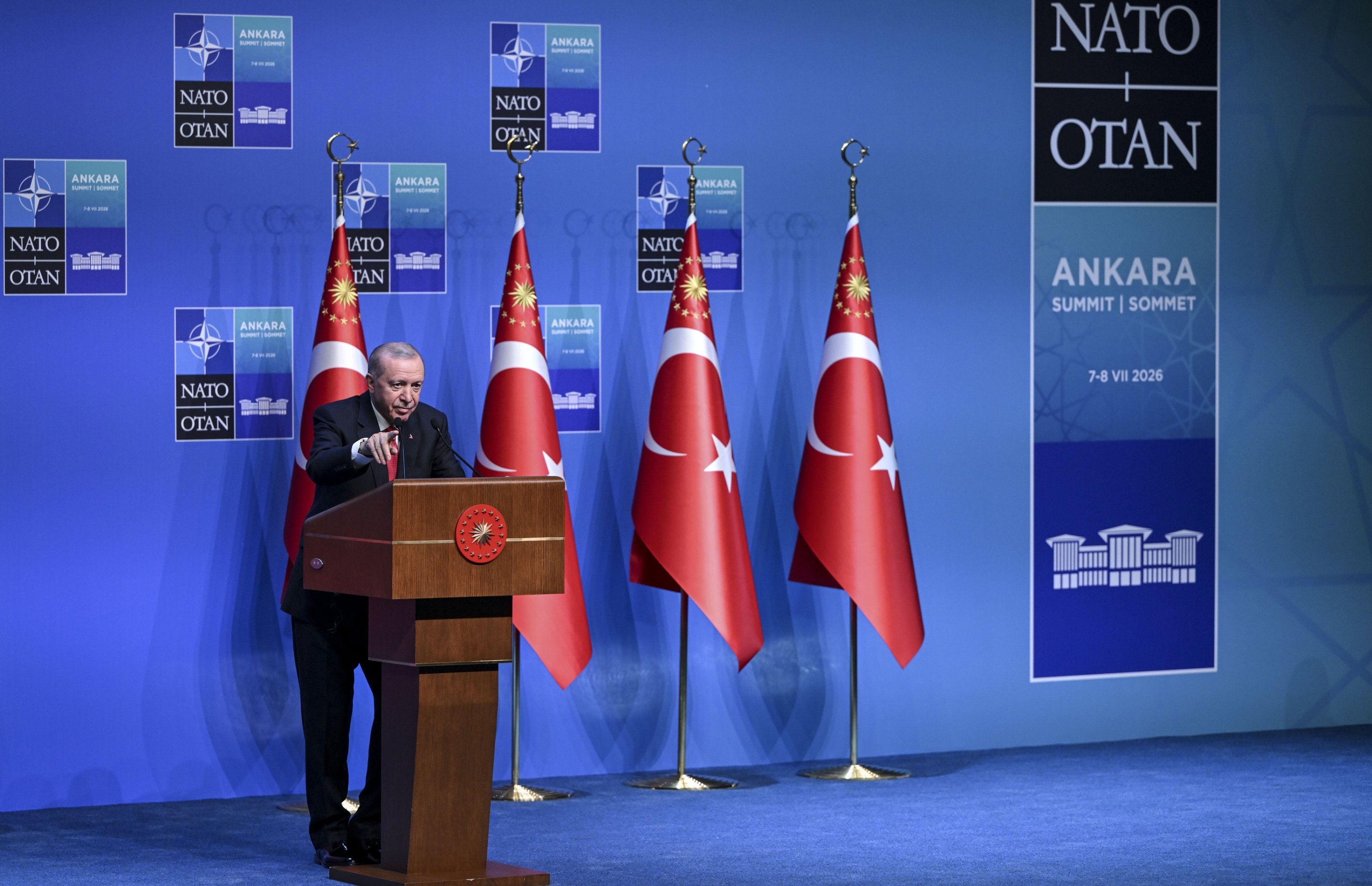
For much of the past decade, the phrase "no equation can be built without Türkiye" has circulated through diplomatic circles with the familiarity of a well-worn cliche. Yet the latest NATO summit suggested that the expression has outgrown the realm of political rhetoric. It increasingly reflects a structural change in international politics. As the post-Cold War order gives way to a more fragmented and competitive geopolitical landscape, Türkiye is emerging not simply as a regional stakeholder but as one of the pivotal states through which Europe's security, Eurasia's connectivity and the wider Middle East's stability increasingly converge.
International politics is periodically transformed by wars, financial crises or technological revolutions. Occasionally, however, it is diplomatic summits that reveal the deeper direction of systemic change. NATO gatherings have long served as more than ceremonial meetings of allied leaders; they are among the clearest barometers of how strategic priorities are evolving within the Western alliance. This year's summit was particularly revealing. It underscored not only Türkiye's growing strategic weight within NATO but also the extent to which its defense-industrial transformation has become an increasingly important pillar of the alliance's future capabilities.
The international system is entering an era defined less by unchallenged American primacy than by the diffusion of power. The strategic rivalry between Washington and Beijing, Russia's confrontation with the West over Ukraine, persistent instability across the Middle East and the restructuring of global supply chains are collectively accelerating the transition towards a multipolar order. Such periods of systemic change distinguish between states that merely adapt and those that shape the environment around them. Increasingly, Türkiye belongs to the latter category.
Perhaps the clearest manifestation of this transformation is found in its defense industry. Two decades ago, Ankara remained heavily dependent on foreign suppliers for critical military technologies. Today, it possesses indigenous capabilities spanning unmanned systems, naval platforms, electronic warfare, missile technologies and increasingly sophisticated air-defense systems. This evolution represents far more than industrial success. In contemporary geopolitics, technological sovereignty has become a central source of diplomatic leverage. States that produce advanced defense technologies increasingly influence not only military balances but also the architecture of international security itself.
The NATO summit reflected precisely this reality. Türkiye is no longer viewed simply as the alliance's southeastern frontier or a geographical buffer between Europe and the Middle East. Instead, it is increasingly recognized as a contributor to technological innovation, crisis management and operational security across multiple theaters. This marks an important evolution not only in NATO's strategic thinking but also in Türkiye's international position.
Yet reducing Türkiye's geopolitical significance to defense production alone misinterprets the broader transformation underway. Geography remains one of the enduring constants of international politics. Situated at the intersection of Europe and Asia, the Black Sea and the Mediterranean, the Caucasus and the Middle East, Türkiye occupies one of the world's few genuinely multidirectional strategic locations. Few countries simultaneously influence European security, Black Sea stability, Eastern Mediterranean dynamics, Caucasian geopolitics and the political evolution of the Turkic world.
That geographical centrality is becoming increasingly valuable. As Europe seeks greater energy security, Central Asia searches for reliable export corridors, and competition intensifies over the Eastern Mediterranean, the Caucasus and the Caspian Basin, Türkiye sits at the intersection of virtually every major east-west and north-south corridor. Energy infrastructure has consequently become more than an economic asset; it has become an instrument of geopolitical influence. Countries that manage strategic transit routes increasingly shape political outcomes as much as energy markets themselves.
At the same time, broader geopolitical competition continues to reinforce Türkiye's importance. Washington's effort to balance China's rise, Europe's search for greater strategic autonomy and Russia's determination to preserve influence across Eurasia all increase the value of states capable of maintaining productive relations with multiple centres of power.
Türkiye occupies an unusual position within this emerging landscape. It remains a key NATO ally, one of Europe's largest trading partners, the leading political force within the Turkic world and a country possessing significant historical and diplomatic influence across much of the Islamic world. Such multidimensional engagement provides Ankara with an increasingly rare strategic flexibility.
Indeed, the changing international system demands a broader understanding of power itself. During much of the 20th century, national strength was largely measured by military capabilities and economic output. In the 21st century, power increasingly derives from the ability to combine technological innovation, logistical connectivity, diplomatic credibility and institutional resilience. Strategic influence now depends as much upon facilitating cooperation, managing interdependence and reducing systemic risk as upon projecting military force.
This broader conception of power helps explain Türkiye's rising profile. Its strategic geography, expanding technological base, central role in energy and transport corridors, and increasingly diversified diplomatic stance position it as one of the more consequential middle powers of the emerging multipolar order. The NATO summit did not create this reality, but it brought it into sharper international focus.
The more significant lesson lies elsewhere. Türkiye is gradually moving beyond the role of a country primarily responding to geopolitical developments. Instead, it seeks to shape regional balances, influence alliance strategy and contribute actively to the construction of the evolving international order. In an age when geography alone no longer guarantees influence, states capable of converting geography into strategy, technology into diplomatic leverage and connectivity into geopolitical advantage will occupy the commanding heights of global politics.
This represents Türkiye's principal strategic opportunity. Modern geopolitics are no longer merely the study of territory. They are increasingly involved in the management of technology, networks, resilience and strategic vision. Countries capable of integrating these dimensions will become not simply participants in the new international order but among its architects.
The NATO summit therefore illustrated something more fundamental than alliance cohesion. It highlighted how structural changes within the international system are elevating Türkiye's strategic relevance. This derives not solely from military capabilities or defense-industrial achievements, important though they are. Rather, it reflects Türkiye's unique capacity to contribute simultaneously to NATO's southern security, European energy resilience, Black Sea stability, Middle Eastern crisis management and broader diplomatic engagement across both the Turkic and Islamic worlds.
Classical geopolitics teaches that national influence depends not only upon the resources states possess but upon their ability to position those resources within the wider international system. That is increasingly Türkiye's comparative advantage. It has demonstrated an expanding capacity to transform geography into strategic connectivity, technological capability into diplomatic influence and historical depth into geopolitical relevance.
For that reason, the assertion that "no equation can be built without Türkiye" should no longer be dismissed as a diplomatic flourish. It reflects a more profound strategic reality. As the contours of a multipolar world continue to emerge, Türkiye is becoming not merely one of the states seated at the table, but one of those increasingly helping to determine its shape.