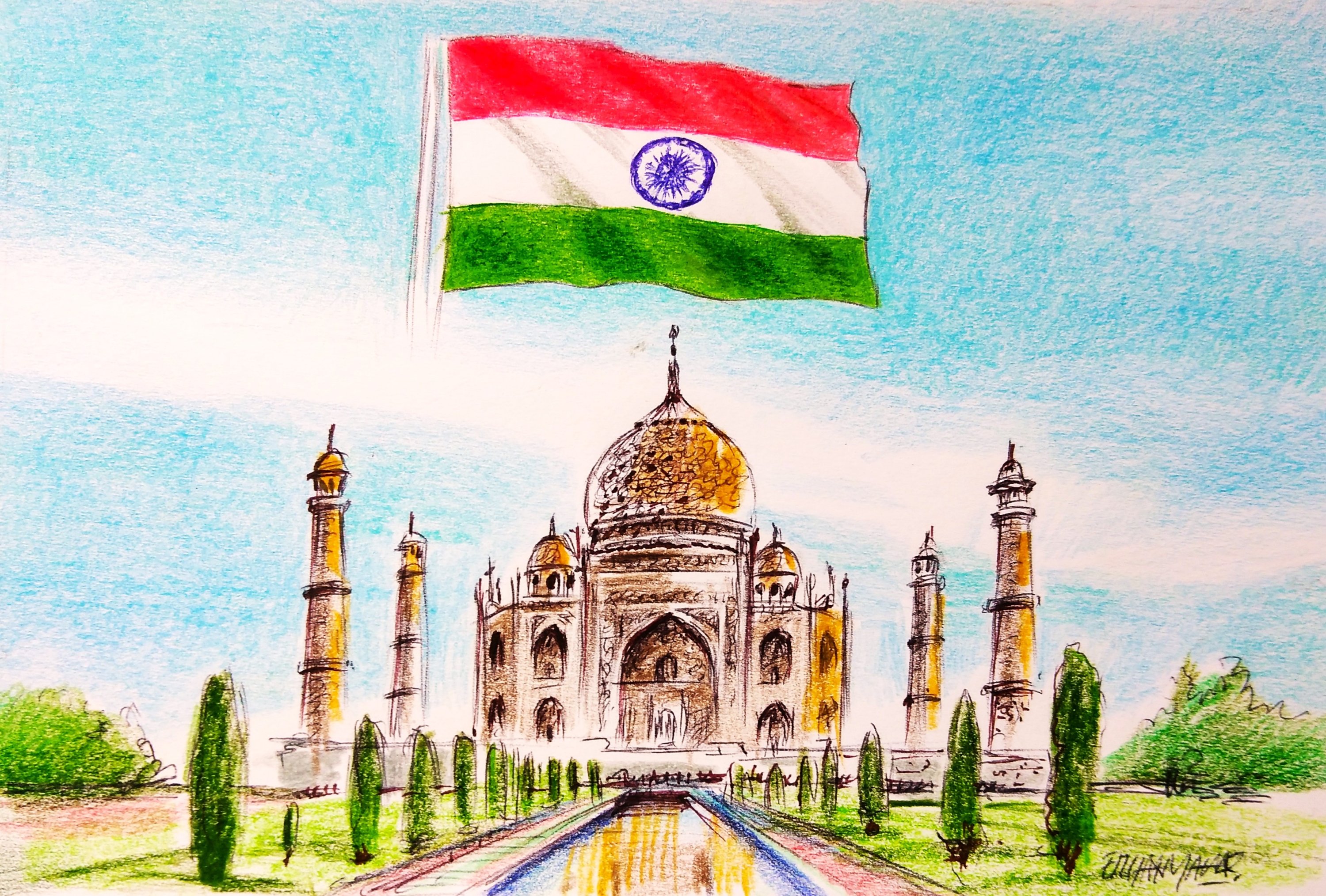
As India continues to argue over how its past should be taught and remembered, an intervention by Indian National Congress lawmaker Shashi Tharoor offers a useful starting point. Speaking in April at a conference on Muslim contributions to India’s history, society and civilization, Tharoor challenged the habit of reading India mainly through conquest. On India’s southern coast, he argued, Islam arrived through old Arab trading connections, “as news, not sword.” Pointing to the Qutb Complex, Humayun’s Tomb and the Taj Mahal, he described them as evidence of “a civilization in conversation with itself.”
The remarks matter because India’s argument over the past is really an argument over who belongs in the present.
A powerful Hindutva reading tells a different story. In this account, Islam enters India mainly through invasion and Muslims remain tied to that moment. The Hindu nationalist volunteer organization, Rashtriya Swayamsevak Sangh (RSS), once put it plainly: “Islam came to Bharat with invaders.”
No serious historian disputes that Muslim rulers conquered parts of the subcontinent. The sociological question begins elsewhere: how does a description of some medieval rulers become a classification of millions of people living centuries later?
The word "invader" looks like a description of the past, but repetition turns it into an organizing principle for the present.
Muslims then appear less as neighbors, farmers, artisans, poets, traders, scholars and citizens, and more as the social descendants of conquest. The category quietly slides from armies to communities, until a single historical event becomes the lens for reading an entire population.
That matters because citizenship is more than a passport or a vote; it also includes cultural belonging, the recognition that a person is part of the nation without having to explain why. When Muslims are repeatedly introduced through conquest, their legal citizenship may remain intact, but their cultural belonging becomes conditional.
They may speak Indian languages, belong to regions their families have inhabited for generations, and participate fully in public life. Yet the question “Where did you come from?” continues to hover over them in historical form.
The invader narrative creates a social boundary this way, without ever drawing one on a map. It tells the majority who is naturally inside the national story and who must still account for being there.
Majoritarian nationalisms also tend to produce a quieter asymmetry: the majority's practices become almost invisible as religion, renamed instead as culture, civilization or national tradition. Minority practices remain visibly religious. In India, this difference can make one community appear as the cultural background of the nation while another appears as a separate identity inside it.
School history matters because such boundaries are learned.
The NCERT Class VIII social science textbook describes Central Asians as coming to India not only for wealth and territory but also to spread their religion, “by force of violence if necessary.” The book also tells students that people today should not be blamed for events of the past. That caution matters. Yet the wider controversy around the textbook shows how politically charged the medieval period has become.
History should not be sanitized, but studying violence is different from turning violence into the permanent identity of a community.
The subcontinent’s past also contains mixed armies, shifting alliances, trade networks, intermarriage, regional loyalties, Sufi networks, conversion, translation and cultural borrowing. Muslim communities in India were formed through many routes, including local conversion, migration, trade and settlement. Dynasties that began through conquest were themselves transformed by the societies in which they ruled.
Compressing this history into Hindu victims and Muslim invaders does more than simplify it. It produces a political memory in which one community inherits ownership of the land, and the other inherits suspicion.
Anthropologist Irfan Ahmad’s concept of “Hindu Orientalism” helps illuminate this process. Ahmad draws attention to a deeper relation between knowledge and power, including how Muslims and other subordinated groups are classified through a dominant civilizational view.
Power works through descriptions as much as through laws. A community repeatedly described as foreign, excessive or threatening can be pushed toward the edge of the national imagination without formally losing citizenship.
Tharoor's intervention, read this way, should push us beyond the familiar language of "Muslims' contribution." Contribution can itself suggest that there was an India first and that Muslims arrived later to add something to it.
Muslims are part of the historical substance of India itself, not an addition to it. Their story includes settlement, conversion, labor, scholarship, music, architecture, food, language, politics and ordinary neighborhood life. It also includes conflict and hierarchy, as every long civilizational history does.
The political power of the word “invader” lies in its ability to collapse these differences. It appears to speak about the dead while quietly judging the living.
A nation reveals something important about itself through the stories it tells about those it mistrusts. If Indian Muslims are remembered mainly as heirs of invasion, citizenship becomes divided between legal membership and cultural belonging. Some citizens appear naturally at home. Others remain permanent guests.
India can continue to read its Muslim past mainly as an injury inflicted upon an otherwise complete civilization, or it can recognize that the civilization itself was made through centuries of encounter, conflict, borrowing and shared life.
Muslims in India are not guests waiting to be accepted into that story. They are among its authors.