If China were to visit a therapist in 2025, it would probably start the session with a long sigh, overwhelmed by external pressures. Amid ongoing U.S.-China trade talks in London, one could imagine the therapist saying: "Stop trying to fix everyone else’s problems. Don’t care about the rest of the world! Look inward, pamper and prioritize your market and rediscover your hidden strength."
Exhausted by trade wars, geopolitical pressure, and a cooling global demand, China seems dangerously close to an economic burnout. The symptoms are all there: weakening domestic demand, sluggish private investment, and a growing identity crisis between being the world’s factory and wanting to become a consumption-driven powerhouse.
Despite being well aware of the urgent need to boost domestic consumption, China seems caught in a cycle of hesitant steps, aware but not quite ready to commit to the transformation fully. It’s like knowing you need a lifestyle change but still holding on to old habits.
China’s economic transformation over the past four decades is arguably one of modern history's most remarkable success stories. Since the 1980s, China’s growth has largely relied on an export-led development model, rapidly integrating into global production chains and becoming a critical player in international trade. However, recent economic data and structural realities suggest that the limits of this model have become increasingly apparent. With the final year of the “Made in China 2025” initiative underway, China is at a pivotal crossroads, forced to accelerate a transition toward a domestic consumption-driven economy. But the road ahead is complex and fraught with economic, social and institutional challenges.
China’s reform and opening-up era, launched by Deng Xiaoping in 1978, marked a decisive shift from a centrally planned economy to market-oriented reforms and global integration. Through special economic zones and foreign investment, China leveraged its vast low-cost labor to become a manufacturing powerhouse. Exports surged from just $18 billion in 1980 – placing China 15th globally – to over $85 billion by 1992, pushing the country into the world’s top six exporters.
From the mid-1990s, the pace quickened. China’s accession to the World Trade Organization (WTO) in 2001 opened new markets and boosted foreign capital inflows. By 2008, exports soared to $1.4 trillion, making China the world’s second-largest exporter after the U.S. Massive investments in infrastructure, from ports to highways, fueled this export-driven boom, alongside a significant buildup of foreign exchange reserves.
Yet, despite lifting millions from poverty, this model exposed vulnerabilities. The Global Financial Crisis of 2008 starkly revealed China’s heavy reliance on external demand, exposing the fragility of an export-dependent growth amid global volatility. This crisis served as a wake-up call, pushing policymakers to advocate for a crucial shift toward rebalancing growth with stronger domestic demand.
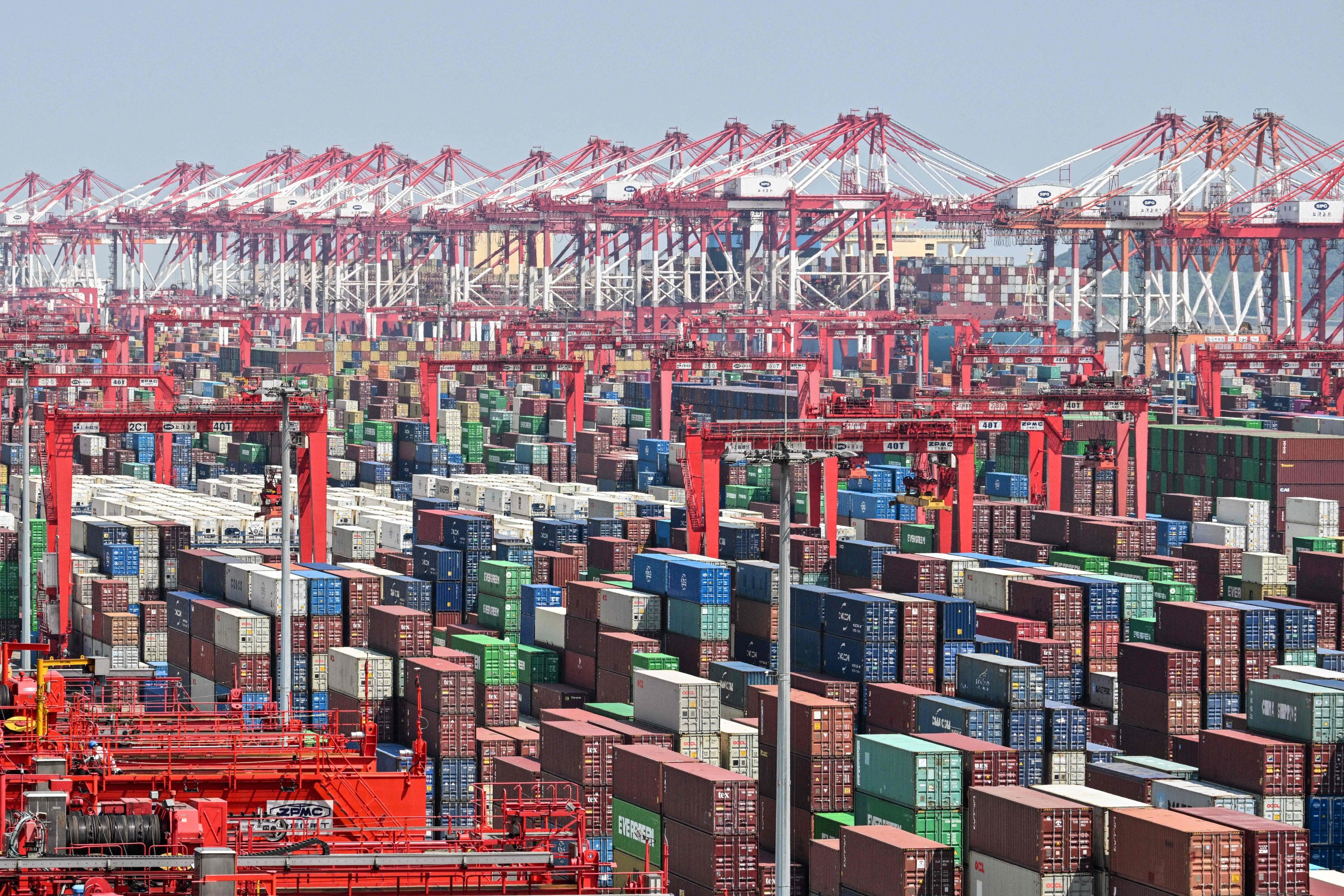
China’s May trade data point to a fragile recovery overshadowed by structural weaknesses. Exports rose 4.8% year-on-year in USD terms, falling short of April’s 8.1% growth and below Reuters' 5% forecast. A temporary tariff truce with the United States supported the figures, but a staggering 34.5% drop in exports to the U.S. (the steepest since February 2020) underscored the ongoing strain in bilateral ties. China’s trade surplus with the U.S. also narrowed sharply, down over 41% to $18 billion.
On the import side, the situation is more troubling. Imports declined by 3.4%, far deeper than the expected 0.9% fall, signaling weak domestic demand. The over-18% drop in imports from the U.S., along with falling purchases of intermediate and capital goods, suggests not just geopolitical tension but a cooling industrial sector. While rising exports to the Association of Southeast Asian Nations (ASEAN), the European Union and Africa helped lift the overall trade surplus by 25% to $103.2 billion, they do little to offset waning internal consumption. The pressure is mounting for Beijing to shift decisively from export-led growth to a consumption-driven economic model.
Beijing’s awareness of its overreliance on external demand dates back well over a decade. The 2009 stimulus package, worth 4 trillion yuan, was more than a crisis response; it marked the beginning of a gradual shift toward bolstering domestic infrastructure and consumption.
This trajectory was formalized in 2020 with Xi Jinping’s “Dual Circulation” strategy, which placed internal drivers –household spending, innovation, and supply chain resilience – at the center of growth, while positioning external trade as a support mechanism. The COVID-19 shock and intensifying geopolitical frictions only reinforced this turn inward.
Meanwhile, “Made in China 2025,” once focused on export-oriented high-tech leadership, is evolving. Increasingly, its emphasis has shifted toward linking Chinese consumers with domestic producers through sectors like electric vehicles, smart appliances and wearable tech, signaling a strategic bet on internal economic loops rather than global dependencies.
Yet, a major gap persists between policy ambition and economic realities. The barriers to scaling domestic consumption are multifaceted and deeply entrenched.
First, household income growth has slowed and become more uneven. Youth unemployment and stagnating real wages have eroded consumer confidence, encouraging households to postpone major purchases. Second, China’s high precautionary savings rate reflects widespread uncertainty due to insufficient social safety nets. With education, health care and pensions requiring significant out-of-pocket expenses, families prioritize saving over spending.
Third, the property market downturn has weakened household wealth. For decades, real estate was the primary store of value for Chinese households. Falling home prices, especially outside Tier-1 cities, have diminished perceived wealth and discretionary spending capacity.
Fourth, demographic headwinds complicate the outlook. China’s rapidly aging population and shrinking workforce reduce growth potential and further dampen consumer optimism. Lastly, inconsistent government messaging and sudden regulatory crackdowns in sectors like technology and real estate create an environment of uncertainty that affects both investors and consumers.
As “Made in China 2025” nears its conclusion, China faces a defining choice: evolve or stall. Sustaining growth now demands a bold pivot: strengthening domestic demand without dismantling the export engine that built its global standing. But this shift requires more than policy tweaks. Without deeper reforms such as rising household incomes, stronger social safety nets, and a confident consumer base, China’s transformation risks stalling.
The path from export-led expansion to consumption-driven resilience is set, but progress remains uneven. Strategic intent must now meet real reform. What happens next won’t just shape China’s future – it will reshape the global economy.