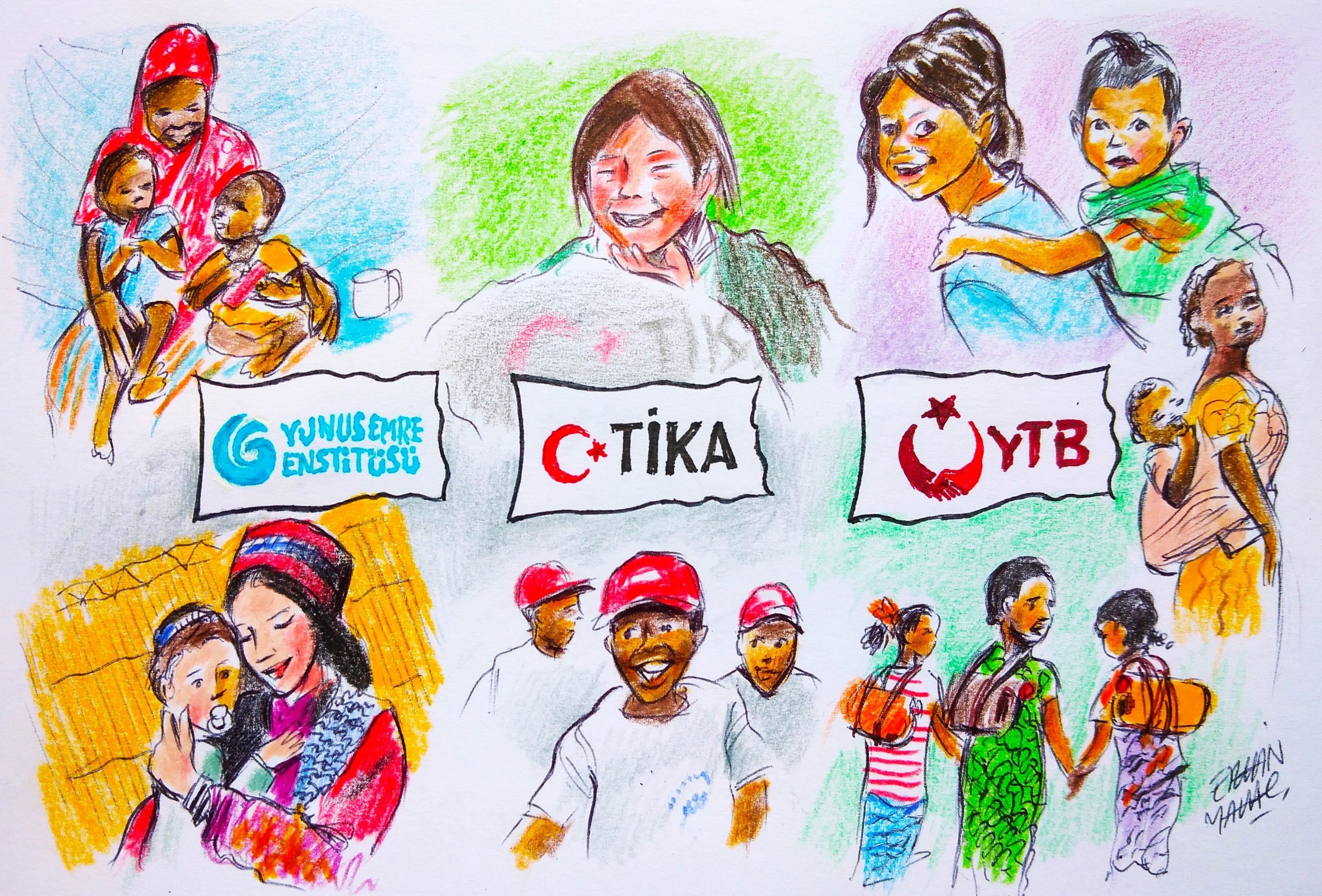
In recent years, Türkiye has witnessed a profound transformation and expansion across all domains. This transformation over the past two decades has not been limited to economic growth, major infrastructure initiatives or political stability; it has also reshaped the country’s foreign policy by building a broad and multilayered sphere of influence grounded in culture, education, humanitarian assistance and communities abroad. The most visible institutional actors driving this transformation are the Yunus Emre Institute (YEE), the Turkish Cooperation and Coordination Agency (TIKA), and the Presidency for Turks Abroad and Related Communities (YTB). Each of these institutions has distinct functions in its respective field, yet together they form a complementary ecosystem that enables Türkiye’s soft power to develop a highly layered architecture. Through initiatives in culture, language, education, humanitarian outreach and social mobility, the bonds formed with different regions around the world have strengthened both quantitatively and qualitatively.
Since its establishment in 2009, the YEE has rapidly built a remarkable institutional capacity, opening 93 cultural centers in 69 countries across the world. Through these centers, hundreds of cultural activities, concerts, exhibitions, film screenings, academic events and gastronomy programs have not only showcased Türkiye’s cultural richness abroad but have also contributed to the formation of a positive perception of Türkiye in diverse societies. This environment of cultural interaction has diversified how Türkiye expresses itself internationally.
A key dimension of the institute’s work is the teaching of the Turkish language. In 2025 alone, the institute taught Turkish language to 46,200 people. Teaching Turkish as a foreign language entails far more than transmitting linguistic knowledge; it also enables learners to understand Türkiye’s history, culture and intellectual heritage. In many parts of the world, knowing Turkish facilitates social, cultural and economic connections with Türkiye. For this reason, Turkish language instruction constitutes a significant component of Türkiye’s cultural diplomacy strategy rather than merely a language-teaching activity. Tens of thousands of people who learn Turkish are drawn toward education, trade and cultural engagement with Türkiye.
While the YEE continues its Turkish-language teaching activities, an important cultural development in recent years has further amplified the impact of these efforts. Turkish TV series and film productions have begun to attract large international audiences, enabling Türkiye’s cultural narrative to spread naturally and organically across the world. From Latin America to the Balkans, from South Asia to the Middle East, and throughout the Turkic world, rising viewership has strengthened curiosity about and affinity toward Türkiye. This development has also significantly increased the demand for learning the Turkish language. Hearing the language in popular series has motivated viewers to take a deeper interest in both Türkiye and Turkish culture. In particular, across the cultural geography of the Balkans and the Turkic States, regions connected by shared history and heritage, these productions offer a profound yet often invisible contribution to cultural remembrance. As a result, new audiences have been drawn to the institute’s courses in many countries around the world.
This linguistic and cultural interaction gains a more concrete depth through the multidimensional development and humanitarian activities carried out by TIKA. While TIKA had only 12 Program Coordination Offices in 2002, today this number has reached 63; the number of countries in which it operates has expanded from 20 to over 170; and since its establishment, the agency has implemented more than 32,000 projects. These figures clearly illustrate the scale of Türkiye’s development cooperation capacity abroad. Between its founding in 1992 and 2002, a 10-year period, TIKA implemented only 2,250 projects, whereas today it carries out nearly 2,000 projects annually. Over the past two decades, TIKA has completed the restoration of 140 historical sites across 40 different countries. These include the Drina (Sokollu Mehmed Pasha) Bridge and the Ferhadiye Mosque in Bosnia-Herzegovina; the Sinan Pasha and Yaşar Pasha Mosques in Kosovo; the Gül Baba Tomb in Hungary; the Monastir Military High School in North Macedonia, where Atatürk studied; Atatürk’s birthplace in Thessaloniki; the house where weightlifting legend Naim Süleymanoğlu grew up in Bulgaria; the Imam-i Azam Abu Hanifa Complex in Iraq; the Hamidiye Clock Tower in Tripoli, Lebanon; and the Keçiova Mosque in Algeria, among many others.
In the field of health, the construction or renovation of more than 100 hospitals, the establishment of thousands of health centers, laboratories and rehabilitation units; in education, more than 5,600 school projects; nearly 700 projects in the areas of environment, water and hygiene; close to 300 initiatives supporting women’s participation in economic life; and over 140 restoration projects aimed at preserving cultural heritage all demonstrate the breadth of TIKA’s activities. These projects strengthen Türkiye’s relations with other countries not only at the governmental level but also at the societal level. Moreover, thanks to the projects carried out by TIKA, Türkiye has maintained its position as the world’s leading country in humanitarian assistance relative to national income for the past five years.
In parallel with these two dimensions, the YTB has implemented a comprehensive strategy aimed at strengthening relations with diaspora communities and related groups abroad. The programs developed by the YTB over the past 15 years have enabled Türkiye to reinforce its ties with its citizens living abroad, enhance the visibility of the diaspora in social and cultural spheres, and build sustainable relationships with kin and related communities across the broader cultural geography. Within the scope of its Turkish-language and educational support initiatives, the YTB carries out a wide range of activities for children and young people living abroad, from bilingual education programs to Anadolu Reading Houses. Approximately 13,000 people have participated in Turkish courses, 4,500 students have benefited from weekend schools, and more than 6,000 young people have taken part in educational academies, figures that reflect the scale of Türkiye’s cultural and educational support for its diaspora.
One of the most strategic dimensions of the YTB’s work is the Türkiye Scholarships program. This initiative enables students from more than 170 countries to pursue undergraduate, master’s and doctoral degrees in Türkiye, thereby expanding the country’s global academic sphere of influence. Since 1992, a total of 125,737 students have been granted scholarships, and today, approximately 4% of all international students studying in Türkiye are enrolled under the Türkiye Scholarships program. Türkiye Scholarships is not merely an educational support mechanism; it is a tool for cultivating long-term networks of relationships. Students who come to Türkiye through this program gain academic expertise while also becoming acquainted with Türkiye’s cultural environment. Upon returning to their home countries after graduation, they form a human network that maintains ties with Türkiye and remains open to cooperation in various fields. In this respect, Türkiye Scholarships deepens the cultural and linguistic foundation established by YEE at the academic level, while simultaneously building a human-centered relational infrastructure that enhances the sustainability of TIKA’s development efforts.
When the activities of these three institutions are considered together, it becomes clear that Türkiye has built a new foreign policy ecosystem over the past two decades. Cultural diplomacy, development assistance and diaspora policy have ceased to be separate fields; instead, they have become components of a shared strategic framework, a common new language. In this way, Türkiye is developing a multilayered foreign policy approach that builds connections not only with states but also with societies, young people, academics, artists, students and local communities. This approach not only strengthens Türkiye’s position in the international arena but also enables the formation of lasting friendships and partnerships in the long term.
On the other hand, the fact that all three institutions are affiliated with the Ministry of Culture and Tourism is highly significant for integrating Türkiye’s cultural diplomacy, development cooperation, and diaspora policies within a single strategic framework. This structure enables culture, education and humanitarian solidarity to be treated as complementary components, thereby enhancing Türkiye’s visibility and appeal in the international arena. The rapid growth of Türkiye’s tourism capacity in recent years receives strong positive reinforcement from this integrated model.
YEE’s cultural activities and Turkish-language instruction, the sense of trust built through TIKA’s development projects in various countries and the lasting ties established by the YTB through diaspora engagement all directly increase cultural interest in Türkiye and the desire to visit the country. The global circulation of Turkish series, films and cultural products further strengthens perceptions of Türkiye, and this institutional synergy translates these perceptions into tangible contributions to tourism. As a result, for the millions of visitors who come to Türkiye, the country becomes not merely a tourism destination but a rich living space rooted in history, culture and art.