Acknowledging the intricate relationship of historical narratives, religious affinities and cultural bonds, Pakistan and Iran are actively strengthening their bilateral relations through collaborative efforts. This endeavor aims to fortify the enduring ties between the two countries. Within the orchestration of this symphony of connection, both countries strived to engage in a nuanced relationship of mutual understanding.
This was demonstrated when Iranian Foreign Minister Hossein Amirabdollahian arrived in Pakistan and met with his counterpart, both countries sought to calm tensions, which have risen amid the conflict in Gaza. In this meeting, both countries actively sought to calm tensions, particularly those that had risen amid the conflict in Gaza. Both countries acknowledged terrorism as a common threat requiring joint efforts, enhanced coordination and intelligence sharing. Furthermore, a mutual decision was reached to implement the deployment of military liaison officers in each other’s countries to respond efficiently to common threats. Both sides assured their commitment to maintaining peace and stability in the border region, which is an indispensable requirement for the well-being of people living on both sides.
Following Iran’s missile and drone attack in Pakistan’s Balochistan on Jan. 16, allegedly targeting Jaish al-Adl (Army of Justice) members, Pakistan responded by targeting Baloch Liberation Army (BLA) and Baloch Liberation Front (BLF) terrorists in Iran on Jan. 18. This exchange led to the recall of ambassadors and a diplomatic impasse. However, a glimmer of hope emerged on Jan. 19, when Pakistani Foreign Minister Jalil Abbas Jilani and Amirabdollahian engaged in diplomatic talks to “de-escalate” tensions. Consequently, ambassadors Tipu and the Iranian envoy are set to resume duties on Jan. 26-27, respectively, signaling a potential easing of hostilities.
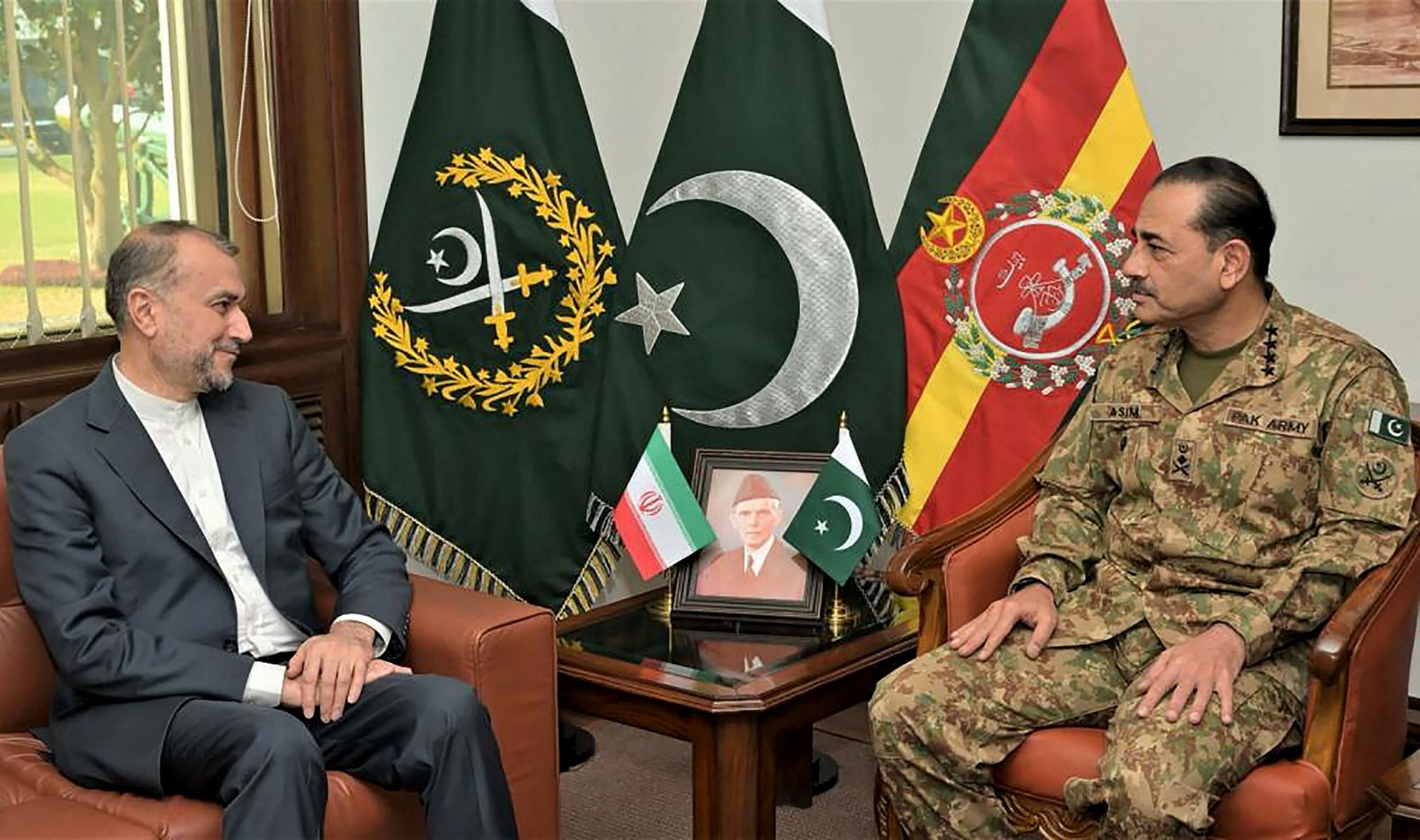
This commitment was reaffirmed during a significant meeting reported by the Inter-Services Public Relations (ISPR) on Jan. 29. During this meeting, Amirabdollahian called on the chief of army staff (COAS), Gen. Syed Asim Munir, at General Headquarters (GHQ), Rawalpindi. COAS emphasized the crucial importance of honoring another state’s sovereignty and territorial integrity, estimating it sacred, inviolable and the paramount principle in state-to-state relations. This principle guided Pakistan’s response to Iran’s airspace violation in Panjgur, Balochistan.
In response, Pakistan conducted an intelligence-based operation, "Marg Bar Sarmachar," targeting terrorist hideouts in Iran’s Sistan-Baluchistan province. This action underscored Pakistan’s commitment to respecting the sovereignty and territorial integrity of neighboring states while addressing security threats proactively. Subsequently, after Pakistan’s retaliatory strikes, Iran recognized the evolving intensity of the conflict and expressed a desire to rebuild amicable and brotherly relations.
Furthermore, the Foreign Office of Pakistan reinforced the country’s profound respect for Iran’s sovereignty and territorial integrity, highlighting its commitment as a responsible member of the international community to uphold the principles of the United Nations Charter. The statement accentuated that Pakistan’s security and national interests remain paramount and non-negotiable.
Before the Iran-Pakistan conflict, Pakistan consistently denied the presence of Jaish al-Adl and other terrorist outfits in its territory, as well as its involvement in terrorist activities against Iran. Moreover, Pakistan also provided proof to support its denial. Whenever Iran raised concerns and shared intelligence about alleged terrorist operations from Pakistan, Pakistan responded diplomatically and took action. Pakistan further provided evidence indicating the use of Iranian territory to support terrorism within Pakistan, as demonstrated by the espionage activities of Kulbushan Yadhav, an Indian navy officer. These activities were launched from Iranian soil.
Despite Pakistan’s efforts to address Iran’s concerns, Iran has not reciprocated. Tehran has conducted attacks in Pakistan without credible evidence, resulting in innocent casualties. However, as tensions flared between Pakistan and Iran, a diplomatic tableau unfolded. Global response and mediation efforts have played a pivotal role in addressing tensions. China’s spokesperson Mao Ning stepped into the spotlight, offering mediation to avert heightened tensions. The United States condemned Iran’s air raids, citing violations in Syria and Iraq, while India reaffirmed its anti-terrorism stance and the right to self-defense. U.N. Secretary-General Antonio Guterres expressed deep concern, urging both nations to exercise restraint through his spokesperson Stephen Dujarric.
Additionally, within the intricate tapestry of international alliances, the enduring bond between Pakistan and Türkiye emerges as a vibrant thread, intricately weaving together shared cultures, histories and a collective pursuit of peace and progress. This steadfast camaraderie recently found a stronger footing as Foreign Minister Hakan Fidan intervened diplomatically, engaging with his Iranian and Pakistani counterparts. The recent diplomatic efforts led by Fidan showcased a steadfast commitment to amicable relations. Fidan’s intervention, engaging with Iranian and Pakistani counterparts, sought to ease tensions following Pakistan’s retaliatory airstrikes on Iran. Expressing hope for de-escalation, Türkiye affirmed its commitment to reducing tensions between the two brotherly countries.
While recognizing the need for a broader regional approach, the Organisation of Islamic Cooperation (OIC) is expected to play a crucial role in promoting positive change. Acting as a neutral mediator, the OIC was uniquely positioned to proactively navigate diplomatic talks, foster regional collaboration and address the humanitarian dimensions of conflicts. Through its advocacy for tolerance and active engagement with the international community, the OIC can play a pivotal role in ushering stability and enduring peace in the region.
Now, the OIC must collaborate seamlessly with member states, regional allies and the global community to ensure the effective implementation of strategic measures and contribute to lasting peace in the Middle East. Unified action at the U.N. is essential to address significant issues such as the Palestine-Israel conflict and Kashmir, with collective voices raised jointly by member states of the OIC.