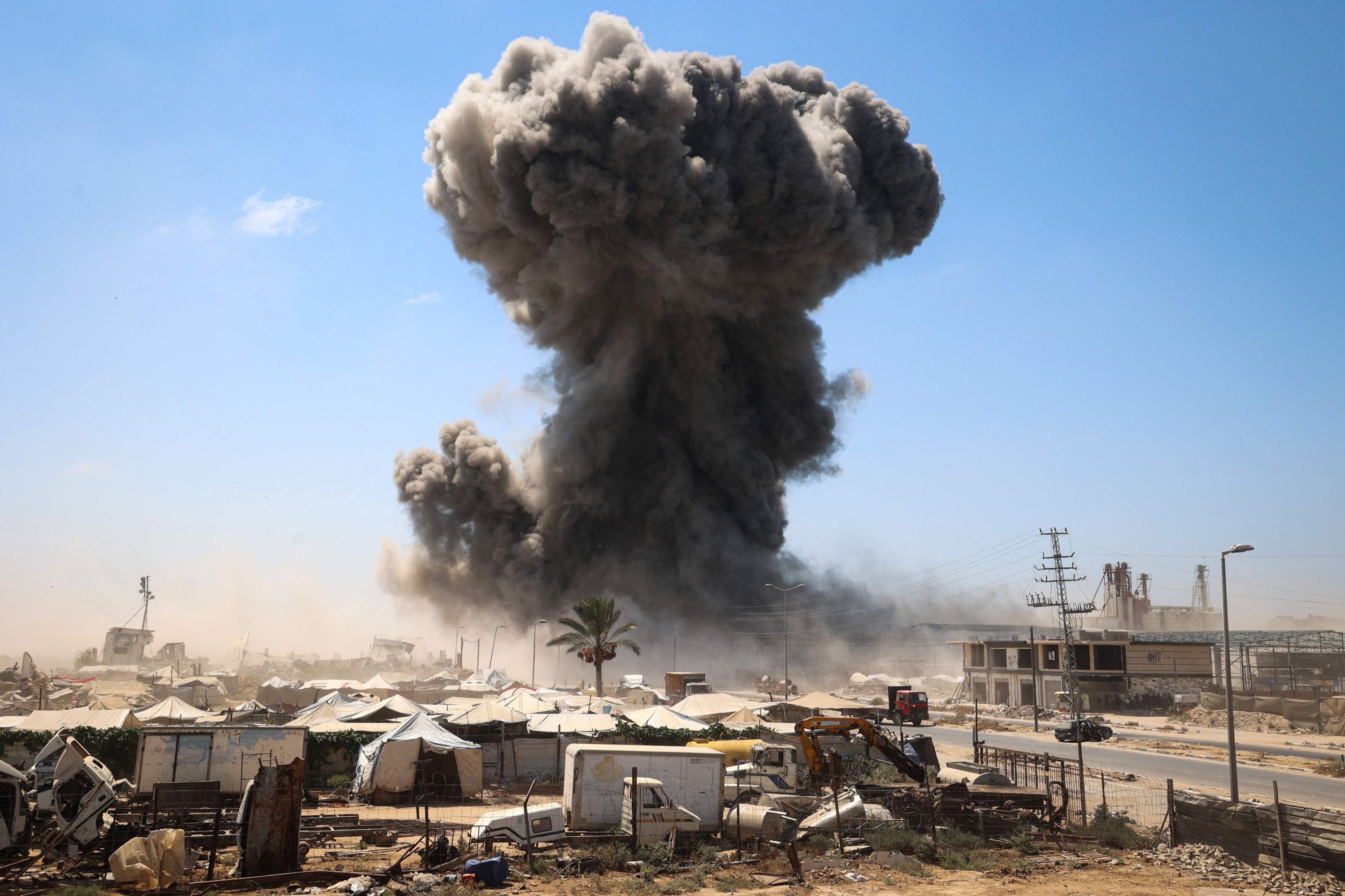
The reordering of the global agenda following the Gaza peace process downgraded human suffering in Gaza: What had been an urgent crisis begging for an immediate collective response and commanding headlines has, with the emergence of new regional wars, become a peripheral issue, an emergent low-density genocide. The cease-fire without ceasing the fire somehow reduced the international visibility of the ongoing catastrophe in Gaza without touching any of its structural drivers. Neither the settler-colonization project in Palestine nor the turbulence of the so-called international order moved one step toward resolution. Yet the numbers are lower: the murdered, the wounded and the suffering. Though destroyed, the landscape is statistically less disturbing, and now we can leave the headlines to other trivia and simply take note of the death toll.
The failure of responsiveness and responsibility is also a failure of what Simone Weil conceptualized as “attention”: the unclouded capacity to recognize the inviolable human weight of the sufferer. Gaza’s displacement within international policy hierarchies is part of a recalibration of global geopolitical attention. It gets lost among the headlines about the war in Ukraine or Iran, energy prices, the closure of the Strait of Hormuz, Indo-Pacific rivalry and anticipated attacks on Cuba.
But Gaza’s suffering has not disappeared. It has only been reorganized into a slower, institutionalized regime of physical, economic and psychological attrition. Beneath the operational cover of the cease-fire lies an ongoing strategy of spatial engineering designed to execute the de-Palestinization of Gaza. The intervention on the terrain shows how the settler-colonial project persists by reducing habitable space and altering its demographic composition. By rendering northern and central Gaza uninhabitable, the physical environment itself becomes a permanent barrier to a humane existence, creating conditions that force Gazans toward permanent southern concentration or departure.
In the meantime, the truce framework in Gaza has allowed foreign policy establishments, blinded by a diplomatic rationale, to treat the conflict as nearly “managed.” Already weak international engagement shifted from urgent intervention aimed at halting human destruction to routine technical administration and abstract discussions of future reconstruction.
Regional states are trying to bring defense, intelligence and diplomacy into closer alignment while building regional institutions capable of setting an agenda of their own. They are also investing more heavily in domestic defense industries and military technologies, seeking to loosen their strategic dependence on imperial powers. But sovereign defense industries cannot be built overnight. Neither can international institutions be reformed or a credible regional security architecture assembled in a few years. These projects take years, perhaps decades, of sustained political effort. But Gaza does not have decades. Its humanitarian crisis unfolds by the hour.
The current inability of regional states to protect Gaza is less the product of present constraints than the cumulative result of historically delayed responsibilities and strategic fragmentation. For decades, governments of the region prioritized realpolitik calculations, short-term regime security concerns and integration with colonial and imperial powers over building a unified regional security architecture.
In this context, the Mecca Joint Defense Agreement between Türkiye, Saudi Arabia and Pakistan may matter beyond the immediate calculus of deterrence. The declaration that an attack on one will be regarded as an attack on all carries weight in itself. But the agreement could mean something more consequential: regional states may finally begin turning shared vulnerability into shared strategic responsibility.
Türkiye’s answer to this impasse has increasingly been to work on two fronts: challenging the institutional structure of the existing international order while building greater sovereign capacity outside it. This includes, among other things, pressing for reform of the United Nations Security Council, changes in voting structures and greater representation for non-Western states. The agreement is another promising step toward turning abstract solidarity into an institutionalized security compact.
The real test, however, is Palestine. Türkiye’s advocacy for a binding regional guarantor mechanism for Palestine seeks to close the gap between negotiated peace and enforceable peace. For Ankara, such a mechanism is not an accessory to a settlement but a condition of its credibility: regional guarantors would assume responsibility for ensuring that the parties abide by an eventual agreement. U.S. envoy Jared Kushner’s latest round of talks with Turkish, Egyptian and Qatari mediators and Hamas representatives in Egypt, followed by talks with Israeli Prime Minister Benjamin Netanyahu, only underlined the problem. Negotiations can produce road maps, working groups and sequences of disarmament, withdrawal and reconstruction, but they cannot guarantee that commitments will be implemented.
This is where the Mecca agreement and the politics of attention intersect. If the agreement gives regional attention institutional continuity, attention can become responsibility: not a temporary recognition of suffering when Gaza returns to the headlines, but an enduring capacity to protect. If Mecca becomes yet another mechanism while Palestinians remain outside the boundaries of effective protection, it will reproduce the very architecture of selective security that has already failed Gaza. But if it becomes the nucleus of a regional security architecture capable of acting on its own, it may begin to secure the oppressed of the region.
We do not need another statement of concern, but a guaranteed mechanism of protection. We failed already to stop a genocide taking place, and we cannot fail again.