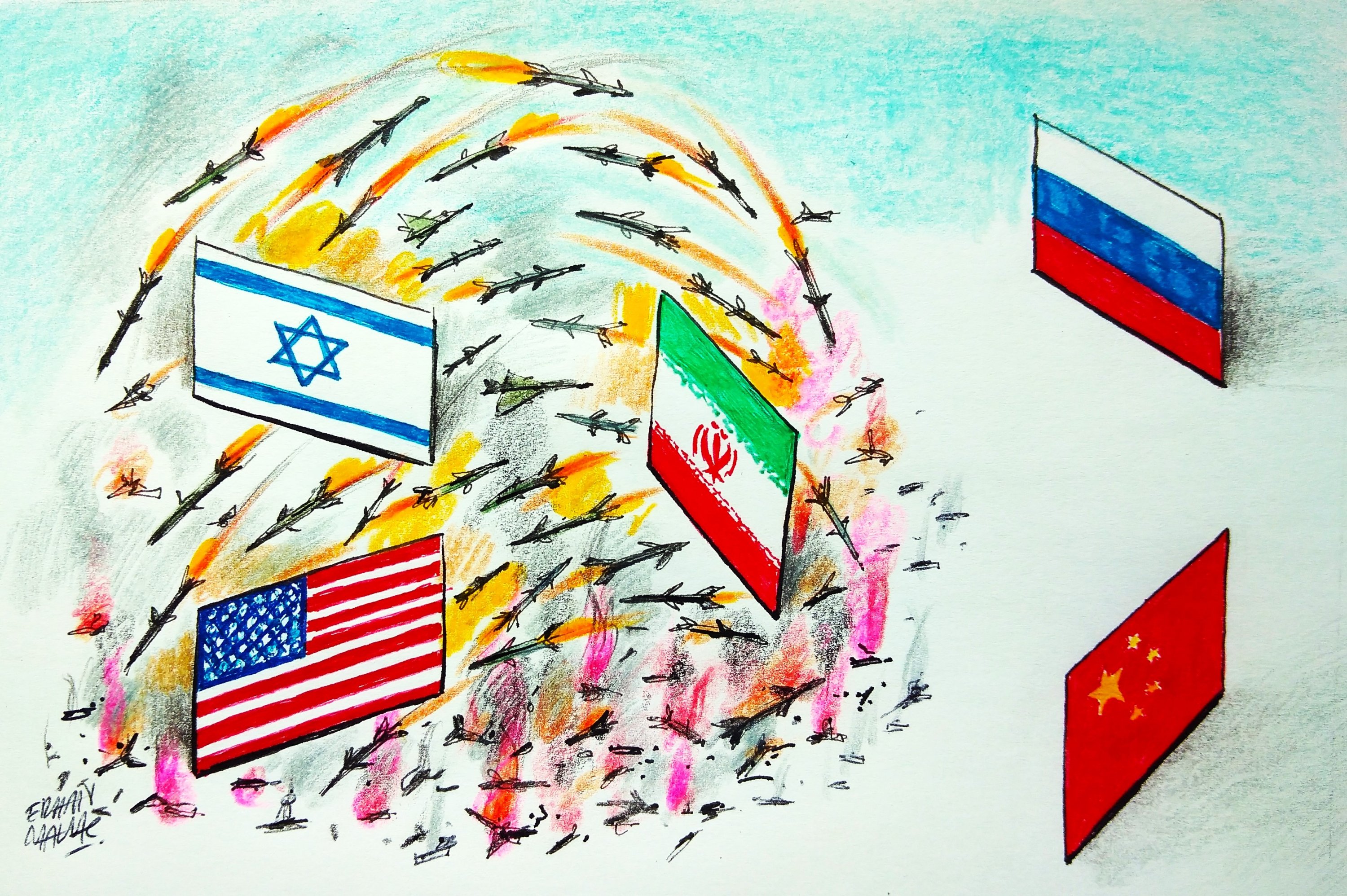
At first glance, a military confrontation involving the U.S., Israel and Iran appears to be a conflict largely confined to the Middle East. Indeed, the immediate consequences would likely be felt most intensely across the region through security instability, economic disruption and shifting alliances. Yet wars of this scale rarely remain regional in their strategic impact. Beyond the visible front lines, the geopolitical ripple effects would reach far into the global balance of power, particularly affecting how Russia and China position themselves in the evolving international order.
In the early stages of such a conflict, it might seem that both Moscow and Beijing stand to lose. Iran has become an important partner for each in different ways. For China, Iran represents a significant source of energy supply and an important node in the broader infrastructure and connectivity networks that Beijing has promoted across Eurasia. For Russia, cooperation with Iran has deepened in recent years, particularly in the context of Moscow’s war in Ukraine, where Iranian-made drones have reportedly played a role in Russian military operations. From this perspective, any serious weakening of Iran or instability that undermines its state structure could deprive both powers of a useful strategic partner.
However, geopolitical outcomes are rarely so straightforward. If the conflict were to expand or drag on for an extended period, the broader strategic picture could look very different. A prolonged confrontation in the Middle East would inevitably demand substantial American military, financial and diplomatic resources. The U.S. would likely need to reinforce regional deployments, strengthen air and missile defenses, protect shipping lanes, and maintain a sustained operational presence across several theaters.
Modern warfare is extraordinarily resource-intensive. Precision-guided munitions, air defense interceptors, surveillance platforms and logistical infrastructure are consumed at a pace that few peacetime planners anticipate. Recent conflicts have demonstrated how quickly even large stockpiles can be depleted once large-scale military operations begin. If Washington were drawn deeply into another extended military commitment in the Middle East, the strain on its military inventory and operational planning could become significant.
For Russia, such a shift could bring indirect advantages. Western support for Ukraine has relied heavily on American military assistance, particularly in the supply of ammunition, air defense systems and other advanced capabilities. If the U.S. found itself diverting a meaningful share of these resources to another theater, the scale or speed of aid to Kyiv could face new constraints. Even a modest slowdown in Western military support might provide Moscow with strategic breathing space on the battlefield or at the negotiating table.
China, meanwhile, would likely view such a scenario through a different but equally strategic lens. Beijing has long been attentive to how the U.S. manages complex military operations and balances commitments across multiple regions. Any large-scale conflict involving American forces provides a rare opportunity for careful observation. Military planners in Beijing would study operational patterns, logistical vulnerabilities and the performance of advanced weapon systems under real combat conditions.
Beyond the purely military dimension, there is also a broader strategic calculation. For several years, Washington’s strategic focus has increasingly shifted toward the Indo-Pacific, where competition with China is widely seen as the defining geopolitical contest of the coming decades. The U.S. has strengthened alliances, expanded regional military cooperation and invested diplomatic energy in counterbalancing China’s growing influence.
If Washington were forced to devote greater attention and resources to a major conflict in the Middle East, that shift could slow or complicate its strategic reorientation toward Asia. Even without a dramatic policy change, the practical demands of managing a new war could dilute the intensity of American engagement in the Indo-Pacific. For Beijing, any reduction in pressure along its immediate strategic periphery from the Taiwan Strait to the South China Sea would be carefully noted.
At the same time, both Russia and China would likely proceed with caution. Neither power has an interest in becoming directly entangled in a military confrontation with the U.S. over Iran. China in particular remains deeply integrated into the global economy, with extensive trade and financial ties to Western markets. An overt military alignment with Tehran against Washington and its allies could carry significant economic risks for Beijing, potentially jeopardizing the stability that underpins China’s continued growth.
Moreover, despite its expanding global influence, China still maintains only a limited military presence in the Middle East. While Beijing has developed economic partnerships and infrastructure projects throughout the region, it has not built the kind of security architecture that would allow it to play a decisive military role in a regional war. As a result, China’s most likely approach would be one of cautious observation, protecting its economic interests, advocating diplomatic solutions, and avoiding direct involvement in hostilities.
Russia faces a more complex calculation. Its political and military cooperation with Iran has deepened in recent years, yet Moscow is also aware that its strategic priorities remain concentrated in Eastern Europe. The Kremlin would need to balance its interest in maintaining partnerships in the Middle East with the potential benefits that might arise from a shift in American attention elsewhere.
Another factor that deserves attention lies in the technological and industrial foundations of modern warfare. Contemporary conflicts depend heavily on global supply chains that include semiconductors, advanced manufacturing components, rare earth minerals and sophisticated electronic systems. Many of these supply chains remain deeply interconnected with China’s industrial capacity.
In the event of a prolonged conflict involving Western militaries, the strain on these supply networks could become more visible. Increased demand for high-tech components and strategic materials might expose vulnerabilities within the global defense industrial ecosystem. In such circumstances, China’s central role in global manufacturing, especially in areas indirectly connected to defense production, could become a source of strategic leverage.
This does not mean that Beijing would seek confrontation. On the contrary, Chinese policymakers have consistently emphasized stability as a prerequisite for economic development. Yet structural advantages within global supply chains may quietly shape the balance of power over time, particularly during periods of prolonged geopolitical tension.
It is also worth remembering that both Russia and China tend to approach international politics with a pragmatic outlook. If internal political changes were to occur in Iran as a result of conflict or instability, neither Moscow nor Beijing would necessarily remain tied to a specific political leadership in Tehran. Historically, both powers have shown a willingness to adapt quickly to new political realities, prioritizing the preservation of strategic and economic interests over ideological alignment.
In this sense, the broader geopolitical consequences of a war involving Iran could prove far more complex than initial impressions suggest. While Tehran might bear the immediate costs of military confrontation, the indirect effects could reshape the strategic environment in ways that extend well beyond the Middle East.
The paradox is striking. A conflict that appears at first to weaken a network of states loosely aligned against Western influence could, under certain conditions, produce dynamics that ultimately benefit those same powers. If a prolonged war were to absorb American attention, stretch military resources, and complicate Washington’s global priorities, the strategic landscape could gradually shift in ways that favor competitors operating outside the immediate battlefield.
History has repeatedly shown that the outcomes of wars are not determined solely by victories or losses on the front lines. Often, the most significant geopolitical consequences unfold in the quieter arenas of resource allocation, strategic focus and long-term power competition. In such a scenario, the most consequential winners may not be the countries directly involved in the fighting, but those observing carefully from a distance, waiting for the balance of global attention to tilt in their favor.