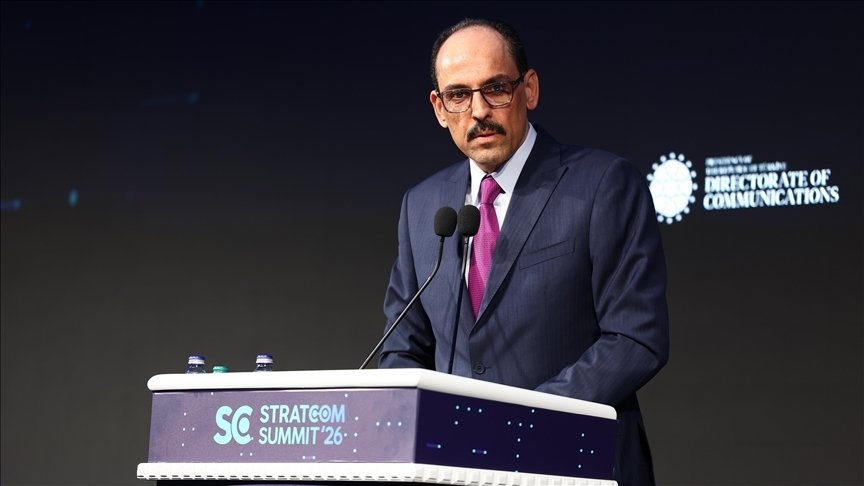
At the International Strategic Communication Summit (Stratcom) 2026 summit in Ankara, Türkiye's intelligence chief Ibrahim Kalın delivered an opening address that defied the conventions of a security briefing, instead sounding like a philosophical manifesto. He spoke about postmodernism, Mulla Sadra, and the chasm between information and wisdom. Kalın mentioned the "dark Enlightenment" and the collapse of the bond between knowledge, truth and being. This was an unusual speech for the head of a national intelligence service.
Kalın's central claim can be stated plainly: The Islamic world, including Türkiye, cannot yet think fully with its own conceptual set, and therefore cannot tell its own story in its own words.
"Even when you use your own words through someone else's grammar," he stated, "you're not using your own language. You're exhausting your own words inside another linguistic universe."
Though the formulation was philosophical, the problem was concrete, reaching far beyond specialized domains. A poor translation of another linguistic universe shapes how we read the world, understand international politics, narrate our own history to our children, and communicate all this to the world beyond us.
The formulation echoes one of the oldest questions in postcolonial thought. Literary critic Gayatri Spivak asked in 1988 whether the subaltern can speak. She was asking if those outside the dominant frame can articulate their own experience without first translating it into the language that excludes them. The postcolonial question was not rhetorical, and Spivak's answer was not reassuring.
Though Türkiye is not a "subaltern state," the question applies to the categories through which Türkiye and much of the non-Western world have been made legible: middle power, regional actor, transactional ally, emerging democracy, hybrid regime. These are not descriptions; they're positions in a sentence written elsewhere.
Sociologist Immanuel Wallerstein mapped the rooms where this vocabulary is set. The categories through which international politics are analyzed are produced in specific institutional locations: universities, think tanks, rating agencies and funding bodies. Their geographical and political concentration is not hidden but rarely named. Concepts travel from these centers outward, presented as universal, leaving countries outside the production line to describe themselves in those terms. What Wallerstein called "European universalism" is not a cultural complaint. Wallerstein called this "European universalism," a structural description of how conceptual authority has been distributed in the modern world.
Scholar of international political economy Robert Cox captured this in a sentence that has aged into precision: Theory is always for someone and for some purpose. For decades, the vocabulary through which we've been taught to read world politics – deterrence, stability, rules-based order, rogue state – has been presented as a neutral, universal toolkit. Pick up the concept, apply it to the case and produce an analysis. But these concepts are not instruments of translation between reality and thought; they are a syntax. They decide in advance what counts as a norm, which actor qualifies as rational, whose behavior requires explanation and whose is taken as the baseline. A country that describes itself exclusively through this syntax does not, in the end, describe itself. It describes the position it occupies within someone else's sentence.
The so-called rules-based order's collapse makes this problem urgent, not academic. The present moment is decisive because the syntax has visibly collapsed. When guarantors dismantle the institutions that produced the rules-based order, the normative grammar detaches from its authors' actions. The hegemonic language of the past decades has not lost its speakers. It has lost its credibility. Those of us who have internalized that grammar are now holding a map that no longer matches the terrain.
The United Nations watched the Gaza genocide unfold for years without response; its founding covenants were treated as rhetoric. International humanitarian law is suspended depending on the victim's identity. The Ukraine war exposed a European security architecture whose guarantors are insecure. The European Union faces a far-right turn, and liberal democracy is in crisis across the societies that created its theory. The architects of this order are dismantling its norms, while those trained in the older lexicon talk about a world that no longer responds.
The post-rules-based moment is the opening for this work. While the hegemonic language prevailed, speaking outside it meant isolation. That language has lost its monopoly, not because it was overthrown, but because its speakers stopped obeying its rules. The question is not about challenging it, but building a new language connecting knowledge, truth and being. The task isn't to reject reason, science or rigor. It's not a retreat from universality.
Kalın's address names the task: not separating knowledge from truth, truth from being, power from right and justice, narrative from meaning and direction. Each of those separations is a concrete failure of contemporary thought. Cox, Wallerstein and Spivak were right that the alternative is a form of speech that isn't one's own. But Kalın assures us that living traditions exist through which we can build our own language to understand our own story, in communication with the world.
This is our intellectual horizon. It is clear, and it is worth stating plainly: Our task isn't to tell our story louder but to tell it in a grammar of its own construction, built from its history, geography, values and actual position in the world. This isn't a retreat into parochialism but an insistence on absolute and universal values: refusing to separate power from justice or narrative from meaning. This is the horizon of this paradigm: constructing a grammar rooted in our own geography and history, yet speaking to the shared condition of all humanity.