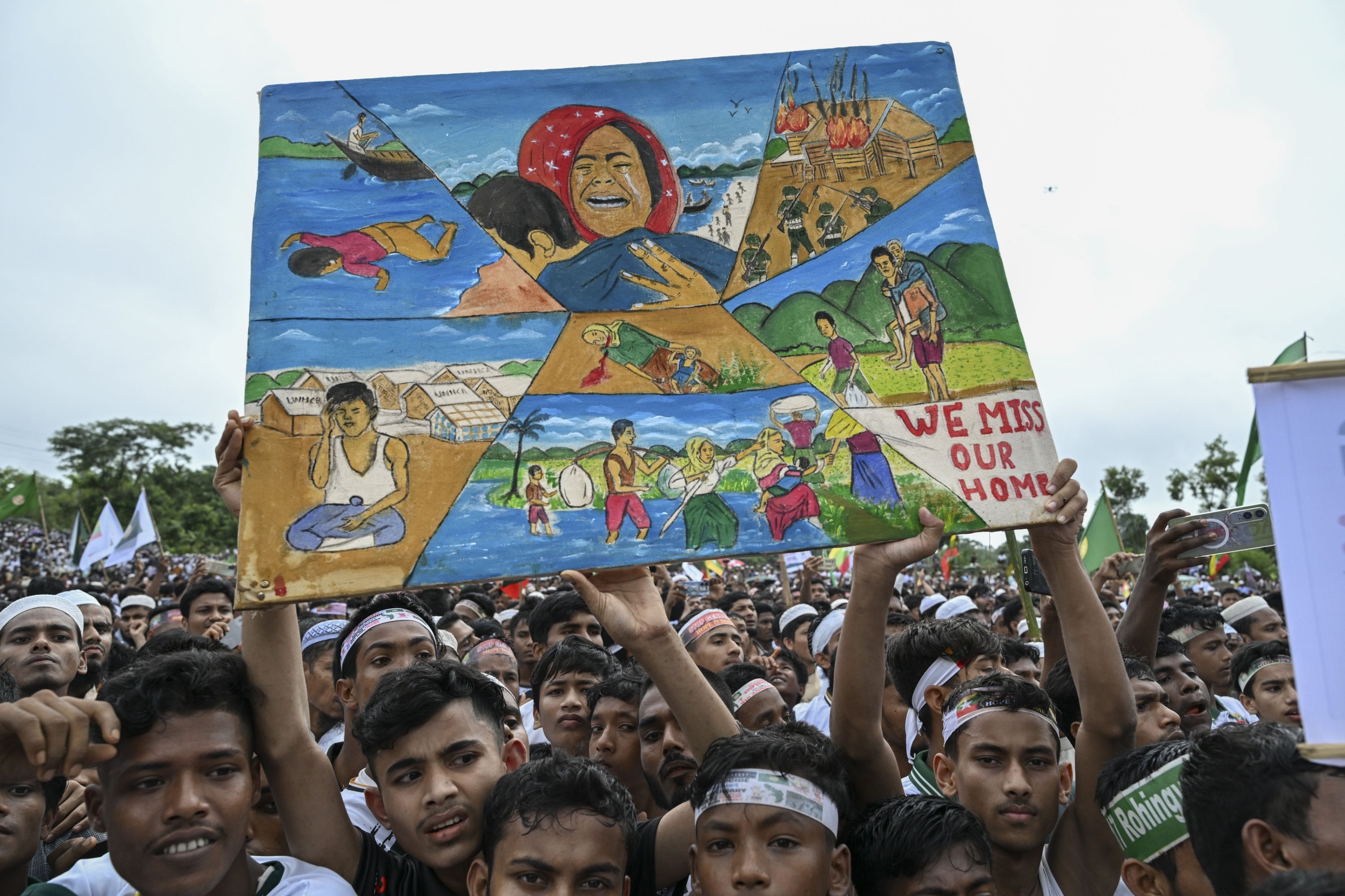
The Rohingya have become an almost forgotten cause, pushed to the margins of international attention. Such is the travesty of human suffering in our time that even Gaza, perhaps the most politically visible humanitarian catastrophe, is beginning to confront something equally disturbing: a fatigue of attention, through which the relentless repetition of suffering gradually normalizes what should never become normal.
It was against this bleak backdrop that I recently came across a video from the Rohingya refugee camps in Cox's Bazar, Bangladesh. A human rights activist describing life there made a profoundly unsettling observation: to be a refugee is almost to acquire a separate ethnicity of one's own. Refugees may share the religion, language or culture of the people among whom they live, yet they remain apart, people who belong somewhere else, but increasingly seem to belong nowhere.
How, then, does the world become accustomed to such a condition? An entire people have been torn apart, one part driven into exile, the other left behind to endure severe restrictions and the denial of recognized citizenship. On one side are people deprived of citizenship and security in their ancestral homeland; on the other are refugees living for years in overcrowded camps, dependent upon an international community whose attention inevitably moves elsewhere. Before questions of prosperity, opportunity or even dignity come something still more elemental: the right to belong somewhere, to possess a recognized identity, to exist before the law as a human being with a home and a future. That such a condition can persist in the 21st century is difficult enough to comprehend. That the rest of humanity can gradually learn to look away is perhaps the greater tragedy.
Legend has it that Siddhartha Gautama, born a prince, who attained enlightenment and became the Buddha, the founder of one of humanity's most profound traditions of pacifism and nonviolence, renounced princely life after confronting the inescapable reality of human suffering. There is, therefore, a painful irony in what has unfolded in Buddhist-majority Myanmar. A country whose civilizational inheritance is deeply associated with Buddhist thought has subjected one of its most vulnerable minorities, the predominantly Muslim Rohingya, to extraordinary persecution and violence.
There is a second irony. The worst phase of this persecution came in 2017, when Aung San Suu Kyi, the Nobel Peace Prize laureate who had spent years resisting military rule and had become a global symbol of democracy and human rights, was Myanmar's de facto civilian leader. The military retained control of the security apparatus. Still, the moral contradiction was inescapable: while Suu Kyi embodied resistance to authoritarianism, an entire community was being driven from its ancestral homes and reduced, in practice, to statelessness. The contradiction deepened when she appeared before the International Court of Justice in 2019 to defend Myanmar against allegations of genocide.
The persecution of the Rohingya should not, therefore, be attributed to Buddhism. What failed was a political and majoritarian mindset that betrayed the very values it professed. No great religious or philosophical tradition can reasonably be defined by acts of violence committed in its name that fundamentally contradict its teachings. Extremism may appropriate the language and symbols of religion, but appropriation does not make religion its source.
Islam has frequently been constructed as the civilizational “other” within the contemporary international system, with the actions of violent groups too readily associated with an entire faith and civilization. Could the Rohingya also be suffering, at least in part, from the consequences of this deeper othering, the unconscious assumption that Muslim suffering is somehow familiar, recurrent and therefore less exceptional? When a people are persistently perceived as the “other,” there is a danger that their suffering too becomes othered: acknowledged, occasionally deplored, yet gradually accepted almost as their inevitable fate.
It is against this larger question of selective perception that the scale of the Rohingya predicament needs to be understood. Their citizenship rights were progressively stripped away, most consequentially under Myanmar's 1982 citizenship framework, leaving most of them effectively stateless. The military operations of 2017 then drove more than 700,000 into Bangladesh. Nearly a decade later, their fundamental predicament remains unresolved: where do they belong, under whose protection can they live, and through what political mechanism can their citizenship, security and dignity be restored?
The contrast with some other struggles for self-determination is striking. East Timor, a small predominantly Catholic territory under Indonesian rule, eventually achieved independence following a U.N.-organized popular consultation in 1999. South Sudan, with a predominantly Christian and traditional-faith population, became independent following decades of conflict, the 2005 Comprehensive Peace Agreement and the internationally supported referendum of 2011. In both cases, the international system helped create a pathway through which prolonged conflict and persecution could eventually lead to an internationally supported exercise of self-determination.
Why, then, can the international system create pathways toward political resolution for some peoples while allowing the plight of the “othered” to remain unresolved for generations?
An international order cannot claim universality merely through the language of universal rights; its universality must ultimately be measured by the consistency with which those rights are defended.
An order that treats the suffering of one people as an intolerable emergency while allowing that of another – Gaza today, the genocide of Bosnian Muslims at Srebrenica then, the continuing catastrophe in Sudan, or the prolonged tragedy of the Rohingya – to become an enduring condition can scarcely sustain its claim to universalism. Perhaps this is the deeper crisis of our time: the international system as we have known it is broken, and the promise of universality on which much of its moral legitimacy rested stands profoundly discredited.