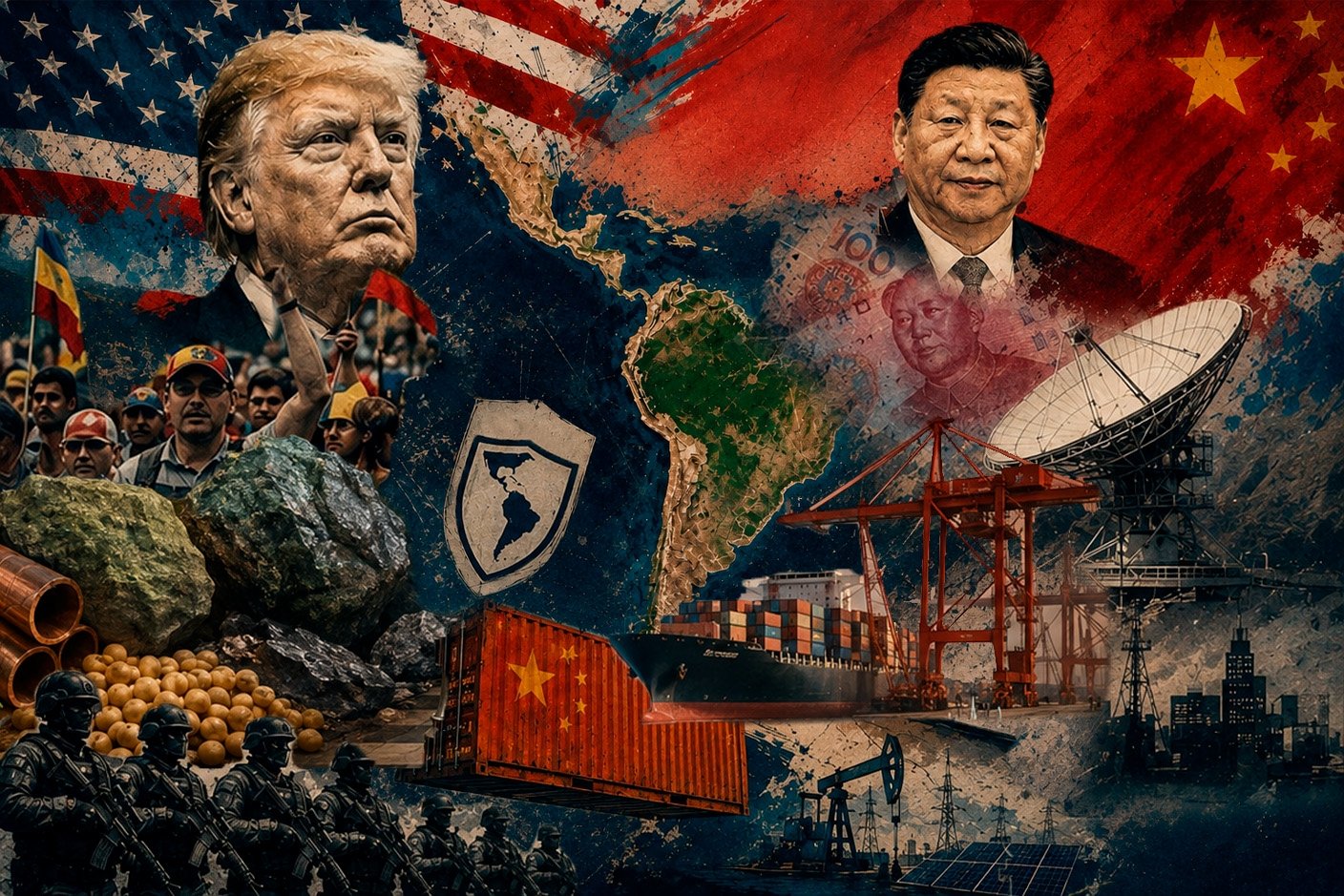
U.S. President Donald Trump’s inauguration in January 2025 accelerated a shift in U.S. foreign and strategic policy. Faced with China's rise, Washington is now abandoning many of the liberal principles that underpinned the U.S.-led global order, as reflected in its renewed emphasis on great-power competition and strategic rivalry.
Multilateralism, globalization and economic interdependence are no longer seen as foundations of the American superpower, but as vulnerabilities threatening U.S. sovereignty and prosperity.
Nowhere is this shift more evident than in Latin America, where the U.S. is reasserting its dominance by recasting economic and political engagement through a security lens. Trump’s 2025 National Security Strategy (NSS) leaves little doubt: The Western Hemisphere is once again a top security priority.
Washington’s newfound anxieties are hardly unfounded. Beijing has become deeply embedded in Latin America, filling the vacuum left by decades of uneven U.S. engagement.
Between 2000 and 2023, China-Latin America trade expanded more than twentyfold, reshaping the region's external economic orientation and accelerating its diversification away from exclusive U.S. dependence.
China is now the region's second-largest trading partner and has surpassed the U.S. economic influence in South America. Meanwhile, Latin America supplies critical minerals, agricultural commodities and energy essential to China's industrial strategy, supply chain dominance and efforts to reduce dependence on U.S.-controlled markets.
Yet, Chinese sovereign lending has declined sharply since 2015, and Beijing accounts for only 3% of regional debt. However, its investments, from Chilean power grids and Argentine energy projects to Peruvian ports and mining operations, are strategically significant. Moreover, 11 countries have joined the Belt and Road Initiative (BRI), translating economic ties into diplomatic and strategic alignment.
Political considerations are equally important. Beijing has leveraged trade, investment and unconditional aid to garner support for its national reunification agenda among Taiwan’s remaining seven allies in the region and promote regional decoupling from U.S. dependence.
The age of uncontested U.S. primacy in Latin America is over. But so is the era of relative neglect, as Beijing has challenged Washington’s long-assumed role as the region’s primary security and economic partner.
The U.S. no longer sees commercial partnerships in the region as engines of growth. While China is framed as an economic competitor globally, the NSS presents it as a geopolitical and security threat in the Americas. Now, critical minerals and strategic infrastructure are viewed as vectors of malign foreign influence within the broader U.S.-China rivalry.
In response, the U.S. re-entered the region aggressively.
Washington’s Jan. 3 removal of Venezuelan President Nicolas Maduro was part of a broader effort underway to contest China’s influence and undercut its access to strategic resources and assets.
By taking control over Venezuela’s oil sales, Washington disrupted a core pillar of Beijing’s regional presence. China had relied on discounted crude, around 470,000 barrels per day in 2025, roughly 4.5% of its imports, to service more than $62 billion in oil-backed loans since 2000.
The shift has immediate consequences for China’s energy security as Beijing is forced to either purchase oil at market prices or secure more expensive alternatives. At the same time, the U.S. control over export flows redirects both revenues and supply chains toward American interests, including U.S. Gulf refineries.
Yet, while the U.S. tilted the geopolitical dynamics in the region, Caracas has not defaulted on the outstanding U.S.$7-10 billion owed to Beijing. Neither has it expelled Beijing’s commercial presence, embedded in telecommunications, digital governance and logistics.
To the same end, the U.S. has also relied on coercive diplomacy, including tariffs and sanctions. It pressured Panama to withdraw from the Belt and Road Initiative (BRI) and cancel the Hong Kong-linked Panama Canal port concession, strengthening Washington’s foothold over a critical global chokepoint.
Yet, China is still the canal’s second-largest user and a major source of revenue for Panama, while retaining stakes in logistics, telecommunications and energy. It has also pushed back by intensifying inspections of Panama-flagged vessels in Chinese ports, underscoring that its economic leverage cannot be easily displaced.
Extracting concessions at gunpoint has not resulted in the region’s universal shift away from Beijing. Nor has it diminished China’s commercial appeal. Latin American governments are not choosing between Washington and Beijing so much as hedging between them. While few openly embrace China as a geopolitical alternative, many seek to maximize leverage by engaging both powers.
Without meaningful economic incentives, Washington has done little to jeopardize China's commercial appeal. Beijing has continued expanding its trade footprint while positioning itself against U.S. protectionism and gunboat diplomacy.
Washington's retreat from multilateralism and democratic promotion has also strengthened Beijing, narrowing ideological differences between the two powers and enhancing the appeal of Beijing's "win-win" model.
Unable to match China's market appeal, the U.S. is constructing an alternative model: embedding economic and political engagement within a U.S.-led security architecture.
Announced in March, the "Shield of the Americas" represents the operational arm of the NSS’ "Donroe Doctrine." Ostensibly focused on narcotics trafficking and migration, it offers a competing pathway to regional influence.
Its 17 signatories, all center-right or right-wing governments, share hardline approaches to crime and immigration. And Washington is leveraging these shared priorities to structure security cooperation aligned with U.S. foreign policy objectives.
In contrast to China's trade and investment-led model, security is the main lever for Washington. This reflects a shift in U.S. statecraft under Trump, who has redefined sovereignty in terms of control not just over territory but supply chains, political alignment and strategic infrastructure.
By projecting domestic political and economic interests outward, Washington has recast China’s regional presence as a security threat, enabling collective security responses across aligned governments.
Securitizing interdependence thus serves a dual purpose: It legitimizes influence-building while reducing accusations of neo-colonialism, even as Washington continues weaponizing economic interdependence through tariffs and sanctions.
Freeing itself from the liberal institutional constraints that helped facilitate China's rise as a counter-hegemon requires Washington to build dependency through something other than the free-trade "win-win" model.
This is precisely what the initiative seeks to achieve.
Security assistance, intelligence-sharing and financing are increasingly conditioned on alignment with U.S. strategic priorities. Through the Americas Counter-Cartel Coalition, Washington is offering lethal assistance, Special Forces cooperation and intelligence support, while the Americas Infrastructure and Energy Compacts provide alternatives to Chinese-backed ports, energy and telecommunications projects.
As access to security guarantees, capital and infrastructure becomes contingent upon strategic loyalty, the U.S. is building regional influence through securitized dependence.
Yet, unless Washington offers a credible alternative to China's markets and capital, Latin America will continue hedging between the two powers rather than decisively aligning with either.