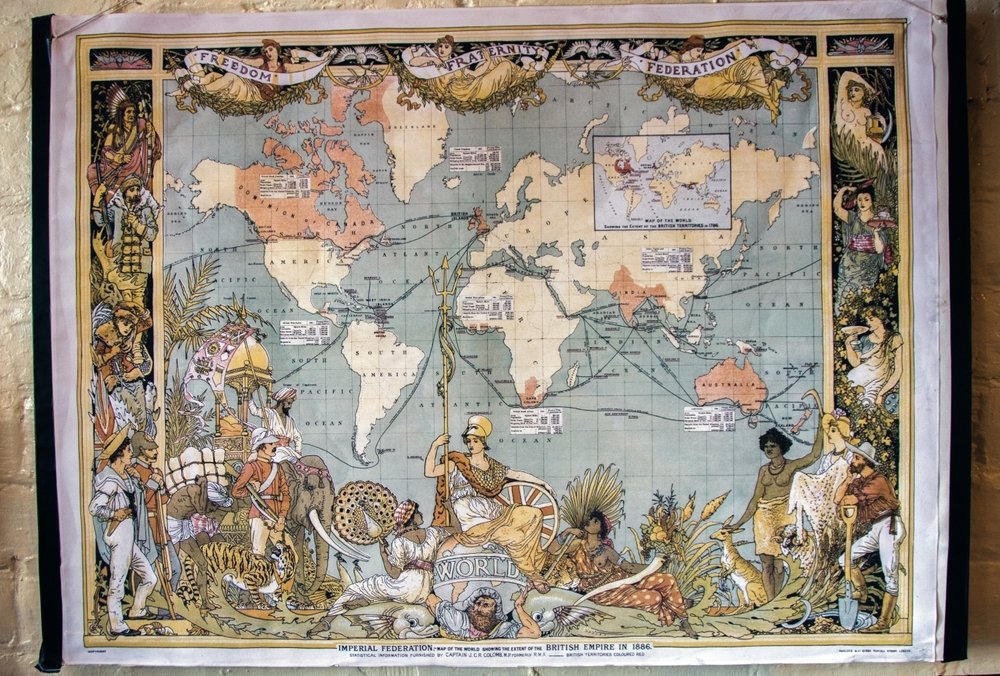
There is a world map that cannot be found in any atlas. It shows neither mountains, nor rivers, nor borders inherited from colonization. It depicts something else: the invisible geography of Western outrage, where some countries are circled in red, marked as “threats to democracy,” while others, though ruled by openly authoritarian regimes, shine in green, labeled “strategic partners.” And yet, this is not a cartographic error. It appears to be the silent logic of a world order where principles travel in business class, but only to certain destinations.
We all watched as Caracas was ordered to "return to democracy" over the course of several months. Sanctions, sharpened like knives long since stored in an imperial drawer, continued, followed by speeches about electoral fraud, narcotrafficking, authoritarianism, a dangerous drift and so on. And finally, the scenario had played out again, almost mechanically, as Washington raised its voice, leading to the capture of the Venezuelan president, Nicolas Maduro. The play was well-rehearsed. Except for the change in actors, the script remains the same, exactly as it has been in some previous cases.
And as the spotlight shone in Venezuela, another scene was unfolding, thousands of kilometers away. That of an African president welcoming Western diplomats to a brand-new presidential palace, where mining contracts are awaiting signature and security cooperation is to be discussed. Polite smiles are exchanged. Yet, in his country, the opposition is suffocating, demonstrations are being dispersed, the media are whispering cautiously, and elections are as predictable as the winter season. Yet: no embargo. No asset freeze. No emergency summit. And here, a question arises, simple but brutal: What makes a dictator unapproachable and another one respectable?
When you think about it, it's not a question of principles. It's a question of position on the chessboard. The West likes to present itself as the guardian of an order founded on universal values. For them, democracy, freedom, transparency and respect for international law are a sacred temple. The rhetoric is beautiful, almost liturgical. But as soon as one observes the practices, another reality is revealed: These values function like a diplomatic passport with conditional validity. They are demanded with surgical precision by some and suspended with remarkable flexibility by others.
From all that I've been hearing on the internet since the crisis, I read comments from Venezuelans like “we aren’t sanctioned because we lack democracy. We’re sanctioned because we have too much oil and not enough obedience,” and “if Maduro privatizes everything tomorrow and opens the floodgates, he’ll become acceptable.”
Such statements had the brutal clarity of truths that are understood too late by most of the international public opinion. It alone sums up the true geography of the double standard, according to which the fault line in the contemporary world doesn’t separate democracy from dictatorship but follows the line between alignment and dissent.
Let's consider, for instance, the notion of "stability." That magic word in diplomatic vocabulary. In some nations of the Global South, regimes have held onto power for decades. In those countries, constitutions have been rewritten, opponents neutralized at will and the media muzzled. But as long as these governments guarantee access to resources, security cooperation or the limitation of migration flows, they become "pillars of regional stability." The word authoritarianism vanishes as if by magic. Criticism becomes a whisper, and morality gives way to realpolitik. Why such selective silence? Because certain African soils, for instance, speak a language Washington understands perfectly: uranium, cobalt, lithium, gas, etc. Some of the continent’s capitals offer well-positioned military bases. Their borders act as barriers against migration. These are the true criteria of contemporary political respectability.
At the same time, terminology suddenly changes for states that dare to challenge the dominant economic or geopolitical architecture. Their leaders become "dictators." Their elections, labeled "shams,” are disqualified before they even take place. Their sovereign decisions are perceived as provocations. It is no longer a question of internal governance. It is a crime against the established order.
Sanctions are the most brutal expression of this system. Presented as tools of moral pressure, they function like modern-day economic sieges. They strangle currencies. Paralyze industries. Weaken states and, of course, strike first, populations. Then it is explained that this suffering is necessary. That it is educational. That it is “for their own good.” Tragic irony: democracy is being bombarded with humanitarian sanctions. The Venezuelan crisis is therefore more than just a Latin American episode. It is a global revelation. It shows that the principles invoked by the West are not false, but conditional. They are not universal. They are contractual.
Meanwhile, other massive human rights violations receive muted reactions. Calls for dialogue are made. “Gradual reforms” are encouraged and supported. The importance of respecting national sovereignty is reiterated. The language suddenly becomes delicate, respectful, almost timid. Indignation is selective. Calibrated. Stratified.
Yet, this system has a profound consequence: It erodes the moral credibility of those pretending to defend the universality of values. But the truth is, we cannot proclaim democracy sacred and treat it as an adjustable diplomatic tool. We cannot invoke international law against some and circumvent it for others. We cannot talk about sovereign equality while ranking the legitimacy of states according to their strategic utility.
Thankfully, in the Global South, this contradiction is no longer ignored. It is observed. Debated. Integrated. It fuels a growing weariness with Western sermons. It explains why many countries are now seeking other partners, other trade corridors, other financial structures, other diplomatic balances. Not out of a naive love for new empires. But out of an instinct for survival in a system that reminds us daily that morality is a matter of perspective.
Because when a world order teaches you that your principles will be judged harshly, while those of your partners are negotiable, you learn to relativize moral lessons. You understand that the language of values often masks the language of interests. And you begin to speak a different language.
This is not about idealizing authoritarian excesses wherever they exist. The Global South doesn't need inverted mythologies. But it demands one simple thing: consistency. If democracy is a universal value, let it truly be so. If human rights are sacred, let them not become bargaining chips. If sovereignty is respected, let it not be conditional on docility.
Venezuela, in this story, is not an exotic exception. It is a mirror. A mirror reflecting the moral geography of our time. A geography where borders separate not only states, but also the value placed on their sovereignty.
And as long as this map remains undrawn, Western indignation will continue to be perceived, in the Global South, for what it has become: not the voice of universal conscience, but the polite accent of self-interest.
The 21st century will remain multipolar, contested and argued. Not because a new empire will replace the old, but because too many people have learned to read the invisible map of double standards. And once you've seen the map, it's impossible to pretend it doesn't exist.