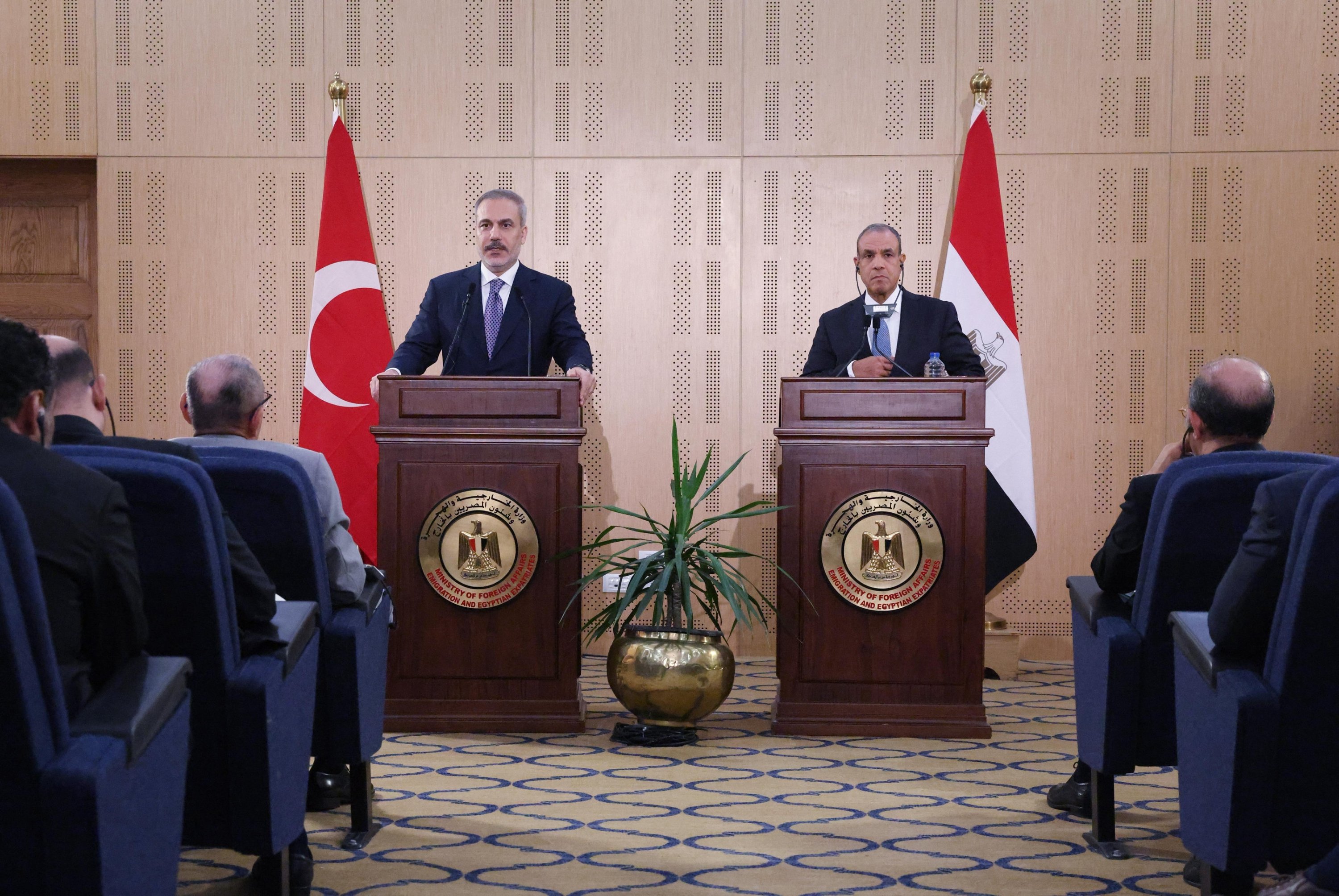
The instability in Syria, the collapse of state authority in Lebanon and Israel's attacks on Palestine, particularly Gaza, have pushed the Levant region to the brink of total chaos. When Libya’s fractured political landscape is taken into account, it becomes clear that these crises are not merely internal but have also spilled into the Eastern Mediterranean, dragging the entire region into instability. Instead of being defined by commerce and economic dynamism, the Eastern Mediterranean and Levant are now synonymous with conflict and disorder, eroding their importance on the global stage. In short, this environment of instability has a profoundly negative impact on the entire region. In this context, Türkiye and Egypt, the two most influential countries in the region, have recently begun to engage in close contact to overcome these negative developments and, in particular, to prevent external interventions. Such contacts carry the potential to serve both countries’ national interests while contributing to broader regional stability.
Ankara and Cairo are gradually leaving behind a period of muted diplomacy and moving toward cautious engagement. The clearest sign of this change has emerged in the Eastern Mediterranean, where Egypt no longer accepts Greece’s far-reaching maritime claims. On July 8, 2025, Cairo officially rejected Greece’s Maritime Spatial Planning map, which had sought to stretch Athens’ influence across the Aegean and Eastern Mediterranean. While Egypt’s response was first and foremost about protecting its own national interests, it also demonstrates that it takes into account the interests of Libya in the west and Türkiye in the north. This shift not only weakens Greece’s leverage but may also complicate its alignment with the Greek Cypriot administration.
Libya is becoming the second arena where this shift is most visible. Instead of fueling divisions, Türkiye and Egypt are working to engage all sides. Ankara has strengthened ties with the U.N.-recognized government in the west, while also reaching out to power centers in the east, long aligned with Cairo. Some significant steps, such as reopening the consulate in Benghazi, restoring flights, high-level ministerial visits, and intelligence contacts, reflect a new mindset. For the first time in years, Ankara and Cairo’s approaches to Libya are converging, laying the groundwork for a partnership that could transform not only Libya’s trajectory but also the balance of power across the Eastern Mediterranean.
This warming relationship also has implications beyond the Mediterranean. Egypt is a major player in the Red Sea and the Horn of Africa, while Türkiye has built strong partnerships and investments from Somalia to Ethiopia and from Djibouti to Sudan. The rapprochement between Ankara and Cairo could therefore provide fresh momentum for stability in one of the world’s most strategically significant regions.
The political rapprochement between Türkiye and Egypt has begun to evolve into historic cooperation in the defense industry sector. Cairo’s preparations to join Türkiye’s Kaan fighter jet program highlight not only the strengthening ties between the two countries but also the possibility of a shifting military balance in the Middle East.
A shared priority for both governments is reducing dependence on external suppliers by advancing their domestic defense industries. In this light, Egypt’s potential participation in the Kaan project represents a turning point. Such an initiative offers Ankara and Cairo their best chance to counter Israel’s long-standing dominance in regional air power. While Washington continues to provide Israel with cutting-edge fighter jets without interruption, Türkiye and Egypt often encounter sanctions or restrictions. Against this backdrop, Kaan emerges as the only viable path to narrowing the gap. Egypt’s willingness to adopt and contribute to the project shows that bilateral ties may evolve into a deeper, more strategic partnership.
This intent has been reinforced by Egyptian Chief of Staff Gen. Ahmad Khalifa’s visit to Ankara in May 2025, where he engaged with leading Turkish defense companies and met senior officials. These contacts suggest that defense cooperation will likely extend beyond Kaan, opening the door to broader collaboration ranging from technology transfer to the sharing of expertise.
As Israel’s massacres in Gaza escalate, not only does the international community remain silent, but regional states have also failed to present a united response. This makes it imperative for countries in the region to put aside their differences and act together for Gaza, applying the pressure needed on Israel and sending a clear message to Washington, its main sponsor. In this light, the fact that two influential countries in the Islamic world, Türkiye and Egypt, have entered into closer cooperation and begun to share a common perception of threat is highly significant. Israel’s actions in Gaza, which trample on human rights and fuel regional instability, can no longer be overlooked. While opposition from fragile states such as Syria, Lebanon, Yemen or Libya carries symbolic value, their ability to impose sanctions is virtually nonexistent. By contrast, Türkiye and Egypt stand in a different category: their steps toward deeper cooperation hold the potential to apply real pressure on Israel and curb its attacks, especially in Gaza.
When looking at the threat perceptions of both Türkiye and Egypt, one reality stands out: Israel has become an increasingly unpredictable and disruptive actor for both nations. From its strikes on the Rafah crossing and disregard for Egypt’s sovereignty, to its persistent efforts to destabilize Türkiye’s neighborhood and fund separatist groups, Israel’s actions reinforce a shared sense of threat. What makes this picture even starker is the role of global powers, chiefly the U.S., whose diplomatic, military and financial backing enables Israel’s unchecked behavior. In such an environment, regional states are left to chart their own destinies. It is within this dynamic that Türkiye-Egypt relations take shape, driven by common interests, common perceptions of threats and necessities.