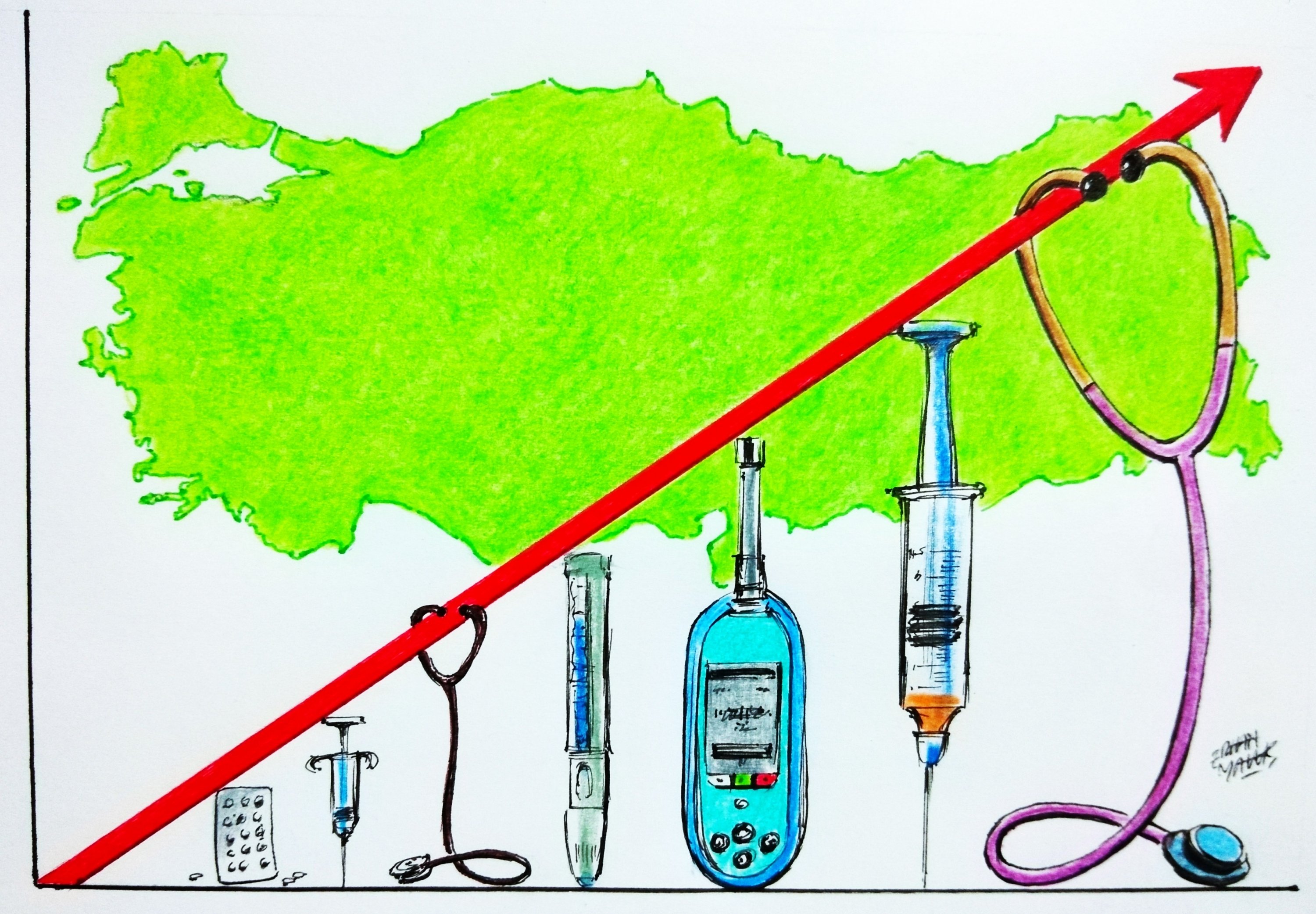
Over the past two decades, Türkiye has undergone a silent revolution in social policy and health care. Infant mortality has declined, life expectancy at birth has risen, and Türkiye has reached a point where it surpasses many European countries in access to health care. Health infrastructure has been renewed, the General Health Insurance scheme has achieved near-universal coverage, and both preventive and curative services have expanded. Yet, the sustainability of these gains is now being tested by a new and insidious threat: the extraordinarily rapid spread of non-communicable chronic diseases, particularly diabetes. Türkiye now faces a "diabetes pandemic."
The number of adults (aged 20-79) with diabetes in Türkiye has increased rapidly over the past two decades. According to the International Diabetes Federation (IDF), the figures are as follows: in 2000, there were approximately 1.8 million adult diabetes patients; by 2011, this number had risen to 3.5 million; and by 2024, according to IDF estimates, it had reached 9.6 million. These data show that the number of adults with diabetes increased more than fivefold between 2000 and 2024.
Academic studies confirm this trend. The Turkish Diabetes Epidemiology (TURDEP-I) study (1998) found an age-standardized diabetes prevalence of 7.2%, while the TURDEP-II study (2010) reported a prevalence of 13.7%. Even more alarming, the age-standardized prevalence rose from 7.9% in 2011 to 16.5% in 2024. This means the rate has nearly doubled every decade. Such a growth rate resembles the epidemic curve of a communicable disease.
Data on medication use are reported not in terms of "number of prescriptions" but rather in terms of consumption volume (DID: defined daily doses per 1,000 population per day) or expenditure. The most comprehensive recent data come from the Trends in Drug Utilization During COVID-19 Pandemic in Türkiye study covering 2018-2022. According to this study, the daily antidiabetic consumption per 1,000 population was 123.6 DID in the pre-pandemic period (March 2018-March 2020), rising to 156.3 DID during the pandemic period (March 2020-March 2022). This indicates a significant increase in a short time. In the same study, oral antidiabetic consumption rose from 71.2 DID to 90.6 DID, while the use of newer drugs such as SGLT-2 inhibitors also increased during this period.
As a longer-term indicator, according to a statement by a health care union based on Organization for Economic Co-operation and Development (OECD) data, antidiabetic medication use in Türkiye increased by 67% from 2013 to 2023. Although Türkiye has risen to the OECD average in antidiabetic medication use, the upward trend over the past two decades is striking. However, there is an important data limitation here: information on the "number of medication uses" (e.g., how many prescriptions were written or how many boxes were consumed annually) is not available as a regular, reliable, and publicly accessible series. The academic studies available generally report consumption volume (DID) or expenditure over a specific period. Therefore, it is more accurate to assess the increase in medication use through "consumption volume" or "expenditure" rather than "number."
Türkiye is not only experiencing rapid growth domestically; it is also by far the leading country in the European region in terms of diabetes prevalence. The IDF explicitly states that Türkiye ranks first in the European region in both the number of adults with diabetes and prevalence. Türkiye's rate of 16.5% is double that of neighboring Greece (approximately 8%) and far above countries such as Italy. This reveals the seriousness of the problem.
What makes this picture even more grim is that the disease burden remains largely undiagnosed. Among the approximately 9.6 million patients, 45.5%, which is about 4.37 million people, remain undiagnosed. This means that a large number of people are unaware of their condition and are living at risk of complications. Moreover, in 2024, diabetes-related deaths accounted for 12.2% of all deaths among those aged 20-79. This burden seriously affects not only individual health but also the health care system and the economy.
In 2024, direct health care expenditures related to diabetes in the Turkish economy amounted to approximately $9.66 billion. The annual economic cost of this disease, with which one in every six adults in Türkiye struggles, reaches $29 billion when indirect costs are included. If no action is taken, this figure could approach $50 billion by 2050 due to chronic diseases associated with diabetes. This picture shows that diabetes is no longer merely a health issue but a strategic threat to public finance and the social security system.
It is possible to say that Türkiye is experiencing a "diabetes pandemic." The term pandemic here is used as a metaphor to describe the extraordinary spread of a non-communicable chronic disease, rather than the outbreak of a communicable disease like COVID-19. The situation in Türkiye supports this definition in terms of data and comparisons: high prevalence, rapid increase, a high rate of undiagnosed cases, and a heavy disease burden all coexist.
Diabetes is not transmitted through the respiratory route or contact; its pathogenesis is closely related to factors such as lifestyle, obesity, genetics and aging. Therefore, it cannot be controlled through quarantine measures to break the chain of infection as with COVID-19. It requires long-term public health interventions such as reducing obesity rates, promoting healthy nutrition, and encouraging physical activity.
Türkiye is experiencing a diabetes pandemic, and it is permanently damaging the Turkish welfare system. If urgent measures are not taken, within decades the Turkish health care system will be unable to bear this burden administratively, and the social security budget will be unable to bear it financially. Since diabetes is the underlying cause of many chronic diseases, the current picture is a pandemic that could collapse the Turkish welfare system entirely. This problem, which goes hand in hand with the demographic transformation and rapid aging Türkiye is undergoing, is the most urgent and pressing item on the agenda of Turkish welfare policy.