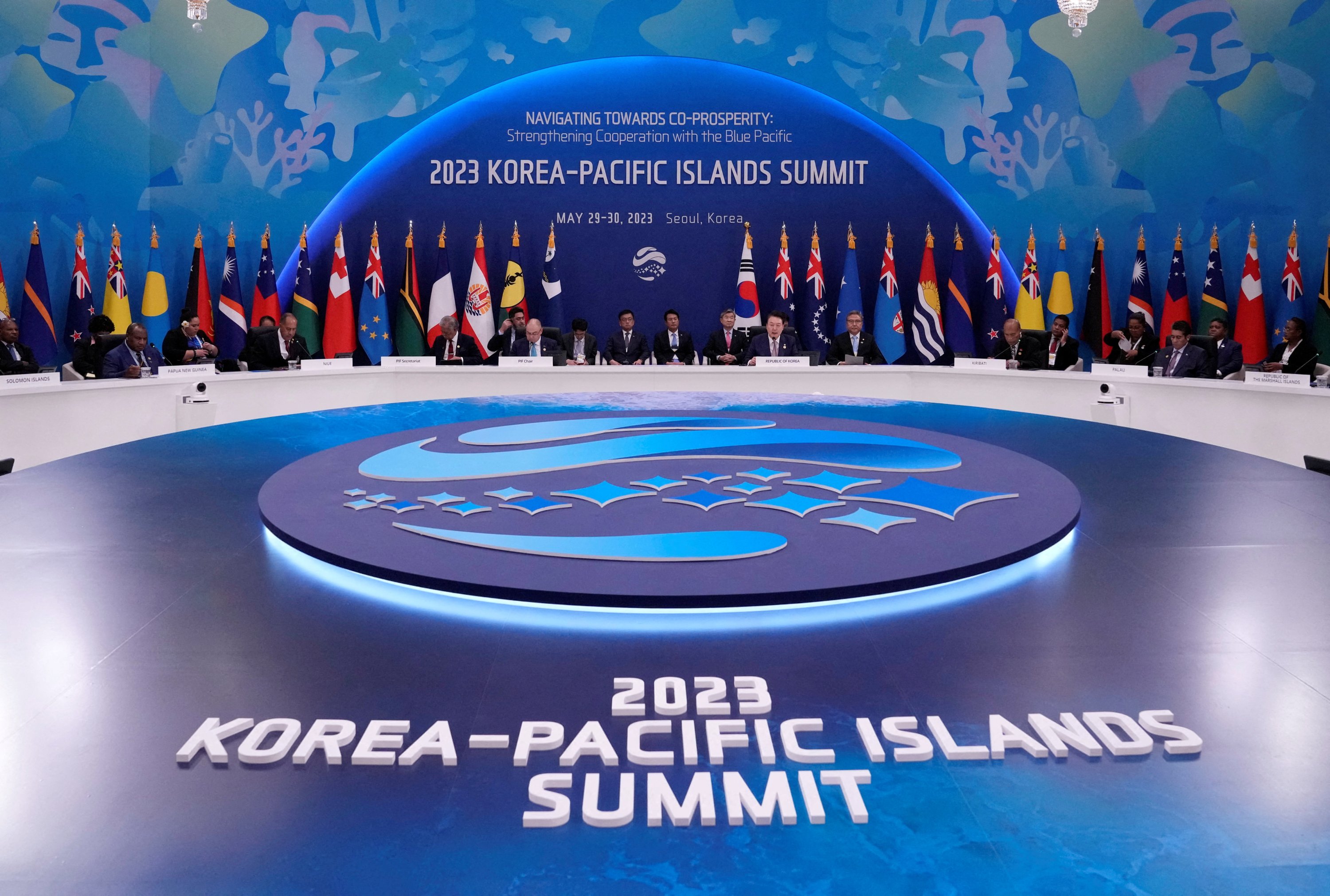
The recently concluded inaugural summit in Seoul between South Korea and Pacific island nations has understandably sparked numerous intriguing questions about South Korea's sudden engagement in the region. The newfound interest of South Korea in these nations has piqued curiosity.
In a span of two weeks, this marked the third summit where Pacific leaders convened, engaging with not only South Korean President Yoon Suk Yeol, but also Indian Prime Minister Narendra Modi and U.S. Secretary of State Antony Blinken.
Swiftly following the third summit of the Forum for India-Pacific Islands Cooperation and the U.S.-Pacific Islands Forum leaders' dialogue, the Korea summit also did not offer anything tangible regarding the Pacific islands, except a few pledges. The swift succession of these summits underscores the evolving dynamics of international relations in the Pacific, with the region assuming a central role in shaping the Asia-Pacific political spectrum. But this series of summits between the Pacific island nations and three major economies raises eyebrows with an air of mysteriousness, rather than optimism. The frequency and involvement of these high-level gatherings evoke a sense of intrigue and curiosity, as it implies a departure from the norm and signals potential shifts in regional dynamics.
Historically, South Korea's involvement in the Pacific region has been relatively limited. With its modest contribution to development finance in 2020, amounting to only $15.52 million out of a total of $4.25 billion, South Korea's presence in the region has been proportionately small, accounting for a mere 0.36% of the combined donor expenditure. Similarly, the volume of imports from the Pacific region to Korea remains relatively minimal, comprising only 0.3% of its total imports. Nevertheless, considering the historical context of Korea's limited involvement, the summit between South Korea and Pacific island nations has fueled speculation regarding Seoul's alignment with Washington in containing China's influence in the Asia-Pacific region.
At the summit, which was themed "Navigating towards Co-Prosperity: Strengthening Cooperation with the Blue Pacific," South Korea committed to double its development assistance to the region by 2027 and to develop security cooperation in areas such as maritime, climate, energy, cyber and health.
However, the gathering, against the backdrop of prior minimal engagement, has drawn attention to the potential strategic implications. South Korea's increased interest in the region raises questions about the motivations behind this newfound engagement and whether it reflects a concerted effort to align with the United States in steering the complex dynamics of the Asia Pacific. This burgeoning attention signifies a potential shift in Korea's regional approach, indicative of seeing this region from the lens of Washington.
Following the footsteps of its allies, such as the U.S., and regional partners like Australia, Japan and India, South Korea has recently embraced an "Indo-Pacific" strategy, prompting a renewed focus on the "Pacific" dimension of the region. In line with this approach, the Yoon government, in its strategy for a free, peaceful and prosperous Indo-Pacific region released in December 2022, expressed its intention to enhance its engagement with the Pacific Island countries, with whom it shares the Pacific Ocean. Subsequently, South Korea joined forces with the U.S., Australia and other participants in the Partners in the Blue Pacific initiative, aiming to improve coordination and cooperation in providing assistance to Pacific island nations. South Korea's Indo-Pacific strategy is ostensibly aligned with the vision outlined by the Association of Southeast Asian Nations (ASEAN), India and Japan, emphasizing the importance of inclusivity– a concept that is notably absent from the strategies put forth by the U.S. and Australia. This approach recognizes the geographical proximity of Korea and its Asian neighbors to China, acknowledging the complexities of pursuing a U.S.-sponsored containment policy.
Although U.S. President Joe Biden's visit to Papua New Guinea – after the G-7 summit in Japan – was canceled because of his urgent bargaining talks on the debt ceiling with House Speaker Kevin McCarthy in Washington, it garnered considerable attention in anticipation of the first-ever U.S. presidential visit to a Pacific Island nation. Biden had planned this visit to sign a new strategic security pact, intended to align Western Pacific nations with U.S. interests rather than counter Chinese ones. This move underlined the U.S. intention to counterbalance China’s security pact with the Solomon Islands and strengthen alliances in the region and reinforce its presence in the face of potential Chinese influence.
Following his engagements in Papua New Guinea, Biden had planned to participate in the "Quad" summit in Australia, alongside India and Japan, which was eventually canceled because of Biden’s engagements in Washington. The Pacific Rim region has become a vibrant hub of diplomatic activity, with notable engagement from the U.S. and its allies as well as China. However, it is crucial to recognize that these diplomatic maneuvers are primarily driven by reactive rather than proactive motives, centered around the objective of containing China. This singular focus on containment has shaped the agenda and priorities of these diplomatic offensives. While there is no denying the strategic competition that exists between the U.S. and China, it is essential to approach the region with a broader perspective. A reactive approach, solely focused on containing China, limits the potential for constructive engagement and cooperation.
By adopting a more proactive stance, countries can seize opportunities for meaningful dialogue and collaboration beyond containment strategies. A proactive approach would involve addressing issues such as climate change, economic integration and regional security through cooperative frameworks. Emphasizing a broader agenda of shared interests and mutual benefits would foster an environment conducive to regional stability and development. While the containment narrative dominates the American-led discourse, there is a need to recognize the importance of proactive diplomacy that promotes cooperation and dialogue.