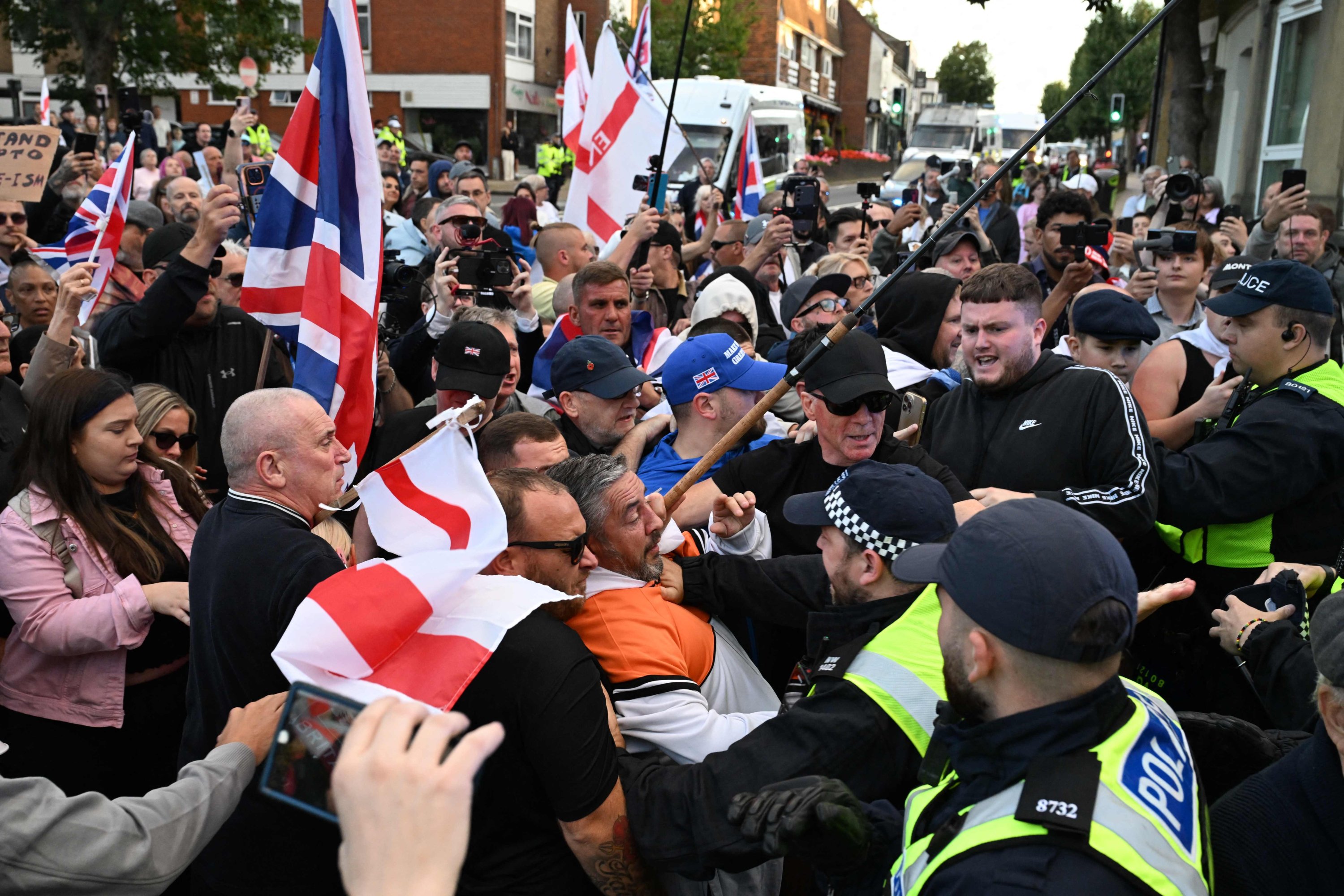
Amid the latest wave of the “far-right” protests and acts in Britain emerged a video showing a mob of protestors chasing down a fellow citizen, harassing him, and even attempting to assault him for the sole crime of freely expressing his opinion on camera. Asked about immigration, the victim remarked that he had not seen the dramatic changes the protestors claimed had transformed British cities over the last decade or so. That was enough to mark him out as a target – in fact, the person who recorded the video described the victim as an “infiltrator.” The incident was instructive to the extent that it revealed that the political sympathies of those protestors lie fundamentally in violence, whatever shape it may take. It is perhaps no accident, then, that apparently the only non-British flag allowed in those “far-right protests” has been Israel’s.
British Prime Minister Keir Starmer’s “encouraging” statements and policies do not help with this mess, either. It appears as though the times when the public would be shocked to see a Labour government acting this way are long gone. Everyone seems to be content with the notion that “being tough on immigration” by, for example, sharing humiliating pictures of asylum seekers getting deported can be a genuine Labour policy. And the normalization of this attitude presupposes, on the part of the public, a deeper understanding of how the world works: that what may seem like a domestic problem in this case is really a part of a bigger global trend toward the “far-right.”
In a recent BBC interview, this understanding was articulated clearly by Liberal Democrat politician Nick Clegg, who served as deputy prime minister from 2010 to 2015. After he criticized Britain’s Brexit decision and its principal architect, Nigel Farage, Clegg was asked whether he was also responsible for Brexit because people had felt disconnected at the time due primarily to the liberal policies he had previously supported. Clegg recognized that this was a common critique coming from the left, yet insisted that a dispassionate analysis would show that “there has been an eruption of nationalist and protectionist politics across the world.” Listing examples from France, Germany, Italy and India, he ridiculed the idea that “all of those things can be explained by decisions taken in the British Treasury in that period of time.”
The implication was unmistakable, and Clegg is certainly right that the trend is global, or at least, as he says in that interview, it has become prevalent in much of the “developed world.” The nature of the kind of development compatible with the occasional rise of such trends is never seriously questioned, of course – and we can put that question aside for now. Particularly telling in Clegg’s confession, however, was his implicit admission that decisions taken by the British government have no bearing on what happens in the world, nor even on what happens in Britain, which ought to be the real scandal.
The “far-right protestors” are supposed to claim sovereignty over their “land.” One would think that they, of all people, would be the ones to want to see decisions taken by the British government having some bearing on at least what happens in Britain, and preferably also on what happens in the world at large. Yet, these are often the very people who support and are supported by those whose actions only accelerate the decline of the British government’s ability to make meaningful decisions on both domestic and global affairs. Billionaire Elon Musk’s amplifying the voices of the “far-right protestors” is a perfect example of this. Or could it be that the “far-right” detests the concept of government so much that they are ready to literally sell their country to a U.S. president so that he can fix it for them, as one “patriot” suggested in another street interview? What passes for patriotism now is little more than outsourcing sovereignty: Britons chanting for sovereignty over their land while asking “outsiders” to rule it in their name.