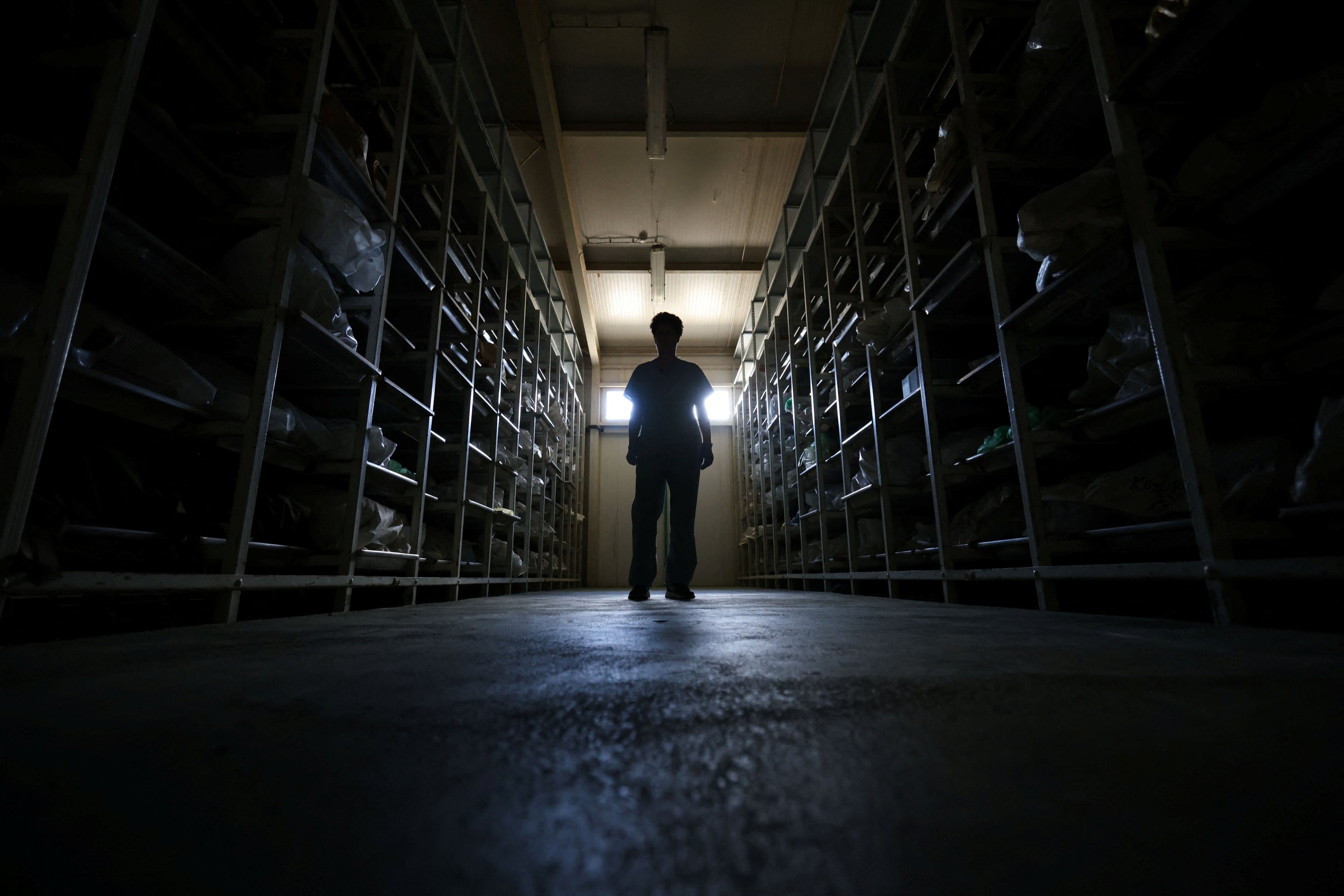
“Their goal was the eradication of a people and all evidence of that people’s culture and existence,” said Michael A. Sells in his work "The Bridge Betrayed." And when Theodor Adorno declared that “after Auschwitz, writing poetry is barbaric,” he marked not only the limits of aesthetics but the helplessness of language in the face of atrocity. Some horrors defy narration.
The joint BBC and PBS documentary "A Cry from the Grave" begins with such a haunting scene: a mother, Hatidza Mehmedovic, years later, returning to the restricted zone in Srebrenica to search for traces of her son Almir, who was killed by Serbian soldiers in July 1995. She was not looking for a grave – his remains, like those of many others, had been scattered across multiple mass graves – but for something to hold on to: a memory made visible. Sometimes a gravestone, sometimes a pine tree, but always something rooted.
Her return was more than physical; it was an act of remembrance. She found the three pine trees her son had planted and devoted her life to them. “These three pines,” she said, “are the living embodiment of Almir’s life.” They still stand. Their branches carry the weight of a mother’s quiet defiance.
In the early 1990s, the breakup of Yugoslavia and Bosnia-Herzegovina’s declaration of independence in 1992 triggered a brutal war fueled by ethnic nationalism. Serb forces, initially backed by the Yugoslav People’s Army (JNA) and later operating under the Army of Republika Srpska, led by Gen. Ratko Mladic, sought to create “ethnically cleansed” zones by targeting the Muslim Bosniak population. Amid this violence, the small town of Srebrenica became a fragile refuge for thousands of civilians. Overcrowded and lacking food and medicine, it was declared a United Nations “safe area” under Resolution 819 in April 1993. Dutch peacekeepers were deployed under the United Nations Protection Force (UNPROFOR), but they were unequipped and lacked the authority to intervene.
In early July 1995, Serb forces launched a full-scale assault on Srebrenica, quickly overpowering the lightly armed Dutch battalion. On July 11, Mladić entered the town and falsely assured civilians they would be safe. But a meticulously planned campaign of extermination was already underway. More than 8,000 Bosniak men and boys, some as young as 12, were separated from their families and systematically executed. Women, children and the elderly were deported, while the bodies of the murdered were dumped into mass graves. Despite desperate pleas from U.N. personnel, the international community remained silent. NATO airstrikes arrived too late. The fall of Srebrenica became Europe’s worst atrocity since World War II.
In the years that followed, survivors gave testimony and forensic teams uncovered dozens of mass graves. Many bodies were mutilated to prevent identification. The International Criminal Tribunal for the Former Yugoslavia (ICTY) indicted Mladic, Karadzic and others for genocide and crimes against humanity. In 2005, the United States officially recognized the massacre as genocide, though many nations had long avoided the term. Even now, justice remains elusive.
Thirty years have passed. And still, some questions remain painfully unanswered: How could such systematic annihilation be ignored for so long?
On June 26, 2025, the U.S. Senate’s Kennedy Caucus Room became a rare space of moral reflection. Usually reserved for legislative affairs, the chamber fell into solemn stillness, not just to remember, but to reckon. As reported by the Washington-based MDBIH Council, this was the first time the Senate officially commemorated the Srebrenica genocide.
The ceremony gathered bipartisan senators, Bosnian diaspora members, survivors, faith leaders, human rights advocates and diplomats. In her opening remarks, Senator Jeanne Loughlin called the massacre “a moral failure we waited too long to face.” She urged that memory shape present responsibility, ending with a survivor’s words: “You cannot bring the dead back. But you can keep them from dying a second time by remembering.”
Bosnia’s wartime president, Alija Izetbegovic, once gave a similar warning: “Do not forget; genocide that is forgotten will be repeated.” This long-overdue ceremony finally heeded that call. A powerful moment came as Imam Sulejman Hadzic, who lost his father and two brothers, lit a candle for the Mothers of Srebrenica. He spoke not of vengeance, but of mourning and justice. The candle flickered quietly beneath the Senate seal.
Beyond symbolism, Congress pledged support to archive war crimes evidence and fund translation of ICTY records – grief had entered the realm of policy. But perhaps the most resonant moment came in silence.
As lights dimmed, a black-and-white image of the destroyed Mostar Bridge appeared on the wall. More than architecture, the bridge had once connected faiths and communities. The room stood still. What echoed in the silence was not just remembrance, it was a question: What will you do with this memory?
Built in 1566 by Mimar Hayreddin, a student of the great Ottoman architect Sinan, the Mostar Bridge linked not only the two banks of the Neretva River but also diverse cultures and religions. For centuries, it stood as a symbol of peace, tolerance and shared life.
That’s why, during the Bosnian War, its destruction was not just an act of military aggression; it was a targeted erasure of memory itself. In the silence that followed, the obligation to protect that memory emerged. And it is precisely there that the voice of Izetbegovic rises again: “Do not forget; genocide that is forgotten will be repeated.” His words are not just a warning, but an invitation to build bridges again, even where they were once shattered.
As Michael A. Sells argues in "The Bridge Betrayed," Srebrenica was not only physical destruction, it was the erasure of identity and belonging. Victims were seen as deviations from a racialized, religious norm.
Behind this violence lay Christoslavism, an ideology that viewed all Slavs as inherently Christian and regarded Bosniaks, who embraced Islam, as racial aberrations. “The material that embraced Islam was genetically deformed,” said Bosnian Serb leader Biljana Plavsic, a biologist. Genocide thus became an imagined restoration of purity. What was destroyed was not only lives, but the very idea of coexistence.
Sells points to the Mostar Bridge as a metaphor: its fall marked the collapse of Bosnia’s interreligious fabric. Srebrenica was not only the fall of a town, it was the collapse of meaning itself.
Today, the silence echoing through the Senate is a quiet protest against the ideologies that once justified genocide. Some wars are waged not with weapons but with meaning, and without confronting that meaning, rebuilding is impossible. Hatidza Mehmedovic’s quiet persistence reminds us that memory lives not only in words but in soil and time. Those three trees she tended offer a living answer to the question posed at the beginning of this article: What will you do with this memory? Sometimes, resistance begins in silence. Sometimes, rebuilding begins beneath a tree. And perhaps justice begins when each fragment of bone is met with a root.