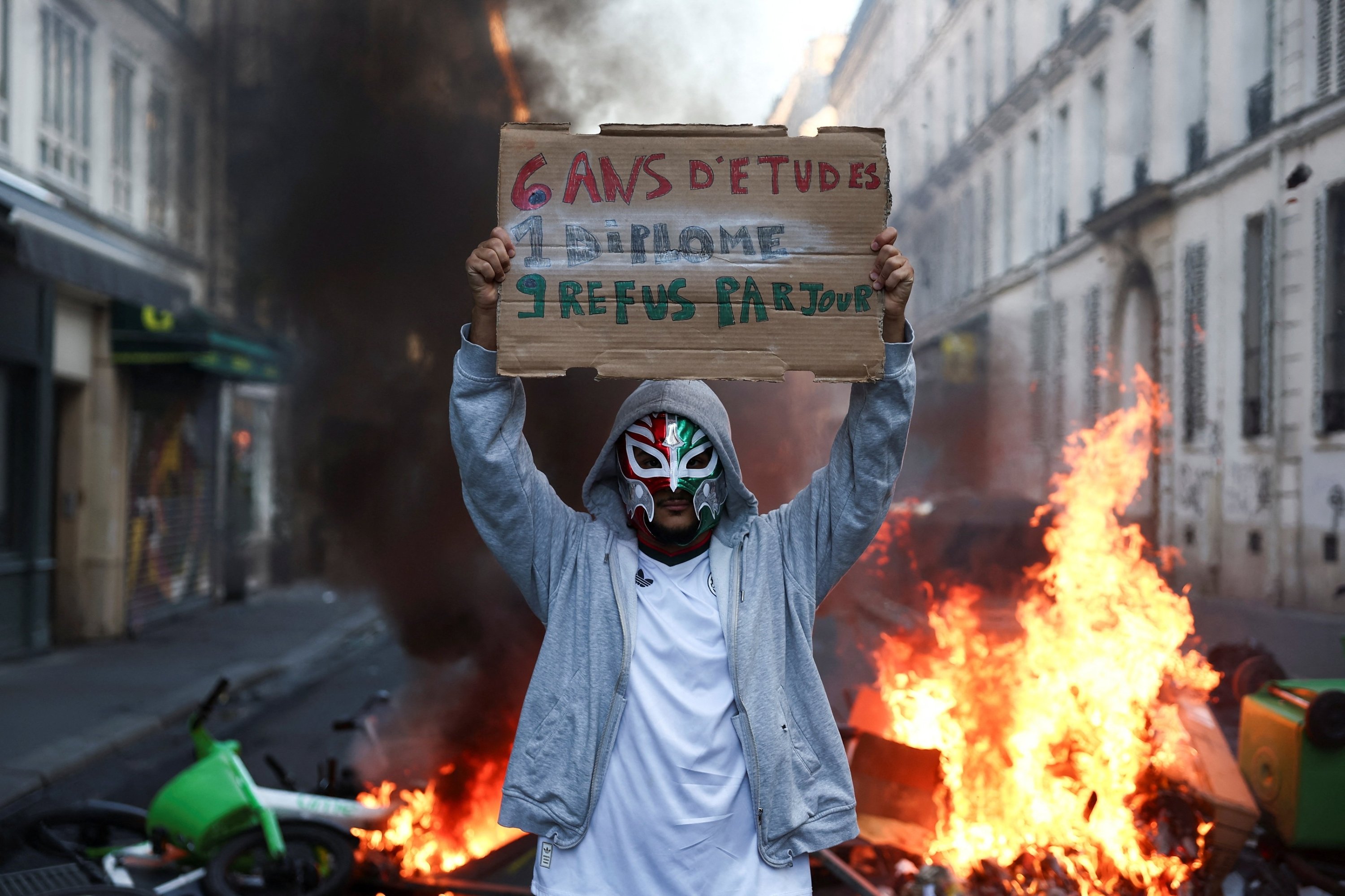
Every few academic cycles, the French Republic witnesses an almost ritualistic confrontation at the gates of its secondary schools. Rows of green municipal waste bins are hauled across school thresholds, handmade banners decrying state abandonment are tied across iron railings, and dense clouds of tear gas drift over city boulevards. As high schools fall under partial blockade, ministerial communication invariably follows a well-worn orthodoxy: the unrest is diagnosed as ideological contagion, youthful impatience, or the tactical manoeuvring of fringe political organizations.
Yet, reducing these episodic insurgencies to adolescent radicalism misinterprets the empirical landscape. The recurring paralysis of French secondary institutions is not born of ideological whim. It is an organic reaction to an increasingly unsustainable fiscal and pedagogical model. Beneath the veneer of republican meritocracy lies a stark macroeconomic contradiction: France commits vast fiscal resources to education, yet produces an institutional architecture defined by under-resourced classrooms, structural stratification, and acute administrative inefficiency.
The paradox begins with aggregate expenditure figures. According to comparative data compiled by the Organisation for Economic Co-operation and Development (OECD), France allocates about 5.2% of its gross domestic product to education, outstripping several European peers. In upper secondary education specifically, France’s annual expenditure per student is roughly 24% higher than the OECD average. From a purely top-line macroeconomic vantage, the French high school apparatus ought to represent an international benchmark of institutional health.
The structural flaw, however, lies in resource distribution. A substantial fraction of the Ministry of National Education’s annual budget, which exceeds 60 billion euros, is tied directly to civil service pension liabilities, legacy overhead, and centralized bureaucratic operations rather than front-line pedagogical resources. The capital that successfully filters down to secondary classrooms is perpetually overextended.
The consequences for classroom sociology are immediate and quantifiable. While significant state intervention successfully reduced class sizes across early primary grades in designated priority education networks (REP and REP+), secondary education bore the brunt of budgetary rationalization. In general and technological lycées, class density has steadily escalated, frequently exceeding 30 to 35 students per classroom. Today, French secondary class sizes rank among the highest across the European Union. In such overcrowded environments, pedagogical differentiation becomes functionally impossible, reducing teaching to rote crowd control and heightening disengagement among precarious students.
Parallel to spatial density is an acute crisis of human capital retention. French starting salaries for secondary school educators, when adjusted for purchasing power parity, trail the OECD average by more than 15%. A starting monthly salary hovering near euro 2,100 provides inadequate incentive against escalating urban living costs, leading to historic recruitment shortfalls in national competitive examinations (CAPES).
The operational outcome is a chronic absence-management deficit. Official audits consistently show that over 15 million pupil-hours are lost each academic year due to unreplaced teacher absences. For working-class and middle-class households alike, the state’s primary social contract, which is the reliable provision of daily and standardized public instruction, breaks down when students spend prolonged stretches in unsupervised study halls or are dismissed prematurely due to missing science, technology, engineering and mathematics (STEM) or humanities instructors.
Compounding these material pressures is France's geometric inequality. The statutory point-based assignment system routinely dispatches the youngest, least experienced teachers into the most socio-economically precarious zones, notably the suburban peripheries of Paris, Lyon and Marseille. In administrative departments such as Seine-Saint-Denis, where child poverty rates consistently exceed 30%, high schools face a compounded crisis: high staff turnover, systemic shortages of administrative aides (AED), and an alarming deficit of school medical personnel. Campuses housing over a thousand adolescents regularly operate without a full-time school nurse or mental health counsellor. When students confront dilapidated infrastructure such as broken winter heating, unventilated classrooms during heat waves, and missing digital equipment, their mobilization is rooted not in abstract ideology, but in the immediate sensory evidence of institutional decay.
This spatial degradation has intersected with bureaucratic angst via Parcoursup, the centralized, algorithmic platform regulating access to tertiary education. Introduced to replace lottery-based university admissions, the platform has inadvertently mechanized student anxiety. Because its internal evaluation criteria remain opaque and vary by department, it has transformed the upper secondary years from an exploratory intellectual journey into an anxiety-ridden ranking matrix. Secondary students correctly perceive that their margins for error have shrunk, even as the state reduces institutional guidance and counseling personnel.
Faced with this compounding crisis, recent executive budget proposals have prioritized fiscal retrenchment, mandating the abolition of thousands of additional teaching posts to curb public deficits. The standard governmental response to high school strikes is to deploy internal security forces to clear physical blockades, alongside palliative announcements of task forces. However, the government’s approach treats structural failure as a mere public-order nuisance.
International evaluations highlight the ultimate cost of this strategy. France’s trajectory in the OECD’s Programme for International Student Assessment (PISA) reveals both an absolute decline in core competencies and one of the highest correlations between socio-economic background and educational underperformance in the developed world. The ecole republicaine, conceived historically as the ultimate instrument of civic assimilation and upward mobility, increasingly operates as a social sorting machine.
Addressing high school unrest requires recognizing it as a systemic indicator rather than a sporadic disruption. Demonstrating students and striking educators are essentially auditing the state balance sheet in real time. Until public spending is restructured away from bureaucratic inertia and directed toward competitive teacher compensation, manageable classroom thresholds, and targeted operational funding for secondary schools, the cycle of blockades will persist. High school protests in France are not a defiance of the social contract; they are an urgent demand for the state to honor it.