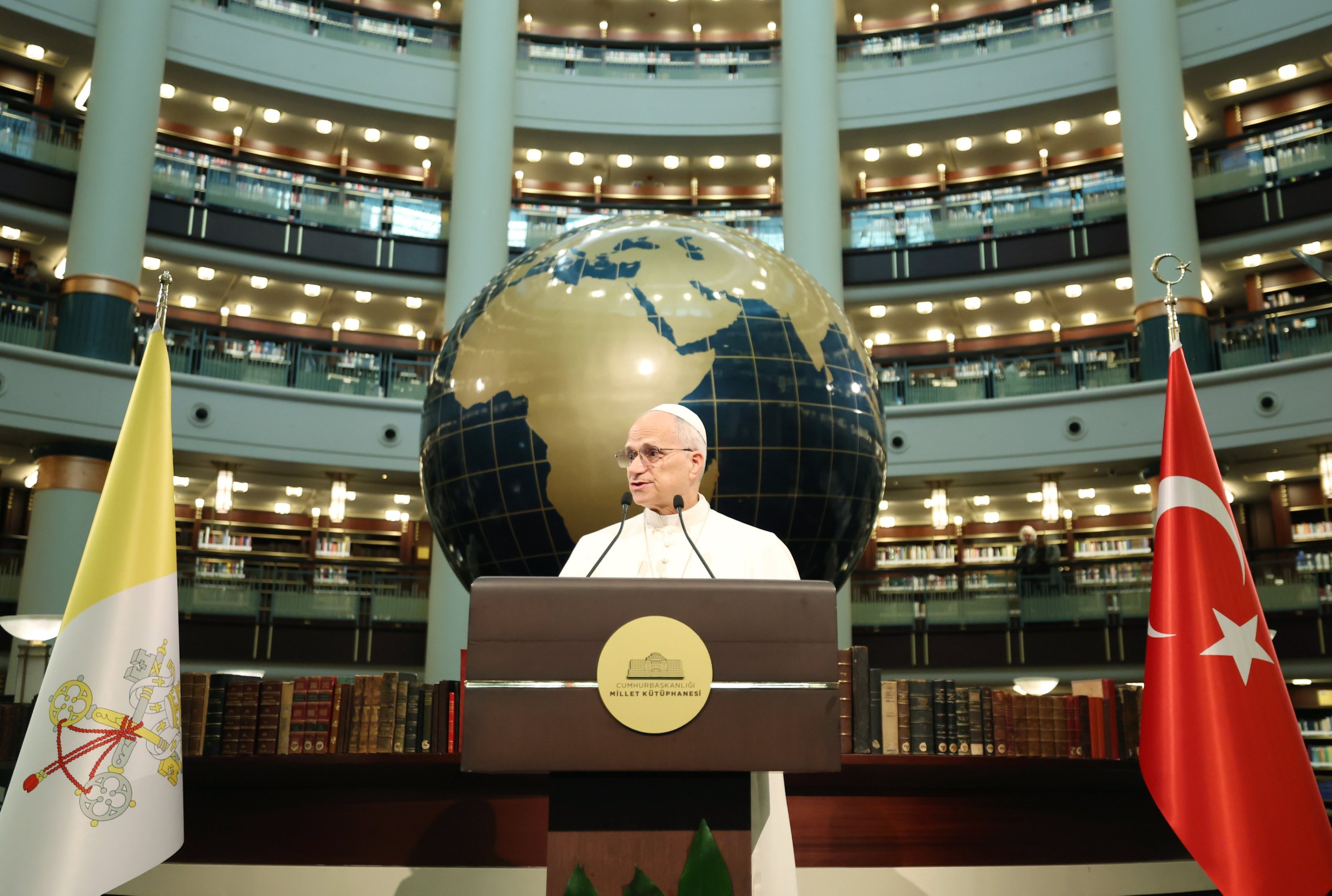
The decision of the new pope – remarkable already as the first American pontiff – to make his inaugural international visit to Türkiye and Lebanon in November 2025 is a choice laden with symbolism. From the outset, he has signaled a personal style distinct from his predecessors: speaking publicly in English, when the occasion arises, rather than Italian, addressing global audiences with clarity and accessibility, and projecting a leader who aims to speak directly to the world’s most sensitive geopolitical and interfaith tensions.
By selecting Türkiye and Lebanon as his first destinations, the pope is making a deliberate statement. These two countries are not only modern political actors but also the cradles of early Christianity. Much of the Christian narrative was born on these lands stretching from Palestine to Türkiye; the apostles walked in today’s Anatolia; the earliest church flourished in Antioch (modern Antakya city) in Türkiye; and Lebanon housed some of the most enduring Maronite, Melkite and Syriac Christian traditions. Türkiye contains sites associated with the very first officially recognized Christian communities, alongside the ancient traditions of Ethiopia and Egypt.
But the pope’s choice is significant not merely for historical reasons. It reflects a carefully calibrated message – to the Middle East, to Christians, to Jews and to Muslims, and unmistakably, to political actors engaged in the conflicts of the region. And it comes at a moment when Christian communities in the Holy Land are living under unprecedented pressure by the tyrannical and anachronistic regime of Israel, a reality increasingly acknowledged by international organizations, human rights groups and clerics across denominations.
One layer of the papal message is directed toward those responsible for the worsening plight of Christians and other civilians in Israel and the Palestinian territories. Without naming specific governments or leaders, the decision to stand symbolically in Türkiye and Lebanon – two countries adjacent to the conflict and historically influential in Christian history – signals the Vatican’s discomfort with Israeli policies in the region that perpetuate displacement, discrimination and violence.
While the Vatican has long avoided direct political confrontation, the new pope seems willing to speak with more clarity. His visit highlights concern not only for Christians but for all communities suffering under militarized policies and spiraling nationalist extremism headed by Israel. His stance parallels a growing sentiment among many fellow Americans who increasingly question the influence of political lobbies shaping U.S. policy in the Middle East. That this pope is himself American adds another layer of symbolism: He implicitly acknowledges these debates, and his visit appears to align with the rising public demand for a more ethical and less unconditional U.S. engagement in regional conflicts.
The second message is directed toward the Muslim world, and this may be the more enduring of the two. This pope is poised to continue – and perhaps expand – the interfaith agenda of the late Pope Francis. Türkiye and Lebanon are both overwhelmingly Muslim-majority nations where Christians nonetheless play historic and contemporary roles. Both countries have long traditions of coexistence: Lebanon through its unique confessional political system, Türkiye through centuries of multi-religious imperial legacy.
Islamic theology itself provides a profound basis for dialogue. Muslims, Christians and Jews are all regarded in Islam as “People of the Book.” Figures such as Jesus and Moses are deeply revered, and their names remain among the most common across Muslim societies. Islam views itself not as a rupture from the earlier monotheistic traditions but as a continuation and restoration of the message of a single Almighty God. This theological affinity historically enabled coexistence, even during politically turbulent periods throughout Islamic history.
Of course, the relationship between Catholicism and the Muslim world has had painful chapters – crusades, colonial entanglements and the excesses of the medieval Church. Yet Catholic thought in the modern era has shifted dramatically. Under John Paul II, Benedict XVI and especially Francis, the Church has increasingly embraced dialogue, pluralism and social welfare. Today’s Catholicism seeks not dominance but understanding.
This pope’s first foreign journey underscores that commitment. By placing Türkiye and Lebanon at the heart of his diplomatic beginning, he is signaling not only respect but recognition. The future of global Christianity cannot be imagined without the Muslim world as a partner.
The timing of the papal decision is critical. The Middle East is undergoing structural changes: demographic shifts, political realignments and widening skepticism toward extremist ideologies of all kinds. Among Jewish communities worldwide, too, there is increasing debate about the moral and political implications of absolutist nationalist movements. Critiques of extremist forms of Zionism now come not only from foreign observers but from within Israel and the global Jewish intellectual community itself.
The pope’s visit, therefore, should not be interpreted as a message to any one religious group. Rather, it is a moral intervention directed at political actors whose policies undermine coexistence, humanitarian norms, and the moral teachings shared by all three Abrahamic traditions. He is calling attention to the human cost of maximalist politics, as in the case of Israel, whether carried out in the name of security, theology, nationalism or retaliation.
What this American pope offers is a reframing of the conversation. By highlighting Türkiye and Lebanon, he elevates the idea that the roots of Christianity lie not in Rome or Western Europe but in the broader Eastern Mediterranean – a region shaped by Muslim, Christian and Jewish traditions alike. In doing so, he invites Christians to rediscover their origins and Muslims to see the Church as a partner rather than an adversary.
The visit also encourages the West to reassess long-standing political dogmas. The pope appears to be quietly acknowledging a global shift: that the moral authority of religious and civic leaders now requires confronting injustice more openly, even when politically uncomfortable.
If successful, this visit could become a foundational moment for a new global religious diplomacy – one grounded not in fear, rivalry or cultural triumphalism, but in a recognition that the spiritual destinies of the world’s great monotheistic faiths remain deeply intertwined.