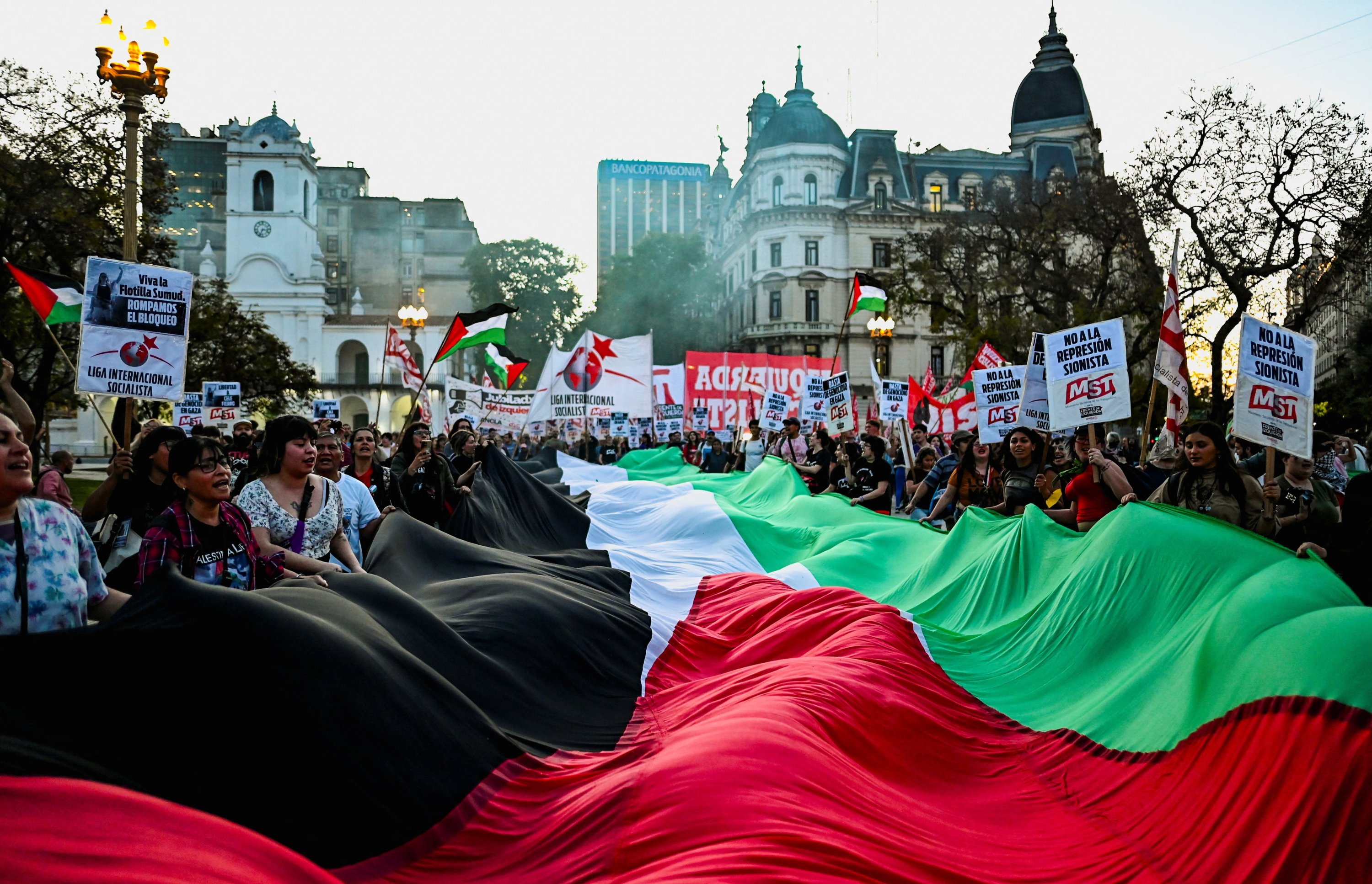
In today’s world, the control of truth has become central to political discourse. With an arrogant statement such as, “The phone in your hand, the tomato you eat, the medicine you use,” Israeli Prime Minister Benjamin Netanyahu recently claimed that the entire world is dependent on them. This is not merely a claim about production and supply. It is also a thesis that truth, choices and even the right to life can be determined from a single center.
Gaza has long been under blockade with deep humanitarian consequences. Since 2007, the restrictions by sea, land and air have isolated Gazan society. The voyage of the Global Sumud Flotilla toward Gaza is both a symbolic act and a tangible, visible and measurable challenge to the blockade. However, this act of defiance is unfortunately struggling to break the Gaza blockade, as Israel, in violation of international law, intervened against it despite its presence in international waters. In the past, a humanitarian convoy was intercepted at sea, resulting in the deaths of 10 people. That incident was etched into memory as the “Mavi Marmara.” It triggered debates on international law, maritime security, and the limits of legitimacy.
As the flotilla draws closer to Gaza, it has also been announced that some European countries’ frigates accompanying the flotilla have ended their military protection. In short, Gaza was once again left in isolation. This episode highlights the profound inconsistency between humanity’s rhetoric and its actions, underscoring the limitations of conscience.
Sometimes, the most powerful tools to understand the present are metaphors. Metaphors function as keys that reveal the truth. The Sumud Flotilla sailing toward Gaza can also be placed in a broader context through such metaphors.
The first metaphor used is Plato’s Cave, where people are imprisoned from birth and can only see the wall in front of them. They perceive the shadows cast on the wall – created by puppeteers behind them – as reality, because it is all they have ever known. Netanyahu’s above-mentioned statements are an example of such a narrative that imposes its own version of reality on people, much like shadows in the cave. The flotilla, in contrast, represents those who choose to leave the cave; it is the act of breaking the chains and seeking the truth.
The second metaphor is the Berlin Wall, which divided people both geographically and mentally. Today, however, invisible walls are built through technology and supply networks, walls that say, “You cannot live without our products.” Sumud is not a tank ramming these walls at their weakest point; it is a passage of solidarity.
The film "The Matrix" presents a coded version of "reality"; a system so all-encompassing that it convinces people there is no world beyond it. Netanyahu's claim that “everything is in our hands” reflects this kind of manipulation. However, the Sumud Flotilla represents the real-world equivalent of those who choose the red pill. It is an act of rejecting the system’s imposed illusions and defending truth, life and the right to exist.
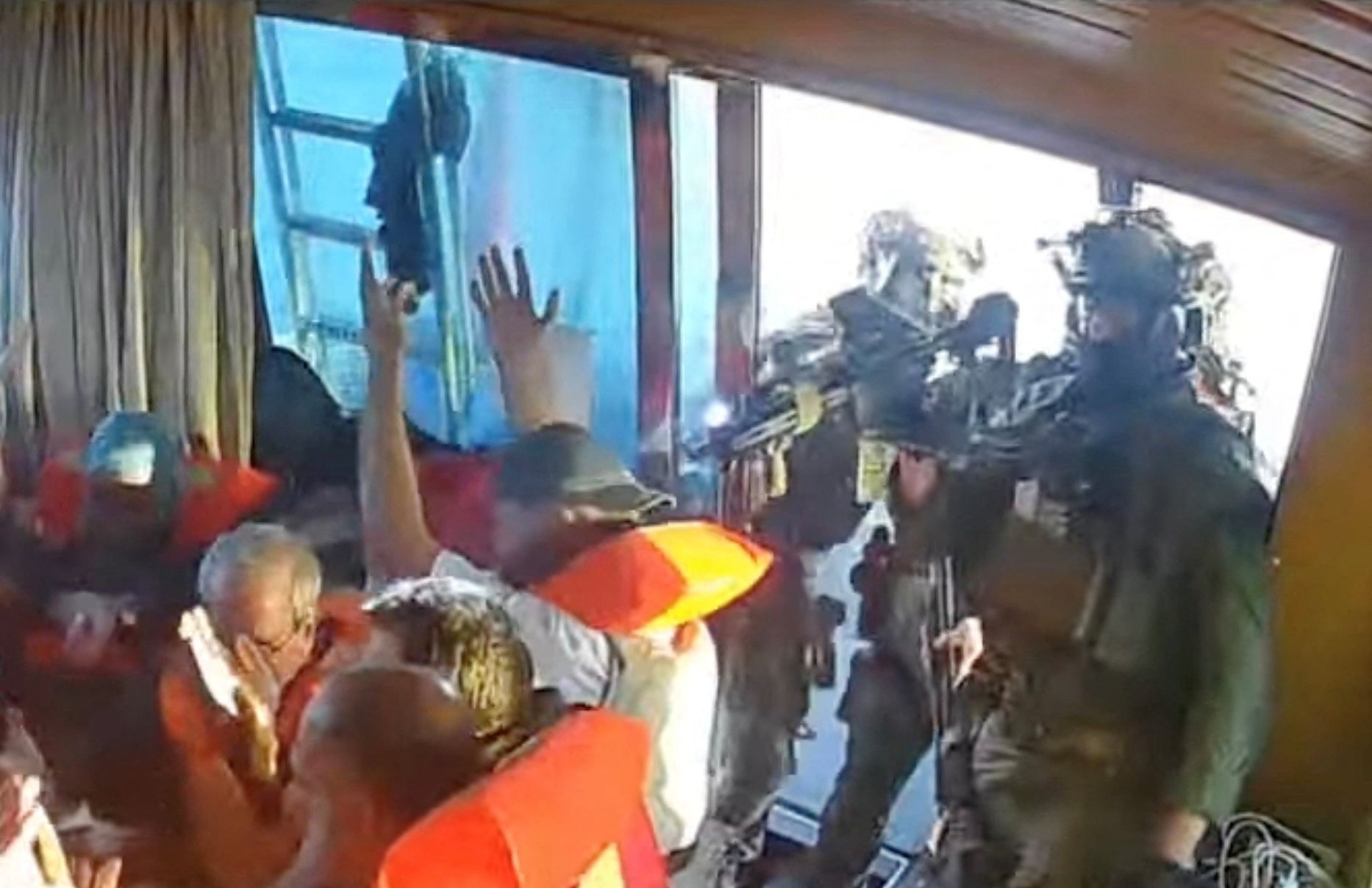
As the flotilla approached Gaza, the risks long discussed turned into reality today. Israel intervened against the flotilla. Thus, what had been considered a possibility in the past re-emerged as a painful reality that could repeat itself. In short, a new “Mavi Marmara” crisis has erupted. Past experiences had already demonstrated clearly that these risks were not abstract. Yet while a successful outcome was hoped for, the intervention has once again brought international law, maritime security and the boundaries of legitimacy into question.
One of the most likely scenarios, Israel’s intervention against the flotilla, took place before the eyes of the entire world. Israel used force against civilian ships carrying humanitarian aid in international waters. This showed that the risk of civilians being harmed was not merely a warning but a direct reality. Once again, history has recorded an intervention against a humanitarian mission. Although an intervention has taken place, the voyage continues. However, the ships have lost communication, and a military barrier has been erected. Therefore, if these naval vessels are bypassed, Israel may portray it as a provocative act and attempt to frame it before the global public as an “attack” against itself.
At this point, regardless of which scenario unfolds, one common truth remains unchanged in all cases where the blockade is not broken: Gaza has been under blockade since 2007, and the dimensions of the humanitarian crisis continue to worsen. Israel’s intervention against the Sumud Flotilla on the night of Oct. 1 has only sharpened this reality. From this point on, regional instability will deepen further, and risks will continue to multiply. Thus, the intervention has taken its place in history as a development that deeply shakes the regional security architecture and challenges the international order.
The failure to break the Gaza blockade has become evident. As a result, it is clear that just prior to Trump’s proposed agreement on Gaza, the international system has once again entered a phase of renewed deadlock over Gaza. Preventing this required the safe arrival of humanitarian aid ships to Gaza. The reality, however, is that since 2007, Gaza has remained under blockade, and the humanitarian crisis has grown steadily worse. The rise in regional instability only serves to multiply these risks further.
For years, the international community has called for the easing of the blockade, but durable breakthroughs have been limited. In the past, several initiatives have sought to break the blockade by sea, with the 2010 Mavi Marmara raid serving as a tragic example. In the years that followed, similar attempts were occasionally organized.
In the current diplomatic framework, the 20-point plan or “peace proposal” put forward by the Trump administration is criticized for its omissions regarding the Palestinian side and for questions about legitimacy. The sustainability of peace is highly doubtful without the direct participation of the relevant actors and without addressing demands for justice. This makes long-term stability difficult to secure. In a scenario of a disarmed Gaza, how would Palestinians be able to protect themselves in the future? Would there be any guarantee that a new massacre could be prevented? Questions remain as to whether there is a peace agreement, whether Palestine will be recognized as a state and whether accountability will be ensured for what has taken place in Gaza.
Returning to our metaphors: In Plato’s cave, shadows can be mistaken for truth; barriers like the Berlin Wall can restrict freedom; and the codes of the Matrix can normalize mental enslavement. But history has repeatedly shown humanity one undeniable fact: conscience will eventually tear down the curtain. No oppression lasts forever.
The flotilla stands as a symbol of this tearing of the curtain. Yet this tearing took place through Israel’s violations of international law last night. At this point, while the courage shown by the activists on board is undoubtedly important, the real issue is the clear exposure of a situation where international law is disregarded and deterrence is absent. Its fate reminds us of one undeniable truth: In the struggle for justice and humanity, we are all on the same ship.