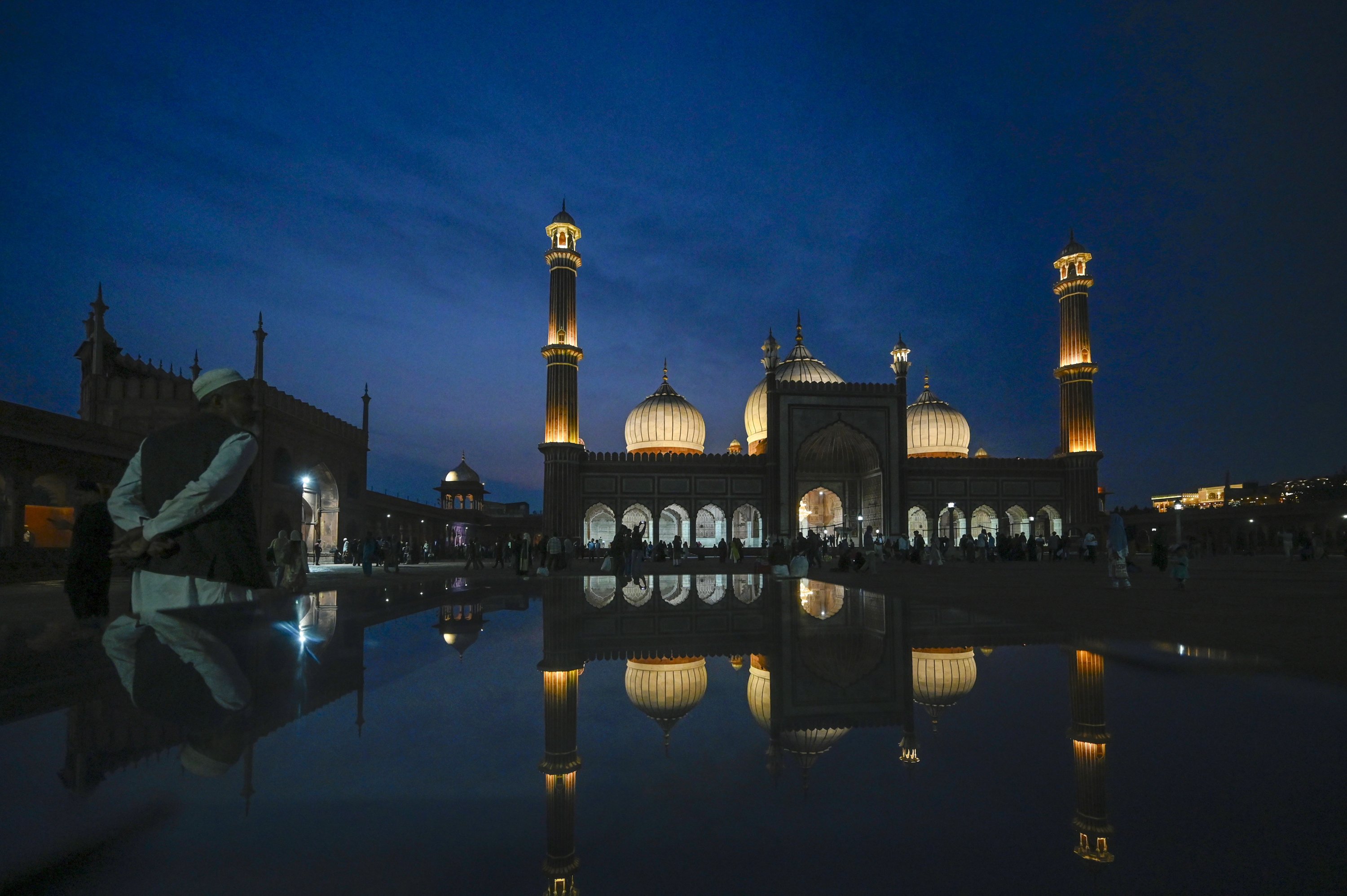
A Muslim is a demographic existence, Muslimness is a civilizational presence. The former describes people who profess a faith; the latter encompasses the history, memory, language, literature, poetry, music, art, architecture, cuisine, dress, expressions, customs and intellectual traditions through which nearly a millennium of Muslim existence became woven into the making of India.
The Rashtriya Swayamsevak Sangh (RSS) project of creating a distance between Muslims and Muslimness has acquired momentum. The strategy is subtle; India cannot realistically be emptied of more than 200 million Muslims. But they can be rendered politically powerless, institutionally invisible and culturally inconsequential, remaining a demographic presence while Muslimness is progressively diminished as a constituent of India's national identity.
This is perhaps how a Hindu Rashtra, or, short of it, the Hindu homogenization of India, can be pursued without removing India's Muslims, they remain in millions while increasingly ceasing to matter to the definition of India itself.
It is against this background that RSS chief Mohan Bhagwat's remarks in New York on Aug. 29 deserve scrutiny. “If any Hindu thinks that there should be no Muslim in Bharat, he will not remain Hindu,” he declared, adding that a Hindu must believe “that all paths are leading to the same goal and that every human has dignity.”
Taken at face value, this sounds like a remarkable change of heart. But Bhagwat was speaking not in Nagpur or Delhi but in America, where the RSS has developed an extensive diaspora network and has an obvious interest in presenting itself internationally as cultural nationalism rather than religious majoritarianism.
His words collide with the reality inside India. Muslims constitute more than 14% of the population, yet only 24 of 543 Lok Sabha members – 4.4% – are Muslim, none from the governing National Democratic Alliance (NDA); there has been no Muslim Union minister since 2022. Muslim legislators in state assemblies have fallen from roughly 339 in 2013 to about 255 today. None presently occupies the presidency or vice-presidency, offices periodically held by Muslims in an earlier India, while their presence at the highest levels of the Union bureaucracy is exceedingly thin.
The exclusion is economic and institutional too. The landmark 2006 Sachar Committee, a government inquiry into the condition of Indian Muslims, found that although Muslims constituted 13.4% of the population, they accounted for only 3% of the elite administrative service, 4% of the senior police service and 3.2% of federal security forces. Two decades later, their marginality has deepened alongside their retreat from political power.
Bhagwat's assurance that Muslims may remain, therefore, answers the easier question. The harder question is whether the Hindu nation imagined by the RSS has room for Muslimness.
The RSS's particular organizational strength is strategic patience. It thinks in decades, anticipates resistance and opportunity, and waits for circumstances to ripen. Once outside India's dominant pluralist consensus, the RSS itself was banned three times; its worldview has progressively traveled from the margins toward the center.
The fate of Urdu illustrates how homogenization can occur without formal prohibition. Developed in the subcontinent, Urdu became a great repository of Indian poetry, literature and music. “Inqilab Zindabad” (“Long Live the Revolution”) was itself a defining slogan of India's anti-colonial struggle. Yet after Partition, Urdu became increasingly identified with Muslims and, more damagingly, with Pakistan.
It survived magnificently in poetry, cinema and popular music even as its script receded from public life. Leaving Delhi's historic Jama Masjid in the early 2000s through the gate toward Ballimaran, where Mirza Ghalib had lived, I noticed that even the prayer timings were written in Devanagari rather than Urdu script. In Ghalib's own neighborhood, a generation was emerging that could increasingly read him only through another script.
At Aligarh Muslim University, I once asked the eminent historian Irfan Habib about Urdu's decline. His explanation was simple; it had been burdened with the accusation of having helped create Pakistan. Once a language ceases to provide educational or economic opportunity, families eventually stop teaching it to their children.
Something similar is happening to India's Muslim past. Nearly a millennium of Muslim presence cannot be removed, but its place in national memory can be diminished and recast. School textbooks have seen material concerning the Delhi Sultanate and Mughals removed or reduced; increasingly, this history is narrated through the vocabulary of invader and outsider rather than as part of India's complicated historical formation.
There is an obvious contradiction. Indian anti-colonial discourse remembers pre-British India as the “golden bird,” one of the world's great economic centers before colonial exploitation. Yet much of that celebrated prosperity coincided with the sultanate and Mughal India. One cannot invoke its wealth to demonstrate what colonialism destroyed while treating the civilization under which much of it existed as an alien interruption.
Once Muslim rule is detached from Indian history, Muslimness becomes something that happened to India rather than something that became part of India. History need not be erased; it merely has to be reclassified. Once the past is made foreign, its descendants can remain citizens while their inheritance becomes foreign to the nation.
But homogenization rarely stops with the minority against whom it begins. Once the boundaries of acceptable identity narrow, the boundaries of acceptable thought begin to narrow too.
In a recent incident in Ahmedabad, a school came under pressure over assigning Nobel laureate Malala Yousafzai's "I Am Malala" and Anne Frank's "The Diary of a Young Girl." When students, teachers and citizens later gathered for a public reading that included the books, they were confronted by activists associated with Hindu nationalist organizations.
The arc of homogenization is turning inward, and the ultimate casualty is India's intellectual plurality. A civilization distinguished by the coexistence and contestation of innumerable philosophies, faiths and interpretations risks being reduced to a prescribed understanding of itself.
Uniformity does not merely diminish the minority. Eventually, it impoverishes the majority as well.