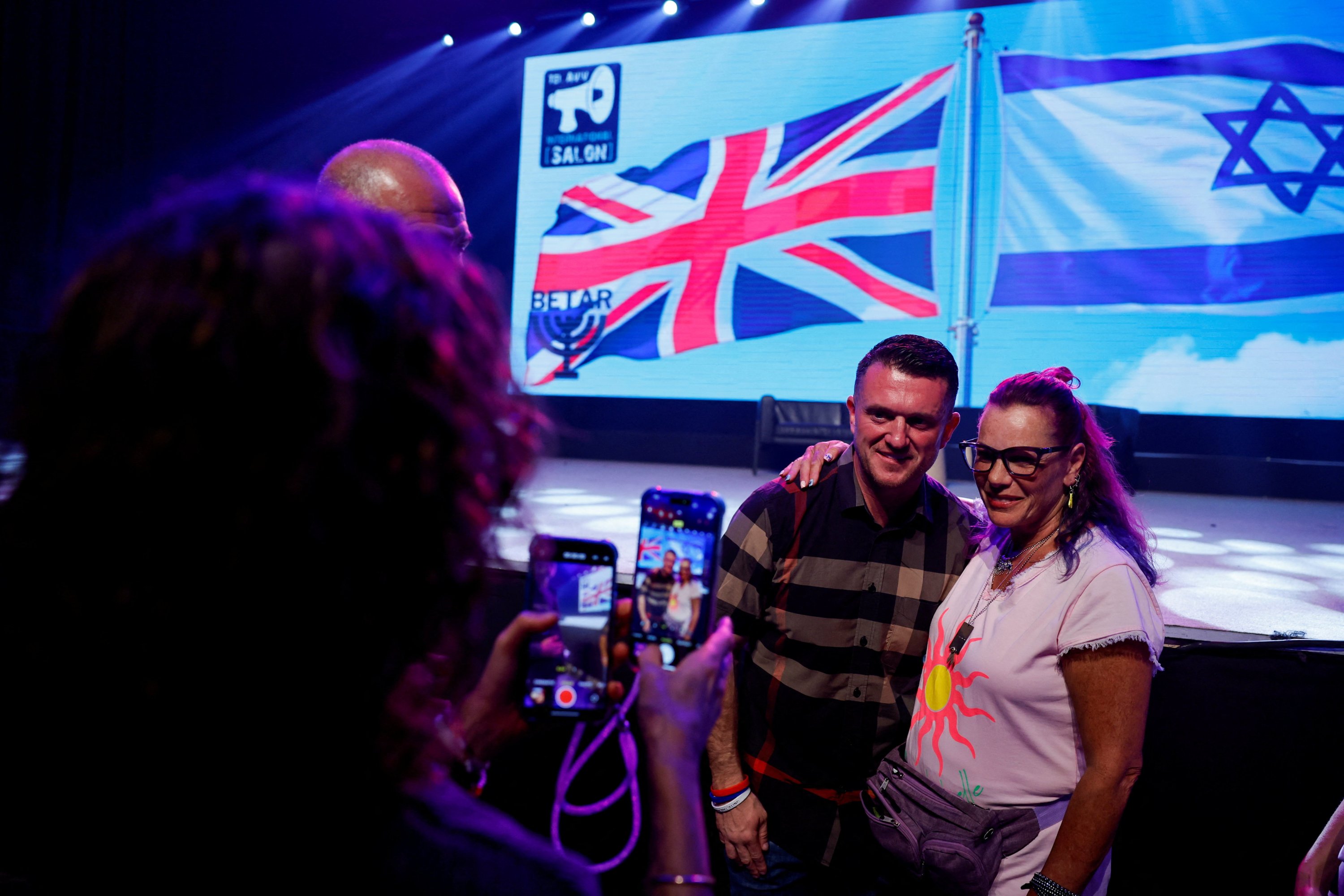
Upon the gracious invitation of Israeli Minister of Diaspora Affairs Amichai Chikli, British “far-right” activist Tommy Robinson finally arrived in the “Jewish state” to deliver his much-anticipated vlog series, in which he traces his unorthodox Zionist roots. The content has been widely consumed by the public and has received mixed reactions. One interview in the series was particularly noteworthy, where Robinson was listening attentively to a strange character named Yishai Fleisher lecturing him about how Britain had “turned on” his people and therefore deserved “a special place in hell.” Remaining unusually calm in the face of such a blatant attack on his country, which he is otherwise known for enthusiastically defending against “foreigners” and their malicious ideologies, Robinson tried to distinguish between “the people” and “the establishment,” claiming that it was only the latter who had “turned on” Israel by recognizing a Palestinian state, all while aiding and abetting its premature destruction.
Yet, according to polls, if someone did “turn on” Israel, it was actually “the people” who overwhelmingly not only support the recognition of a Palestinian state but also demand sanctions on Israel for its appalling conduct in Gaza. In other words, “the people” of Britain do not care so much about ending up in “a special place in hell” if “turning on” Israel indeed leads to that outcome, as both Israeli government ministers and British “far-right” activists seem to believe. In fact, Robinson’s acceptance of Fleisher’s premise illustrates why successive British governments have gone to great lengths to avoid giving any impression of “turning on” Israel and why “the establishment” has always warmly welcomed advice that reinforces that stance.
Take, for example, Israeli Foreign Minister Gideon Sa’ar’s latest phone call with British Foreign Minister Yvette Cooper. Sa’ar informed the public that, in that call, he had “raised the need to take practical measures against the use of the slogan ‘From the river to the sea – Palestine will be free’ in public spaces in the U.K.” To make his case, he referred to British Prime Minister Keir Starmer’s recent statement that the slogan was “anti-Semitic,” and he urged that legislation be enacted “to enforce a ban on the use of the slogan.” Sa’ar’s advice was taken very seriously and with immediate effect: On Tuesday, a British Palestinian doctor was arrested for “inciting racial hatred,” apparently for voicing her criticism of Israeli exceptionalism.
It appears as though the kind of exceptionalism in question has transcended the domain of international relations, as it is increasingly having a real impact on Britain’s domestic affairs. Last week, virtually every media outlet in Britain led with the story of the ban on Maccabi Tel Aviv fans attending the upcoming football match between that club and Aston Villa in Aston, Birmingham, where many of the people who “turned on” Israel live (although they are not really “the people,” according to Robinson’s definition). With the sole exception of the Green Party and a handful of independent members of Parliament, every politician condemned the police’s decision to ban Maccabi Tel Aviv fans who, not so long ago, caused serious disorder in the streets of Amsterdam when their side played against Ajax. Even the leader of Reform U.K., Nigel Farage, who normally cannot stand the sight of “violent foreigners” roaming the streets of Britain, came out to defend Maccabi Tel Aviv fans, describing the ban as “taking racial discrimination to a whole new level.”
That banning hooligans with a track record of violent behavior could be construed as a matter of racial discrimination or hatred is, of course, absurd. However, it is amusing to see those who typically find no problem indulging in every form of racism known to man make a rare exception and suddenly develop a deep awareness of racism when it comes to Israel. Israeli exceptionalism takes many forms, but the version embraced by “far-right” activists and politicians is surely the most baffling.