When a payment between a Turkish consumer and a Turkish merchant is routed through a foreign card scheme, the purchase price itself does not leave the country. Most of the merchant fee is also distributed among domestic banks and payment providers. Yet scheme assessments, processing, licensing, tokenization and certification charges can still flow to foreign infrastructure providers. Individually, these costs appear marginal. At national scale, they become a recurring payment for access to rules and systems that Türkiye does not control.
The larger issue is not the fee. It is dependence on an external permission, routing and data layer at the heart of everyday economic life. A payment card is not merely a product. The scheme above the cardholder, merchant, issuing bank and acquiring bank defines the technical standards, security protocols, dispute procedures and conditions of access. The decisive question is therefore not which logo appears in the wallet, but who controls the route taken by the transaction.
Russia demonstrated the strategic importance of that distinction. After international networks stopped serving cards issued by several sanctioned Russian banks in 2014, Moscow established a national payment card system and developed Mir. When Visa and Mastercard suspended their Russian operations in 2022, Russian cards lost much of their international functionality, but domestic payments continued because the national switching layer had already been built. What preserved continuity was not the brand printed on the card. It was control over the domestic route.
The lesson is not that every foreign network will eventually leave Türkiye. It is that the possibility of exclusion can itself become geopolitical leverage. A disruption to retail payments would affect far more than shopping. It could impede public disbursements, electronic commerce, logistics, tourism and the ability of households to function during a crisis. The European Central Bank now describes dependence on non-European payment providers in similar terms, linking payment infrastructure directly to economic security, resilience and strategic autonomy. International schemes accounted for 66% of electronically initiated card transactions in the euro area in the first half of 2024.
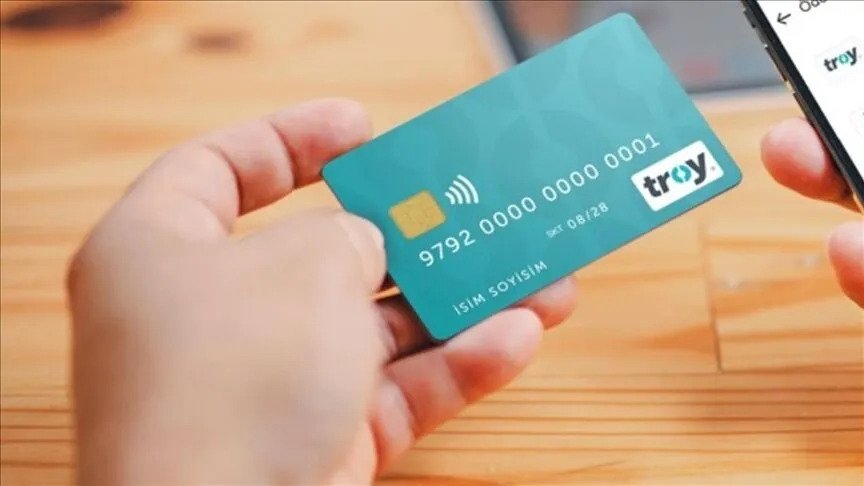
Türkiye is not starting from zero. It established a national payment card system, Troy, in 2016 through the Interbank Card Center (BKM). According to the BKM, the number of Troy-branded cards reached about 89 million by the end of 2025, while annual transaction volume rose to 4.8 trillion Turkish liras and Troy's share of total card spending reached 25.3%. The figure does not mean 89 million credit cards or 89 million separate users. It includes credit, debit and prepaid cards, and one person may hold several cards. Türkiye had 460.6 million cards in total at the end of 2025, including 142.1 million credit cards.
These numbers show scale, but not yet full sovereignty. Türkiye's card economy is driven by credit. Installments, reward points, campaigns, electronic commerce and mobile wallets create the strongest network effects at the credit card layer. Expanding domestic debit and prepaid cards is valuable, but the most commercially important part of the system remains dependent if credit authorization, digital wallet tokens and dispute rules still rely on foreign schemes.
The next phase for Troy should therefore be measured not by how many additional cards are issued, but by how deeply it enters credit cards, electronic commerce and mobile wallets. A co-branded card can carry both Troy and an international application. A transaction between a Turkish cardholder and a Turkish merchant can be routed through the domestic application by default, while the international application remains available for travel and cross-border commerce.
Yet co-branding alone does not solve the problem. Sovereignty extends through the entire transaction chain. Authorization, tokenization, online authentication, fraud scoring, chargebacks and technical fallback all matter. A card may look domestic while its most sensitive functions still depend on foreign infrastructure. The true unit of sovereignty is not the logo. It is control over routing, security architecture and the data produced by the payment.
China offers a different model. China UnionPay first achieved scale inside a vast domestic market and then expanded abroad. UnionPay is now accepted in 183 countries and regions and cards are issued in 84 of them. Beijing combined a national card scheme with powerful mobile payment platforms and a central bank digital currency project. The transferable lesson is not that Türkiye should close its market. It is that a domestic system produces strategic autonomy only when it reaches sufficient scale, convenience and international acceptance.
Troy should therefore develop reciprocal acceptance across the Turkish Republic of Northern Cyprus (TRNC), the Turkic states, the Balkans, the Gulf and the main tourism corridors connected to Türkiye. Using a domestic card abroad should not be an act of patriotic inconvenience. It should be an ordinary commercial choice. International reach would also give Turkish banks and companies an additional channel in periods of political or financial friction.
The least discussed dimension is intelligence. Payment data does not merely reveal aggregate consumption or regional economic trends. When identity, time, location, merchant, device and transaction frequency are combined, they can reconstruct the routines of a specific person with remarkable precision. Repeated payments can identify a home area, workplace, travel pattern, social circle and regular meeting points. Transactions made by different people at the same locations and times can expose contact networks that would remain invisible in ordinary account records.
This matters directly for counterintelligence. Financial traces can indicate indebtedness, unexplained income, gambling, concealed relationships, addiction, recurring foreign contacts or spending patterns inconsistent with an official position. None of these signals proves disloyalty. But when fused with travel records, communications metadata and open-source information, they may reveal pressure points that can be exploited through bribery, coercion, blackmail or recruitment. For diplomats, military personnel, intelligence officers, researchers and employees of critical infrastructure, payment history can show not only where a person has been, but also where that person may be vulnerable.
The United States' Terrorist Finance Tracking Program demonstrates the operational value of financial information. The Treasury Department states that financial messaging data has been used to identify and locate operatives and financiers, uncover cells, fill missing links and map networks across borders. The same analytical capacity that serves legitimate counterterrorism can become a national security risk when sensitive domestic payment functions, metadata or analytical models are subject to foreign legal authority or corporate control.
This does not mean that foreign card companies routinely hand all customer data to their governments. Such a claim would be unsupported. The risk is structural. It concerns where data is processed, which jurisdiction governs it, who controls tokenization and behavioral models, under what conditions authorities can demand access, and how companies may respond to sanctions or political pressure. Türkiye could localize settlement while still outsourcing the intelligence value generated by transactions.
A sovereign payment architecture must therefore protect more than money movement. Identity verification, tokenization, fraud intelligence, behavioral analytics and dispute data must also remain under effective national supervision. At the same time, domestic control must not create a single vulnerable point. Troy, FAST and the digital lira require geographically distributed infrastructure, independent security audits, crisis exercises and the capacity to shift rapidly between payment channels. Sovereignty means resilience against both external pressure and internal failure.
The digital lira adds another layer. Its potential value is not simply novelty or faster payment. Programmable functions, interoperability and limited offline use could help preserve basic transactions during earthquakes, telecommunications failures or cyber incidents. For a country exposed to both seismic and geopolitical risk, an offline payment capability is part of civil preparedness.
Dollar stablecoins make the issue more urgent. If households and companies move transaction balances from lira deposits into privately issued dollar tokens, the result may be digital dollarization without branches or banknotes. Bank funding, monetary policy transmission, payment data and part of the country's monetary control could migrate to foreign private networks. The durable answer is not prohibition alone. It is a domestic digital money system that competes on reliability, privacy, liquidity and ease of use.
None of this requires hostility toward Visa or Mastercard. Global networks remain indispensable for tourism, travel and international commerce. Payment sovereignty is not autarky. It is the capacity to route, authenticate and settle a domestic transaction without depending on a foreign permission layer, while retaining international networks where they create genuine cross-border value.
Türkiye has already assembled much of the architecture. Troy can provide the domestic scheme, FAST the instant payment backbone and the digital lira, a programmable form of central bank money. The remaining challenge is to make these layers commercially competitive, operationally resilient and secure enough to carry daily economic life.
The last mile of monetary sovereignty is not the plastic card in the wallet. It is the system that decides which rules govern the payment, which infrastructure carries it and who can turn the resulting behavioral information into intelligence.