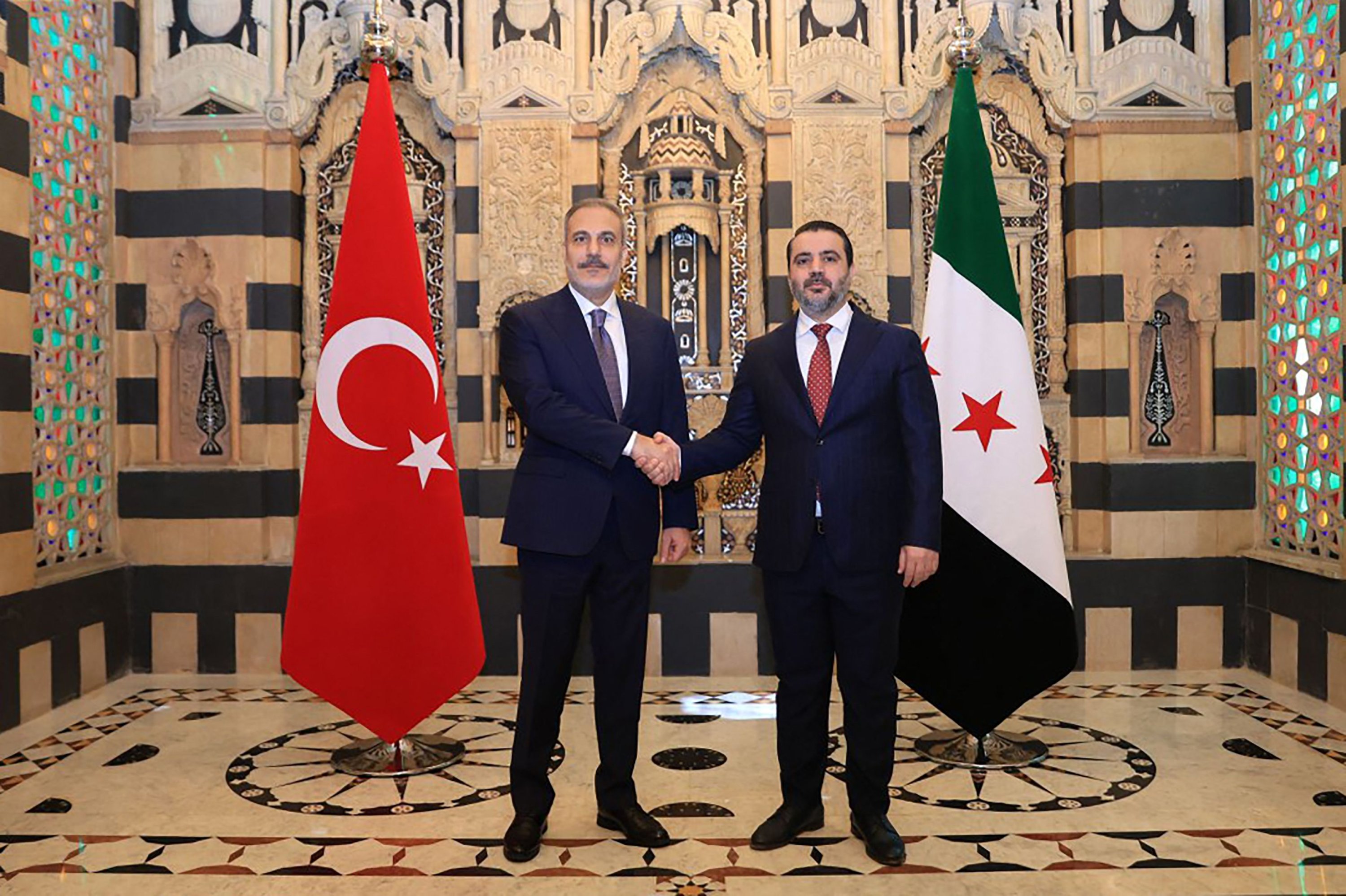
The collapse of the Bashar Assad regime in December 2024 did more than reset Syria’s internal balance; it exposed long-buried fractures in the regional architecture. Among the most significant of these is the growing strategic rivalry between Türkiye and Israel. Syria, transformed into a de facto buffer state, now reflects the diverging geopolitical visions of these two countries.
Türkiye’s approach to post-Assad Syria is marked by continuity and stability. Ankara has thrown its support behind the new administration led by Ahmad al-Sharaa, favoring centralization, territorial integrity and gradual reconstruction. Türkiye’s footprint, through safe zones, civilian infrastructure and coordination with the Syrian Interim Government, demonstrates its preference for a cohesive state model capable of bringing refugees back and neutralizing separatist ambitions represented by the YPG, the PKK terrorist group’s offshoot in Syria.
Israel, in contrast, is driven by fragmentation. Since Assad’s fall, Israel has redoubled efforts to prevent the emergence of a centralized authority, led by al-Sharaa, that might become adversarial. Instead, it seeks to promote a cantonized Syria composed of ethnic and sectarian enclaves, managed via limited kinetic force, intelligence liaisons and covert partnerships. The logic echoes Israel’s historical Periphery Doctrine, once focused on non-Arab and non-Muslim alliances, now transmuted into localized deterrence models.
This recalibrated strategy follows the failure of Israel’s prior bet on constructing a liberal, Western-aligned zone of influence in southern Syria through humanitarian soft power. That experiment, dubbed the "Good Neighbor" policy, ultimately gave way to what is now a more assertive military presence extending beyond the Golan Heights. The failure of this model and the collapse of any expectation that a Western-backed regime could emerge organically have pushed Israel toward hard deterrence and territorial leverage.
The core divergence between the two powers lies in their threat perceptions. Türkiye, for its part, sees these moves as both threatening and illegitimate. Ankara’s influence in northern and central Syria, hard-earned through years of security cooperation and infrastructure investment, is now being challenged in the south by Israeli airstrikes and intelligence maneuvers. For Türkiye, stability in Syria is a national security imperative. A functioning state curbs refugee outflows, weakens the PKK/YPG and opens the door to phased reconstruction.
For Israel, however, a unified Syria, particularly one leaning toward Türkiye, represents a long-term strategic risk. At the heart of this new approach is the perception that Türkiye’s deepening ties with the new Syrian government represent not merely diplomatic engagement but the reemergence of a strategic core hostile to Israel’s long-term interests. This view has spurred not only tactical responses but structural policy shifts. Tel Aviv increasingly views Syria through the lens of managed instability: better a fractured Syria than a functioning state aligned with Ankara. The rivalry is no longer passive; it has entered the realm of active containment.
Indeed, since December 2024, Israel has significantly escalated its campaigns across southern Syria. No longer limited to so-called preemptive strikes, the Israeli campaign has expanded to include legacy regime arsenals and, more subtly, moves to establish influence over Druze and other minority communities. In doing so, the Israeli army advanced beyond the 1974 disengagement line and penetrated deep into Syrian territory, reaching areas far beyond the Golan region. While framed in terms of security and minority protection, this footprint clearly signals a deeper Israeli ambition: to shape Syria’s post-war order in a way that limits Türkiye and exploits the vacuum to its own advantage.
This divergence has sparked a contest over narratives as much as territory. Israel now portrays the al-Sharaa government as ideologically radical, unstable and incapable of controlling the same militant factions it once opposed. Türkiye, on the other hand, frames its involvement as a stabilizing force aimed at preventing renewed refugee waves, countering terrorism and preserving regional equilibrium. The collision of these narratives reflects the on-the-ground rivalry unfolding from Deraa to Quneitra.
Syria has thus shifted from being a common denominator in Turkish-Israeli security calculus to a wedge issue. Their rivalry, currently confined to intelligence maneuvering and aerial strikes, risks escalating into a broader confrontation, especially as both powers expand their footprint and push conflicting models of post-war governance.
In many ways, Syria has become a mirror of the escalating rivalry between Türkiye and Israel. Once defined by pragmatic convergence, the two are now embroiled in a structural conflict driven by incompatible visions of order, threat, and legitimacy. Without strategic restraint and diplomatic dialogue, Syria may shift from a buffer zone to a fault line of confrontation, with implications far beyond its borders.
Israel’s post-revolution posture in Syria is viewed by Ankara as a direct challenge to its strategic depth and regional influence. By promoting fragmentation and empowering minority actors, Israel seeks to constrain Türkiye’s role in shaping Syria’s future. This runs counter to Ankara’s emphasis on territorial integrity and stable governance. For Türkiye, Israel’s actions are not just a security concern but a broader attempt to redraw the regional balance, requiring vigilant counter-strategies to prevent strategic encirclement.