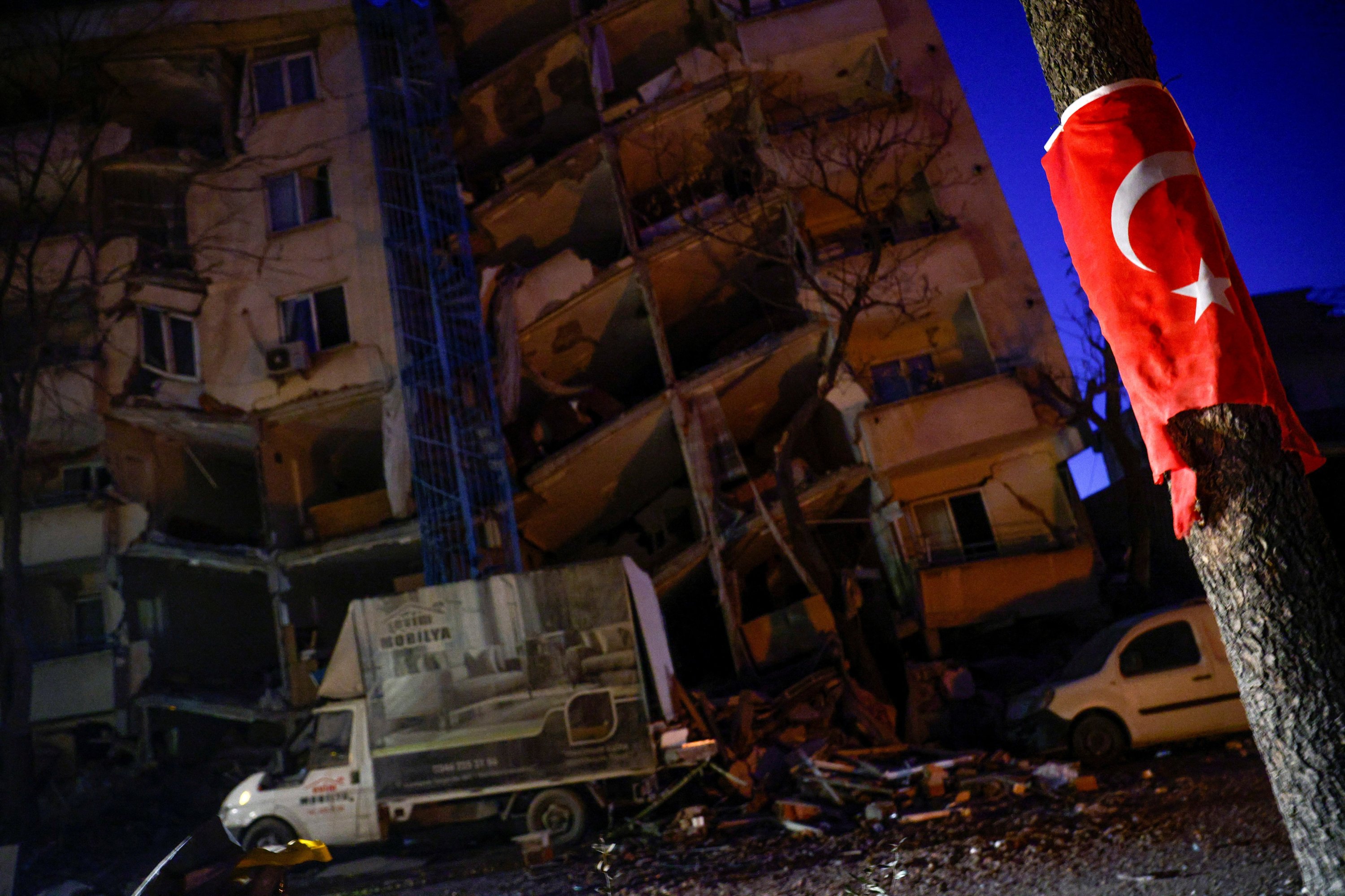
Rescuers digging through rubble for missing persons, survivors pulled out on stretchers, children comforting their siblings trapped under debris, voices heard from beneath the racks of a building, a father weeping over the body of his infant. There are so many heartbreaking and dramatic scenes after devastating earthquakes hit Türkiye and Syria.
On Feb. 6, a pair of massive, powerful 7.7 and 7.6 magnitude earthquakes created disaster zones on both sides of the Türkiye-Syria border, including areas home to millions of people already displaced by the civil war in Syria.
Earthquakes that ravaged southern Türkiye and northern Syria have killed more than 34,000 people – the death toll continues to rise every hour – tens of thousands were injured, thousands of buildings fell to rubble, and hundreds were trapped under collapsed buildings. Even worse, millions were driven to extremes amid a freezing winter without shelter since this tragic incident occurred just after the area was hit by a heavy snowstorm that has seen temperatures plummet.
Recently, President Recep Tayyip Erdoğan said the country had been shaken by the “strongest disaster of the century.” He declared a state of emergency in 10 provinces for three months.
Earthquakes are not uncommon in Türkiye as the country sits on one of the world’s most active fault lines. Significant quakes of 7.0 magnitude or more have struck the country in the past 25 years. Nevertheless, Monday’s earthquake is believed to be the largest and deadliest one to hit Türkiye in decades.
More than 300 aftershocks rumbled after the initial quakes, according to Vice President Fuat Oktay.
Authorities said the quakes affected 10 cities, where 13.3 million people live – about one-sixth of the country’s population.
Meanwhile, the densely populated northwestern region of Syria impacted by the earthquakes is already home to more than 4 million people who rely on humanitarian assistance, according to the U.N. Office for the Coordination of Humanitarian Affairs.
Many are internally displaced persons who have fled to opposition-controlled areas since the Syrian conflict broke out more than a decade ago. The region is controlled by various armed groups and relies heavily on international aid.
These earthquakes formed yet another devastating blow to the vulnerable Syrian population already struggling after years of conflict and where hospitals are overstretched as they grapple with a recent cholera outbreak.
Syria, ravaged by 12 years of war and terrorism, with its infrastructure heavily depleted and under Western sanctions, is the least prepared to deal with such a disaster.
It is a crisis within multiple crises: many in northwest Syria have been displaced up to 20 times. With health facilities strained beyond capacity, even before this tragedy, many did not have access to the health care they critically need.
The earthquake struck amid a very harsh winter with some areas in the northern part of the country hitting subzero temperatures when people face huge electricity, fuel and water shortages.
Syria’s current complex humanitarian emergency is among the world's largest humanitarian crises, and the earthquake will only exacerbate the situation and vulnerabilities. This earthquake will only increase the quantity and severity of needs on the ground.
According to the World Health Organization (WHO), the affected regions in Türkiye and Syria are currently home to around 23 million people, including 1.4 million children.
Governments and humanitarian organizations worldwide quickly responded to requests for international assistance, deploying rescue teams and offering aid.
More than 60 countries, and the European Union, have offered assistance after Türkiye activated a “Level 4 Alert,” meaning the country needs international help. Erdoğan confirmed that in addition to NATO and the EU, 45 countries have reached out to Ankara with offers of assistance, including the United States and even war-torn Ukraine, as well as China and Russia.
Hundreds of thousands of people in both countries have been left homeless in the middle of winter. Many have camped out in makeshift shelters in supermarket car parks, mosques, roadsides or amid the ruins, often desperate for food, water and heat.
With the cold and wet weather system moving through the region, poor conditions have made reaching affected areas trickier, and rescue and recovery efforts on both sides of the border significantly more complex and challenging once teams have arrived.
Temperatures have been bitterly low, plummeting several degrees below zero.
With scattered showers and snow in the region set to continue, the elements are putting the lives of those trapped underneath the rubble – who have already gone days without food and water – at risk of hypothermia.
On their part, officials have asked residents to leave buildings for their safety amid concerns about more aftershocks.
Nobody knows how many people lie trapped under the rubble, and rescuers are racing to dig them out before they succumb to injury, thirst or the biting cold. Besides, buckled roads, complex terrain and the vast size of the affected areas make the relief effort hellishly challenging to manage.
Unfortunately, currently, there is no way to reliably predict when an earthquake will happen, its strength, or its length. Although meteorologists can predict disasters like hurricanes or floods, seismologists cannot do the same with earthquakes. The most they can offer are devices that detect the fast-traveling pressure waves from a quake that arrive a little before the ground-convulsing shear waves turn up, and these give warnings of only a minute or so at most.
After search and rescue operations end, efforts will shift to recovery and ultimately to rebuilding damaged and destroyed infrastructure. At the same time, the physical and psychological impacts on people will be far greater and longer lasting.
We do not know how, and we do not expect to see how any time in the foreseeable future.
The focus and efforts on the long-term mitigation of earthquake hazards must be by helping improve structures' safety, rather than by trying to accomplish short-term predictions.
The earthquakes that shook Türkiye and Syria represent a shocking human tragedy that will forever change lives for millions across the region.
As Türkiye approaches its presidential election on May 14, this natural disaster will be a clear political challenge for the ruling Justice and Development Party (AK Party) government. It will measure its effectiveness and legitimacy just months before the critically tricky elections.
Besides, the Turkish earthquake response, rescue efforts and reconstruction will be a great challenge for Erdoğan's run-up to the May elections, which is already the toughest of his two decades in power.
The question remains: How will the Turkish government face this challenge to secure the well-being of its citizens and perhaps its political future?