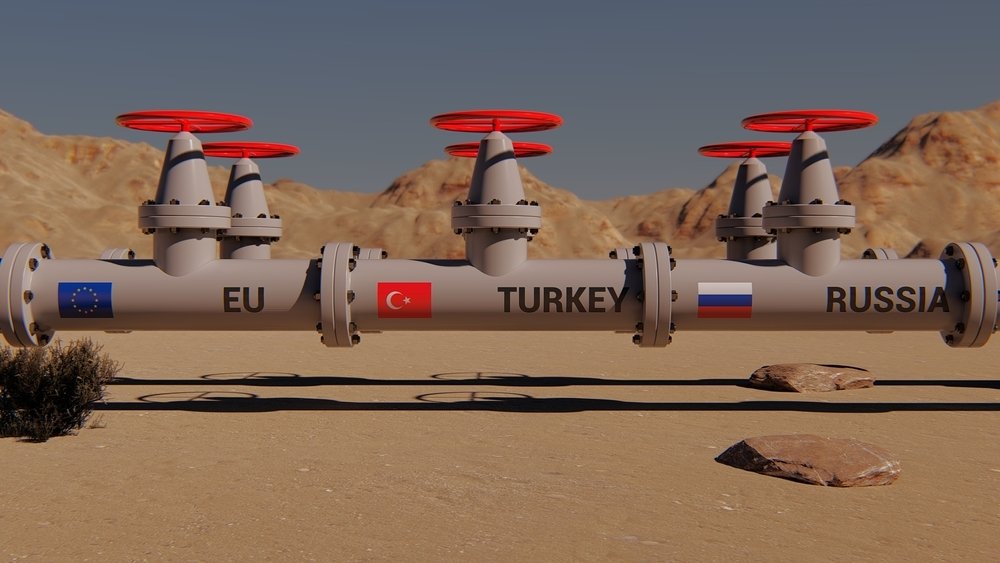
Russia has two main pipelines that supply natural gas to Türkiye through the Black Sea. The first of these is the Blue Stream pipeline, which was commissioned in 2003 and directly supplies gas to Türkiye with an annual design capacity of 16 billion cubic meters (bcm). The second pipeline, TurkStream, consists of two parallel lines. One of these lines provides natural gas for Türkiye’s domestic consumption, while the other was designed to deliver gas to Southern and Southeastern European countries. Commissioned in January 2020, TurkStream has a total capacity of 31.5 bcm. Passing beneath the Black Sea, these two strategic energy corridors play a critical role not only for Türkiye’s supply security but also for the balance of Europe’s energy supply.
The geopolitical importance of this infrastructure has recently returned to the agenda following a number of statements. Russian President Vladimir Putin described potential threats against pipelines running along the seabed of the Black Sea as “a very dangerous game.” According to information obtained by Russian intelligence services, Putin claimed that Kyiv, with the support of certain Western intelligence agencies, may be preparing a move targeting Blue Stream and TurkStream, similar to the sabotage that previously affected the Nord Stream pipelines.
The Russian leader stated that Türkiye had been informed about the issue and emphasized that targeting such infrastructure, particularly in the current geopolitical climate, could create serious risks for regional energy security. However, these statements should not be interpreted solely as a security warning directed at Türkiye. Putin’s remarks are also widely seen as an indirect message to Europe.
Although Russia’s share in Türkiye’s natural gas imports reached nearly 45% in the early 2020s, it has shown a gradual decline in recent years. Data from Türkiye’s Energy Market Regulatory Authority (EPDK) indicate that this share generally fell into the 30% to 40% range during the 2023 to 2025 period. The increase in Türkiye’s liquified natural gas (LNG) imports and its policy of diversifying suppliers have been among the key factors behind this decline.
Nevertheless, Russia continues to remain among Türkiye’s largest natural gas suppliers alongside Azerbaijan and Iran, and it still largely maintains its leading position in terms of share within total imports. At the same time, the fact that several long-term natural gas supply contracts between Türkiye and Russia are set to expire in 2026, and that negotiations regarding the future of these agreements are ongoing, has become an important agenda item shaping how Türkiye-Russia energy relations may evolve in the coming period.
Considering the sabotage scenario raised by Putin, a number of potential risk scenarios related to energy security must be evaluated from Türkiye’s perspective. The ongoing military tensions in the Persian Gulf and attacks targeting LNG cargoes have once again demonstrated how vulnerable maritime transportation and energy infrastructure are to geopolitical risks. The fact that key natural gas suppliers for Türkiye, including Russia, Azerbaijan and Iran, are located at the center of different geopolitical tensions further increases this fragility.
In a possible scenario, one of the most important factors determining Türkiye’s short-term supply security would be its storage capacity.
In this context, Türkiye has two main underground natural gas storage facilities. The first is the Silivri North Marmara Underground Natural Gas Storage Facility located in the Marmara region, created by converting former natural gas fields into storage areas. The second is the Tuz Gölü Underground Natural Gas Storage Facility in central Anatolia, developed using salt cavern technology. Through capacity expansion projects carried out in recent years, Türkiye has significantly increased the storage volume of these two facilities.
Another critical component providing flexibility within Türkiye’s natural gas system is its liquefied natural gas infrastructure. In addition to the Marmara Ereğlisi and Egegaz LNG terminals, the Dörtyol and Saros floating storage and regasification units have enabled Türkiye to reach a significant capacity in LNG imports and storage.
According to data from Türkiye’s Energy Market Regulatory Authority (EPDK), Türkiye’s underground natural gas storage capacity reached approximately 6.3 bcm by the end of 2025 through the capacities of the Silivri and Tuz Gölü facilities. This capacity can absorb a limited supply interruption and serve as a temporary buffer. However, given that Türkiye’s annual natural gas consumption exceeds 50 bcm, the existing storage capacity would be insufficient to cover a prolonged supply disruption on its own. Planned expansion projects aim to increase this capacity to 12 bcm in the coming years.
In particular, the closure of the Strait of Hormuz and temporary production pauses at LNG facilities in Qatar affected roughly 20% of global LNG supply, creating physical tightness and price pressure in the spot market.
For Türkiye, this situation has been reflected in costs not through direct volume losses in LNG supply but through delivery delays and intensified competition for alternative sources.
In addition, the missile strike carried out by Iran against Azerbaijan raised questions about whether the Trans Anatolian Natural Gas Pipeline (TANAP) energy infrastructure could be among potential targets.
This geopolitical uncertainty could create potential pressure on the gas supply that Türkiye receives through Azerbaijan. At the same time, this situation also highlights why nuclear energy projects that Türkiye has accelerated in recent years carry strategic importance for energy supply security, alongside LNG terminals, pipeline diversification and strategic storage investments.
In the event of potential damage to any of the TurkStream, Blue Stream or TANAP infrastructures, the most affected party would, according to forecasts, undoubtedly be Europe, because natural gas storage levels from the beginning of 2026 through the end of March are projected to average 22% to 27%, significantly below the five‑year average of approximately 41%. This situation clearly shows that Europe’s existing storage and LNG infrastructure does not possess a sufficient security buffer under multiple geopolitical risk scenarios.
In light of current data, Europe may face a new wave of crisis similar to the energy shock experienced in 2022. Possible geopolitical risks could restrict the volume of gas reaching Europe through Türkiye and increase the risk of a crisis in electricity and heating supply.