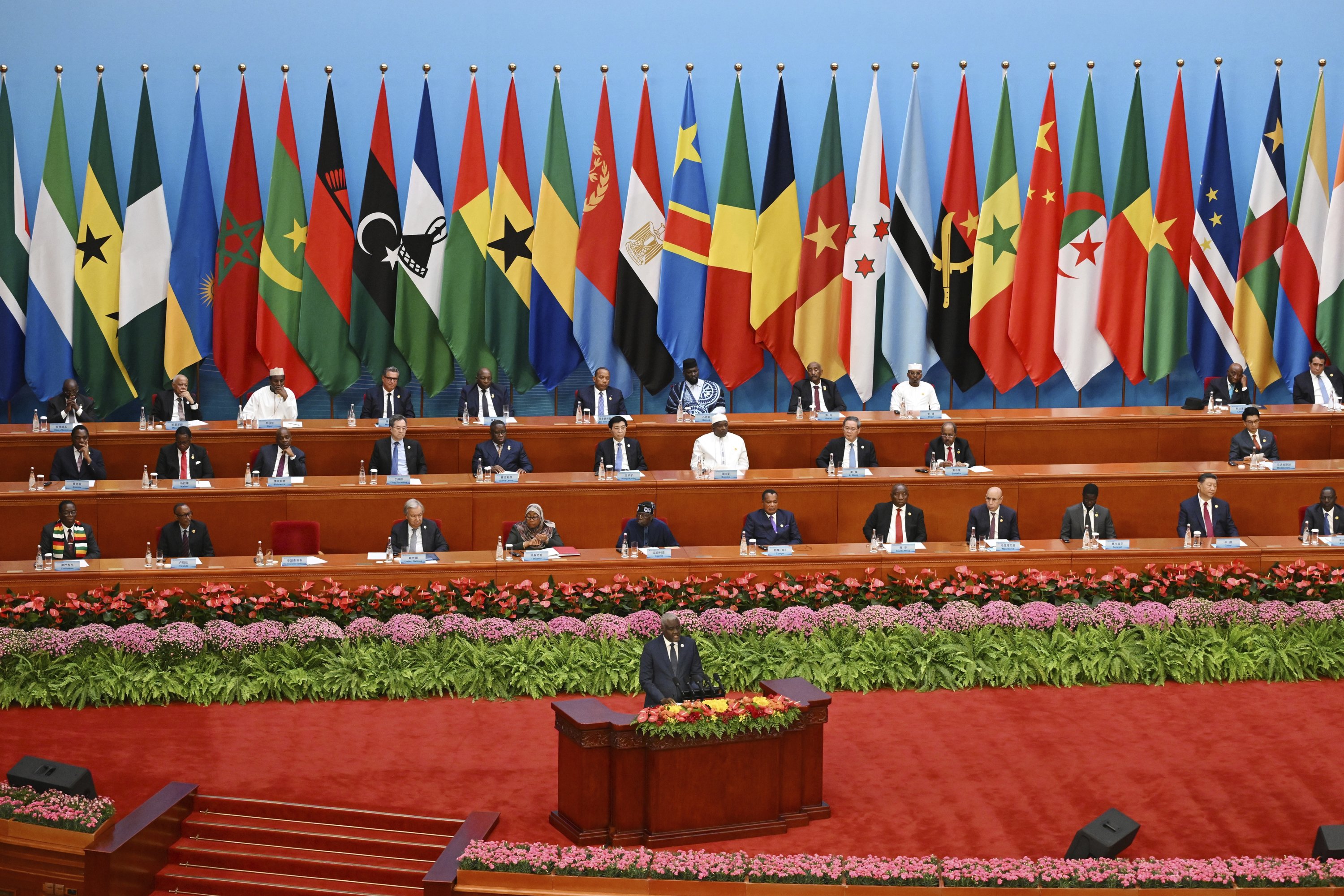
At the tail-end of his presidency, U.S. President Joe Biden traveled to Angola on Dec. 4 to attend plans to advance the Lobito railway project. This railway line would be a critical project to channel minerals from central and southern African countries. During his visit, Biden met the presidents of Congo, Angola, Zambia and Tanzania, as well as the vice president of Tanzania. The U.S. president's visit to Africa is overshadowed by a fierce geopolitical contestation over minerals and geopolitical influence in the continent with its arch-nemesis China.
In the last few years, we have witnessed great powers competition and contestation for geopolitical influence, commercial agreements, military partnerships and natural resources mining in Africa. A new scramble for Africa is underway, rendering the continent’s geostrategic location, commercial potentials and natural resources a source for competition among global superpowers. The continent has 40% of the world’s gold and up to 90% of its chromium and platinum. The largest reserves of cobalt, diamonds, platinum and uranium in the world are also in Africa.
As the post-pandemic global order shifts toward a multipolar system, Africa, with its natural resources and vast markets, has raised the continent's geopolitical stakes in the global order. Alongside the U.S. and China – countries with vast commercial and geopolitical interests and influence in Africa – countries like Türkiye, Russia, Japan, Brazil and India have invested commercially, militarily and diplomatically to various degrees in Africa in the last decade.
China seems determined to knock the U.S. off its global pedestal and influence in Africa. Russia has embraced its role as a “spoiler” of Western and particularly French interests and influence in West Africa and the Sahel region. Türkiye pulls the shots in Libya and the Horn of Africa, has numerous economic interests and investments in the continent and is now trying to bring peace to Sudan.
Amid all these competitions for Africa, how can the continent and its people benefit from this geopolitical vitality? How can the African Union (AU) spearhead African agency, interests, agendas and sovereignty in this multipolar world system?
The U.S. is a significant geopolitical actor in the African continent, with numerous military installations and substantial diplomatic and political influence in many African countries. However, the recent withdrawal of the U.S. military from Niger is indicative of the U.S. losing its position to the new geopolitical actors on the scene.
Moreover, China has challenged the influence of the U.S. and Western countries in Africa by investing heavily in infrastructural projects on the continent and offering financial loans to African states. Recently, at a Beijing summit, China pledged $50 billion to fund investments and loans in Africa, making it the continent's number one investor.
In the last two decades, China has become Africa’s largest bilateral trading partner, surpassing the U.S.: The trade volume between China and Africa reached $282 billion in 2023, with primary commodities being metals, mineral products and fuel. Moreover, Chinese foreign direct investments (FDI) in Africa in 2003 was $75 million; in 2022, it reached $5 billion. While there are genuine concerns about these loans and investments occasioning a debt crisis across Africa, China has accrued political and geopolitical influence in Africa.
To counter China’s Belt and Road Initiative (BRI) in Africa, in 2022, the Biden administration published “U.S. Strategy towards sub-Saharan Africa.” In the following U.S.-Africa leaders’ summit, the U.S. International Development Finance Corporation (DFC) committed over $2 billion to 46 transactions in Africa. In 2023, the U.S. Trade and Development Agency (USTDA) funded 15 project preparation grants designed to help leverage more than $3.4 billion in infrastructure finance for projects across the continent. While the U.S. is a significant geopolitical actor in Africa, successive U.S. administrations have focused on the Middle East and the Asia Pacific, rendering African countries to seek new partnerships with rising global powers. Türkiye is one of the significant geopolitical actors in the continent.
Türkiye has recently attracted attention for its commercial, military and diplomatic role in Africa. There are many cases including oil and gas exploration and railway construction projects. According to the Foreign Economic Relations Board of Türkiye (DEIK), Turkish contracting firms have completed 1,864 projects across Africa in 2023 worth $85.4 billion.
Türkiye, alongside China and Russia, is emerging as a contending geopolitical actor in Africa. The trade volume between Türkiye and African countries has increased eightfold and reached $40.7 billion in the last decade. Last year, Türkiye made $21.2 billion in exports to Africa, up from just $2.1 billion in 2003. Apart from commercial engagements, Türkiye is also becoming a major security and military player in Africa: A military base in Somalia and a security and maritime border agreement with Libya is just the tip of the iceberg.
According to some experts, Türkiye brands itself in Africa as an alternative to China and the West and it is seen more as a reliable partner in Africa, given its historical ties with many African countries. Türkiye has recently signed defense agreements with Somalia, Libya, Kenya, Ethiopia, Rwanda, Nigeria and Ghana. Moreover, Türkiye’s growing military industry and drone technology have attracted African countries' attention; Bayraktar TB2 is proving effective against insurgent groups in the volatile Sahel region.
How can African countries successfully navigate this new scramble for the continent’s natural resources and geostrategic vitality and ensure it enhances African agency and the continent's commercial interests? The AU and African civil societies should play a significant role in Africa’s relations with the world. The AU should formulate a holistic and comprehensive continental strategy to deal with great power competition for African resources and markets. For instance, the AU should formulate parameters and strategic frameworks that African countries should adopt to safeguard and protect the Africa Continental Free Trade Area.
Finally, African civil societies, women and youth should hold accountable both their governments, these global superpowers and their companies. France’s uranium exploitation in Niger ruined hectares of land and the locals’ health; Shell-BP oil spills destroyed the natural environment in the Niger Delta in Nigeria; Russia’s Wagner group runs clandestine gold mines across the Sahel. Africa’s natural resources and habitats should be protected from exploitation and environmental catastrophes. Furthermore, this geopolitical competition for Africa should bring jobs, training, digital literacy, technological transfer and infrastructural development to the continent.